"Wind thinning" on PNW conifers

Re: \"Wind thinning\" on PNW conifers

"quantify some variables ahead of time and come up with a prescriptive approach based on a particular tree having a low factor of safety,"

Zeb i agree, but this is (or should be) commonly done. You just described writing specs according to ANSI standards.

Some flexibility is required to help[ trees live with people--the lack of tons of robust and compelling data on the efficacy of thinning does not mean it's always bad.

re topping, unless someone defines wtf they mean by that term, I do not know what they mean. STANDARD definitions, please!!
 
Re: \"Wind thinning\" on PNW conifers

[ QUOTE ]
[ QUOTE ]
I think arborists get hung up on the rhetoric of topping in some cases - the best way to reduce the hazard level of an urban conifer in the PNW, especially a newly exposed tree, is to top it. Call it a reduction or whatever you want, but you're topping it. You come back 5 years later, and maybe remove it, but more than likely, re-top it, and move on. No big deal. I can see some of these statistical approaches to thinning working in forestry applications, like reducing windthrow on cutblock edges or something, or maybe on open grown trees that have new targets. I'm all ears though. .

I get more requests to thin conifer canopies for light than for wind. i.e. "I can't grow tomatoes in the back yard because the front yard row of firs blocks the sun. Can you thin them because I've heard topping is bad. . ." Not to de-rail the thread, but you've got to top the trees or move to a sunnier spot.

[/ QUOTE ]

Good post Jeff. I've worked for companies that sell thinning for light, what a waste of time and money.


Study of wind pruning effectiveness in forestry.

This study (relevant portion at p205) notes that crown modification reduced windthrow around logging cutblocks by an average of 40%. It also says that no increased mortality was noted for three years, then in some places a slight increase was noted in the fourth year. Probably not statistically significant.

[/ QUOTE ]

Gord,
Why do you think that thinning for light is a waste?

Is it that you don't get more light, or that it is maintenance work?


Four years is way to short to measure mortality or disease.


-----------------------------------------------------------
Water-front Doug-fir repeatedly topped for view. I don't know how large of an original topping cut, or how many times this was topped. I can say that it was a larger diameter top to the spar at the time of removal. The decayed wood was able to be scooped out by hand.

P1030790.jpg


I don't have a picture of a topped hemlock we removed from the people's deck, just short of their house. They had it topped for "safety".


I can see that some would say that if a tree is healthy, it can withstand a (arbitrarily stated) 4-8" topping/ heading cut. This happens with storm damage all the time, right? Don't we deal with trees that are typically is nutrient-stripped, soil compacted, abnormally watered, root damaged areas all the time. Opportunistic decay organisms are just waiting to get at a stressed tree that is further stressed.

What about less decay-resistant trees like hemlock?


For those that say that it is just a matter of re-topping, are you just figuring that it is the HO's responsibility to have this continue? Sort of saying that as long as the HO (and any future HO's) continues to have the damaging work done, its okay?

Where would one draw the line for how much/ how large to top on which species? 2", 4", 6", no hemlocks, 25% canopy loss.

 
Re: \"Wind thinning\" on PNW conifers

Thanks for those photos Sean, I agree with you and with Guy who asks wtf re. topping definitions.

Jeff, I think topping is a huge deal actually. How do you know as a tree service if you will be back to deal with the "re-topping" management? Why not instead practice, if feasible, a different approach to getting light into your clients properties while reducing risk (possibly using EWR pruning) AND educating them why you're not topping?

To clarify "crown reduction" WITH THE INTENT TO KEEP MANAGING THE TREE AS TIME GOES ON (ie. year to year if needed) to me is different than topping.

Again ... pointing your eye downwards to remind you that all that above stuff correlates to the rooting area - how they have developed to spread wind loading, how they are responding to disease, how they have grown to support the tree structure. Mess with the above, you'll have something going on below for sure.

Unatool - I don't think that all tree inspection or work is a guess. The last ten years of arboriculture has finally provided us with some science backing up/debunking stuff Shigo and loggers were talking about without studies, just gut feelings and experience.

Understanding how hazards in a tree can cause it to fail is not generally guessing - sure some of the "when will it fail" is subjective but not all. Basing work (or prescriptive work) on what a visual/aerial inspection provides can give a worker or a homeowner a pretty good idea of what can be done to reduce risk/increase/whatever.
 
Re: \"Wind thinning\" on PNW conifers

Cool photo, Sean. But I would say that the chainsaw is what finally caused the tree to come down. The prescriptive approach would mean that there is not a generalized answer for how much. As Shigo stated, "A professional is someone who understands dose" (Loosely quoted)
 
Re: \"Wind thinning\" on PNW conifers

[ QUOTE ]
I'll say it again, if you think that science is behind windthinning trees, you are wrong. The studies do not point to generalized treatments for individual trees. Unless you can quantify some variables ahead of time and come up with a prescriptive approach based on a particular tree having a low factor of safety, you are "harming" the tree by reducing its ability to do what trees do best, that is, adjust to their surroundings.

[/ QUOTE ]

When we are managing trees that developed over a long period of time in a certain setting which is dramatically changed in a short period of time, we need to keep our minds open. We also need to remember the goals of the management. In a forestry setting, the goal of windthinning and crown reduction is to reduce windthrow to preserve the integrity and timber value of the remaining stand. In urban arboriculture we act to preserve the integrity of the individual tree while balancing safety and other cultural concerns. Analyzing and prescribing treatments to urban trees based upon forest science and practice is simplistic. The reverse, I think is also true. A topped, quickly decaying tree with a poor root system in a forest will cycle back to the earth and provide benefits to following generations of flora and fauna. These benefits are outweighed by safety concerns if the tree stands twenty feet from your gramama's back door.

Trees in urban and forestry settings, IMO represent two different realms of understanding because of the difference in the goals of management, and therefore require two different systems of analysis and management prescription. Of course there are overlapping situations which represent a combination of both.

I agree that windthinning and height reduction will reduce windthrow on the edge of cutblocks and maintain the integrity of the remaining stand, and its ability to regenerate. I've seen firsthand the problems which stands once surrounded by forest experience when exposed to the wind and erosion that is common to the forest periphery. The support structures are removed, and the roots compromised in a relatively short period of time. The individual tree is not the focus of the procedures in the paper Gord presents or in the good work he does.

Are the solutions to windsail reduction and thinning on the edge of cutblocks, riparian areas and retention patches in forestry practices analogous to urban arboriculture? That is the big question, surely at times the conditions that lead to these practices being prescribed can be similar to the conditions that urban trees experience. Of course, any event which creates a wound on the woody cylinder or reduces the photosynthetic capacity on the tree is harmful, but so is a strata's or a homeowner's decision to remove a tree because it is 'too big.'

However, reduction, thinning and spiral pruning happen to be the only tools we have to physically reduce the surface area of a tree affected by windload, or to reduce the lever arm acting on the root crown and system of the plant. Guying or cabling are techniques which can act to provide additional stability to the entire tree or its component parts, but are not practical in all situations.

So, do we stand idly by and do nothing to reduce the surface area of these trees while we wait for the science to be validated or researched, or do we do our best with the tools that we have?

Oh, and there is no way that a tree's adaptive ability can keep up with the dramatic human or environmental changes so far discussed in its immediate environment, Zeb, thus the prescriptive practices to deal with trees which are newly exposed to far greater forces. Gradual change, yes, dramatic change, no.

FWIW Topping = indiscriminate, internodal branch removal.
 
Re: \"Wind thinning\" on PNW conifers

I don't advocate irresponsible tree work. I do however believe in informing a client of all available options to gain whatever it is that they might desire, and letting them choose. If they want more light, I explain the tree work that will give them maximum light, the consequences to the tree's health (long and short term), the need for maintenance if appropriate, the possible increase or decrease in risks due to the pruning or removal, etc. The area I work in has an extreme number or large trees on small lots, and growth rates are very fast. This allows certain benefits such as the option to top trees harshly, allow other more site-appropriate species to grow up as privacy screens (if desired), then remove topped trees a few years in the future. Also, many of our native species aren't trees that are suited to growing overly close to structures, as well as most neighbourhoods are relatively young, meaning that removals are very common. It's not uncommon for a lot 50x120 to have a twenty 100' plus conifers on it.

But in regards to wind-thinning conifers, my opinion (and it is backed by research) is that in some circumstances it is appropriate to prune to reduce windsail. If conifers have been standing in an unchanged environment for a length of time and have withstood high winds with no notable cause for concerns, then any kind of pruning for windsail reduction is probably unwarranted. If trees are for whatever reason of poor health, pruning is almost certainly the wrong treatment, save in 'prune now, remove later' situations agreed upon with the client. But if a client is dead set on some kind of pruning to reduce the perceived risk, I will recommend some remedial measures.

Western Hemlocks: Depending on local health of the population, little to no pruning or full removal. So many of these trees around here just aren't worth having near targets.

Douglas-fir: Upper crown thinning, minimal EWR reduction on heavy limbs over targets if the habit is such that it is prone to limb failure.

Western Redcedar: Upper crown thinning on the odd tall skinny bushy specimen, crown reduction in some cases of bark included multiple leaders.

True firs: Small reductions in crown height in multiple top mature form specimens if deemed necessary.

Sitka Spruce: Rarely upper crown thinning, EWR on heavy limbs or removal of the suspect limbs.

Of course all of the above is subject to health of the individual tree, soil on site, importance of targets, etc. I enjoy helping home owners get the most out of the property and their trees. I think it's great to cut a few trees down if it means the owner gets more enjoyment out of their residence, but that's a qualified statement. If I worked in an area that had few trees and slower growth rates, I would make an effort to promote less tree removal. I also like seeing poor trees cut down so that appropriate species can be planted that will be appreciated for generations to come.
 
Re: \"Wind thinning\" on PNW conifers

"However, reduction, thinning and spiral pruning happen to be the only tools we have to physically reduce the surface area of a tree affected by windload, or to reduce the lever arm acting on the root crown and system of the plant."

Only reduction reduces surface area and lever. thinning reduces mass.

"do we stand idly by and do nothing to reduce the surface area of these trees while we wait for the science to be validated or researched, or do we do our best with the tools that we have?"

Dylan, I am not advocating standing idly by, just that we approach each tree with an open mind. Too many practitioners are applying the wind thinning approach to management without examining whether the tree needs any modification or not. And if it does, how much?

As far as trees adapting to changes. Shigo calls it going from zig to zag. A scenario - a large doug fir is standing by itself due to the loss of it's neighbor, definitely a change of direction for the tree. Removing branches, dead or alive mechanically is another change the tree has to adjust to, too. Will our pruning help it move to the new conditions, or will it simply cause a greater degree of stress that the tree must now adapt to as well. This is where we as practitioners need to take a step back and examine all of the available tools we have at our disposal, and use the right ones. Balance our assessment with the needs of our clients, especially as regards risk. But even with risk assessment, we are usually dealing with a high perceived risk as opposed to actual risks of failure.

MDVaden has the right approach with very limited amounts of material being removed. This is dose. It sounds like most of the others posting here get that as well. But for certain, before we start making changes to a tree, we need to have a good idea of current condition and the tree's ability to adapt beneficially. A hugely missed portion of prescriptive tree care is the soils, as Pruninggal refers to. If you need to make changes due to a tree being in a negative condition, better start with below ground issues. If these can't be solved/improved, the tree is going to decline, no matter the dose above ground
 
Re: \"Wind thinning\" on PNW conifers

Good post, Gord! Sounds like you have a good reasoned approach to the work you are doing. I would still disagree that the science supports the application we are giving it.

Put another way, WINDCALC is based on models in a wind tunnel, not on actual 100' trees. Gillman's and Kane's research is based on small trees in as controlled environment as possible.

What you and I are doing in the field is interpreting their data. That's what I mean by the science not being there for wind thinning. It is supposition at best. The science has to make assumptions that reduce variables in order to get quantifiable results. It can help us to make decisions, but that's about as far as we can take it.

I like the concepts we have for helping our client's deal with trees, and the more tools available the better. So nothing should be off the table. But we have to realize that every tool is not needed on every tree. Unless I have a reason to modify the tree, it does not get pruned, and then only to such a degree as I deem necessary. Lot's of defensible reasons to do a lot of different types of treatment, but the overriding philosophy that NW conifers benefit from wind thinning is erroneous.
 
Re: \"Wind thinning\" on PNW conifers

We had to drive about 20 minutes west to pick up our Chihuahua from the vet today, and since I was just riding, I spent a lot of time glancing at tops of many Douglas firs. In groves, groups, and alone.

Most had enough natural thinning from past storms and snow, that I didn't really even notice one that looked like more thinning could benefit. I was looking at mostly taller ones.

It looks like nature has beat many of us to it anyway with a lot of these Doug fir.
 
Re: \"Wind thinning\" on PNW conifers

[ QUOTE ]
Cool photo, Sean. But I would say that the chainsaw is what finally caused the tree to come down. The prescriptive approach would mean that there is not a generalized answer for how much. As Shigo stated, "A professional is someone who understands dose" (Loosely quoted)

[/ QUOTE ]

Agreed, it came down by the saw. The previous actions of repeated topping, along with the chainsaw, coupled with the risk of loss to the neighbors is ultimately what brought it down.

The need or perceived need for it to come down by the saw was that it leaned toward the neighbors' house, close enough for an uprooted or low-on-the-stem break toward the lean to put around 20" wood onto/ into the neighbor's house.

Arboriculture, loosely being the care trees, would not apply to this situation. The tree was not cared for, the neighbors safety/ property were. This job would certainly fall under "tree work" not "tree care". This is an aspect that many/ most of us deal with in our day to day work.
 
Re: \"Wind thinning\" on PNW conifers

[ QUOTE ]
...but the overriding philosophy that NW conifers benefit from wind thinning is erroneous.

[/ QUOTE ]

If you go by the disreputable regional company's flyer, all trees need windsail reduction, balancing, centering, and deadwooding.

At a customer's request, I visited her mother, recently out of the hospital, who was nervous after aforementioned company's salesman (sailsman) visited. I went for a look, and was able to reassure her that there was nothing significant. Relatively small D-firs had minor deadwood with no targets, and cherries with minor inclusions with no targets. Scumbag salesman and company if you ask me, preying on old people. Yep, they have "tree experts" as part of their name.
 
Re: \"Wind thinning\" on PNW conifers

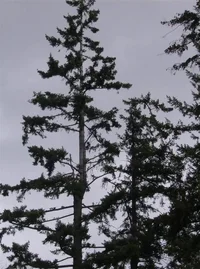
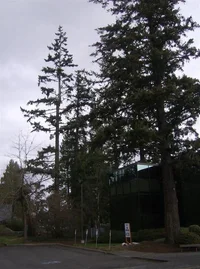
I had to go get propane for the BBQ. I took these photos of a tall D.Fir that got thinned last month. I know the tree climber that did the job...
The 'target' below is a dentist office. The neighboring Fir blew over (uprooted) in December wind storm. The dentist had a consulting arborist give recomendations and tree service was hired to thin tree.
I thought these photos were representative of this conversation. Trees in urban setting getting trimmed...
 

Attachments

  • 273649-March2011trees008(Medium).webp
    273649-March2011trees008(Medium).webp
    91.2 KB · Views: 73
Re: \"Wind thinning\" on PNW conifers

Sure looks thin.

What did the root ball of the blown over tree look like? Any sign of root decay?

Any root inspection that you know of for this thinned tree?
 
Re: \"Wind thinning\" on PNW conifers

That to me is what gives thinning the somewhat negative connotation that is has to some. I would expect the health and vigour of the tree has been compromised due to the amount of removed foliage, and I've seen an increased likelihood of limb failure on similar trees pruned as harshly as that one.
 
Re: \"Wind thinning\" on PNW conifers

Thin, yes. I would say you could not take one more branch.
I should take a pic of the (blown over) root ball and post. I think it has not roots, just a 'ball'... The tree that failed has black top within 10 feet and cars even park on the lawn under the tree.
The wind was coming hard from the Frasier Valley, Nor'Easter @ 61 mph that day.
No one in Bellingham offers root inspection. I have only read about it, never seen it performed.
 
Re: \"Wind thinning\" on PNW conifers

[ QUOTE ]
I had to go get propane for the BBQ. I took these photos of a tall D.Fir that got thinned last month. I know the tree climber that did the job...
The 'target' below is a dentist office. The neighboring Fir blew over (uprooted) in December wind storm. The dentist had a consulting arborist give recomendations and tree service was hired to thin tree.
I thought these photos were representative of this conversation. Trees in urban setting getting trimmed...

[/ QUOTE ]

Honestly, unless the pruning was just deadwood or defect removal, that looks extreme.

It's as if the remaining roots, trunk and branches lack sufficient leaves to manufacture food.

If the tree earned the recommendation for that kind of thinning, seems the right recommendation could have been removal.
 

New threads New posts

Back
Top Bottom