Wibbly wobbly birch fell

Thought I'd share this one with you. I'm afraid the photos aren't great, it was a grey day and I was against the light.

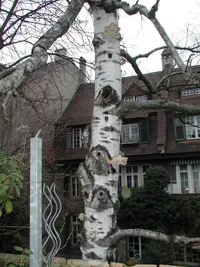
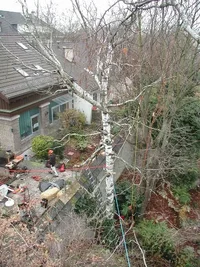
OK, the story goes likt this: I got a call from a guy with a birch. "It's been dead for a while" he say on the phone. I go and have a look. He wasn't exagerating, the bloody thing had been dead for at least three years, was full of piptoporus betulinus , an aggresive fungus you get on birches producing brown rot, top to bottom and was dropping bits. It was still about 18 meters tall. Below was a pavillion with a copper roof and other bits and bobs, so no dropping. Go figure! Oh, yes, and no access whatsoever for a bucket truck or such.
The owner wanted to get a crane in and lift the tree over the roof. I felt this was not such a good idea, as the possibility of the tree snapping in half seemed quite realistic!

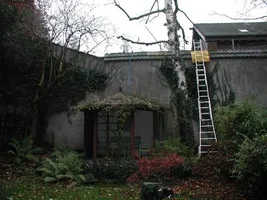
In the attached picture you can see the situation in the garden.
 

Attachments

  • 19173-P1010119.webp
    19173-P1010119.webp
    79.7 KB · Views: 290
Sooooo... what to do?

Well, first off I put in a good price. We shouldn't be doing stuff like this for free. If they can wait three years they can pay. Let's face it, not many other people can do it!

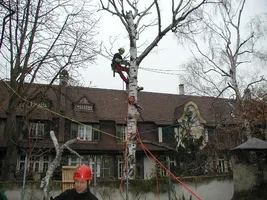
First of all we attached the stem to two adjacent trees and a balcony railing via pulleys to three port-a-wraps. That way, if the base of the tree should fail we'd be able to lower it in a - more or less - controlled fashion all the same.
 

Attachments

  • 19175-P1010124.webp
    19175-P1010124.webp
    130.4 KB · Views: 241
Then we got two anchor points on the neighbouring trees. Not brilliant, addmitedly, but still a damn sight better than nothing!

After that it was pretty straight forward. We had a couple of bales of hay on a balcony to cushion the fall of the pieces coming down and it was mainly straight cut and chuck.

The tricky - and interesting - thing with this job was not the final take-down in itself, it was the discussions and preparation for it. It just showed me, once again, how a realistic assessment of the situation, combined with a good team and the right choice of techniques really makes a big difference!

OK, this tree wasn't a big deal, you could say. But it'd still have been big enough to break your neck on! The middle part of the tree was completely decayed, the wood had the consistency of pulp!

Also, you do have an opportunity of giving you company a good profile. This customer was really impresssed with the degree of control and safety during the job. And that also counts for somthing.

Besides coming back to the family in the evening, that is. /forum/images/graemlins/smile.gif
 

Attachments

  • 19176-P1010127.webp
    19176-P1010127.webp
    104 KB · Views: 241
Mark nice photos...Glad to see you took the time to really access the problem and take the precations.

It's not always the big trees that are a problem to remove , because they have the bulk to to handle weight loads. But the little guys, can be more problem matic because of thier size and amount of regidity that is left and dispersed decay that creates the hazard for climbing and removal.I've found sometimes, the littler removals can be more a pain in the ass than a larger ones.Especially if you have no rigging points and a good TP.

keep up the good work

Thanks
Greg
 
This thread pretty much answers your question about $$$v job. Plenty of money on the job allowed for enough people,time and forward planning to get it done in a less hazardous manner. Good job!
 
If this case makes but one thing clear it might be this: In training and teaching we often talk about the importance of having a plan B. Well here we had:

Plan A: Lift tree over house with crane, didn't work, because of risk of tree snapping half way over and have it piling through the roof... whoops, sorry about that, m'am!

Plan B: Conventional rigging, no go, due - obviously - to the condition of tree.

Plan C: Pop a throwline over the roof of the building and pull a line over to rig a speed-line over the tree. Didn't work due to the too shallow angle the speed-line would have been at. Tree to tall, roof too low.

Plan D: Anchor in Chestnut next door. Didn't seem clever, as falling into the line would have resulted in a pretty brutal pendular fall!

And finally, Plan E: Anchor in the two neighbouring trees with the tripple Port-a-Wrap back up on the tree.

That's a lot of different scenarios to run through and weigh up their pro's and con's. Yes, Rupe, I agree, price is a major factor in having the financial framework to choose between different game-plans.

Also, your mental tool-box ought to have enough tools and techniques in it to be able to improvise and take decisions in situ (see Plans A to E).
If you've only had a very basic training - obviously - it's going to be hard to have a basis which you can build on and work with.

Dan, is 2005 going to be the year in which we get you over to Europe ? Go on... we'll have a great time. ETCC in Copenhagen should be great! /forum/images/graemlins/laugh.gif
 
Mark. I want to get there. Last summer I told everyone I was going to go this summer. But right now I’m working on paying my mortgage every month, and dreaming of building a woodworking shop with money from who knows where.
So I think I’m all talk and probably not going to make it again. How sad.
I’m taking a Spanish class and last night they showed us a movie of Spain, how magnificent it is. With huge aqueducts made with only well cut stones (no cement) by the Romans that are still in use today. I want to see the wonders of Europe but times are tight, and I’m good at living faster than my money can keep up. We’ll see. Cheers.
 
Compression can be good bracing at weak spot and strongly into ground.

Brace weak spot with 2x4's and trucker's ratchet webbing. Tripod brace with lines, against angles of pull from lean and rigging, and more firmly compressing into ground too with tight lines. Suppoprts should be adjustable, with plenty of travel to adjust to rebrace as weight balance of tree changes to keep climber safest. Directional Force of Support should be more down, not across spar i think; so more down is less leveraged, and takes advantage of the loaded, compressive support/stabilizing/ bracing effect.

Nice tie in strategy. Another is to place tripod rope brace high, keep angle of compression and support feeding straight into ground, unleaveraged, place higher in tree. Then tie in below, lock agianst rising up spar, then trail spaced slings and carabiner set up spar, and place lifeline in; as to make several stops/ workstations from the lower set liefeline.

Any rigging off of subject tree, should be from a higher angle of another tree, perhaps with another line from another tree from opposite side, not letting too much across pull on subject tree.

Or, something like that; mebbe.
 
Nice pics Mark. Glad things went safely for you. Lots of foresite.
One thing we've done in the past when we thought there was a possibility of the tree or limb snapping while picking with a crane. Take the appropriate rope diameter and run a series of marline hitches down the stem or branch, about every 3-4 feet. We used 2 ropes on oppposite sides of the trunk and staggered the hitches. That way, the climber can work off the crane to set the ropes. It takes time to set up, but has worked on the occasions we've used it.
Just a thought, not sure if this would have worked in your scenario.
 
Good points, Norm and Tree Spyder.

I agree about the merit of the temporary bracing of potentially hazardous trees. The only niggling doubt I have in my mind is this: We know are trees notoriously fickle beings to judge correctly, or rather their condition from a static point of view. Just look at the length of some of the threads on "normal" bracing of trees.

I feel the truth of the matter is that often as not we're making educated guesses at the way trees respond to loading. On top of that in rigging operations we're imposing unnatural directions of forces. Add to this prior damage, and hey presto... try to judge that! Still, I reckon we're able and knowledgeable enough to make reasonable working assumtions. If we apply temporary bracing - and this is my worry - isn't there the theoretical possibility of creating new pivot points? By fixing one part of the stem, isn't one part of the stem going to act as a lever across this pivot point and shock the other part?

Still, it's an important - and useful - tool in our mental toolbox. Like all tools it should not be used indiscriminatly or without caution.
 

New threads New posts

Back
Top Bottom