












Navigation
Install the app
How to install the app on iOS
Follow along with the video below to see how to install our site as a web app on your home screen.
Note: This feature may not be available in some browsers.
More options
You are using an out of date browser. It may not display this or other websites correctly.
You should upgrade or use an alternative browser.
You should upgrade or use an alternative browser.
Why 1/3 notch depth?
- Thread starter Matt hawley
- Start date


But I do worry, to a degree (not so much for a skilled professional like yourself), that if we’re not clear on such a wide reaching forum, that some poor soul might get hurt or much worse if armed with the wrong idea. I try to make sure I’m not pointing fingers at anyone in particular with any comment here. It’s also why I appreciate your last post. Thanks for taking the time to write that all out.No worries, I am not suggesting you or I would take any unnecessary risk, nor ignore any of the other factors that come into play with accurate felling.
I see this as a discussion and exchange of ideas, thoughts and experience. I hope some are finding value in the discussio.
Given your hypothetical scenario of the perfect saw, I would not be concerned with face cut depth, but that is a bit of a trick answer, as the ”depth” is not something I monitor under normal felling conditions. I, as many others in this thread, look to hinge length. So I go as deep as necessary to obtain the hinge length I want for the given situation. Of course, the center of gravity of the tree, et al will influence the decision.
So depth only becomes a consideration if my hinge will behind the center of gravity of the tree. This is soemthing under normal circumstances with whole trees I avoid, but with stubs and wood will do quite often.
I think, in the end, we are saying the same thing, but from different angles, pun intended! A 6 of one half dozen of the other, but I find value in seeing how others view these concepts and how they explain them. I am appreciative of all the well thought out responses.
A face cut accomplishes three things in felling:
1. Gives space for the tree to move. Think of the space in front of a door. Of couse with out a face cut the tree will also move, but with less predictably and no face cut (space to move) will exacerbate the forces you so eloquently described a few posts ago.
2. The apex of the face cut forms the front of the hinge wood. This is true no mater the type of face cut you use.
3. Lastly it removes a section of support. Think about breaking 1 leg off of a 4 leg table. The table can still stand on a level floor, but as soon as some force is applied it is much more likely to tip towards the broken leg. (To follow the analogy a face cut positioning the hinge behind the center of gravity of the tree is like breaking two legs off the 4 leg table.)
In a front leaning tree this third aspect is much less of concern, but all three are just factors to consider and manipulat.
The goal is to use the combination of face cut and back cut to form a hinge and provide as much predictability as possible. There are many ways to accomplish this.
This My .02 and the gist of all the felling training I do, have done and will do. While methods come and go the principles have remianed constant since the days of crosscut and ax.
Respectfully,
Tony
Back to the front, and the question of why 1/3 depth…much of what I wrote was in regard to the increased barber chair potential with a shallow face cut. Overall, I am in agreement with your view on hinge wood and it’s role. And also that 1/3 as a rule can be just fine for tree felling situations without any special concerns. But we in time it becomes more like language, and we can strive to find just the right worlds…especially when the gravity of the conversation increases.
Recent? Around here, about now, we’d have to cut the cheeks out to keep the bark from peeling away with the log leaving the stump.
Looks like you're back in the saddle. Congrats on the recovery.
Do the long pulled fibers constitute about just under half of your hinge thickness?
Per Oceans' magic fast saw I think there is some time dependence in wood fiber failure, if you've ever witnessed a slow death breakage. This suggests that maybe how long you wait after the face cut gives the fibers time to tee up/settle to a more stressed situation, just at the time you're going to address the back cut. Doh!
On the other hand, if the conditions for a split exist if you meet the geometry criteria, that suggests it will pop no matter how quickly you pass through that configuration during the cut. (?)
Do the long pulled fibers constitute about just under half of your hinge thickness?
Per Oceans' magic fast saw I think there is some time dependence in wood fiber failure, if you've ever witnessed a slow death breakage. This suggests that maybe how long you wait after the face cut gives the fibers time to tee up/settle to a more stressed situation, just at the time you're going to address the back cut. Doh!
On the other hand, if the conditions for a split exist if you meet the geometry criteria, that suggests it will pop no matter how quickly you pass through that configuration during the cut. (?)
Last edited:

Daniel
Carpal tunnel level member
- Location
- Suburban Philadelphia (Wayne)
There is quite a bit more going on in many face cuts ....A face cut accomplishes three things in felling:
1. Gives space for the tree to move. Think of the space in front of a door. Of couse with out a face cut the tree will also move, but with less predictably and no face cut (space to move) will exacerbate the forces you so eloquently described a few posts ago.
2. The apex of the face cut forms the front of the hinge wood. This is true no mater the type of face cut you use.
3. Lastly it removes a section of support. Think about breaking 1 leg off of a 4 leg table. The table can still stand on a level floor, but as soon as some force is applied it is much more likely to tip towards the broken leg. (To follow the analogy a face cut positioning the hinge behind the center of gravity of the tree is like breaking two legs off the 4 leg table.)
4. determines how far the tree will move before the face closes and therefore at what point the tree will separate from the stump which will direct the movement of the tree after separation. This becomes more crucial when trying to throw tops (narrow face cuts) or have the tips rotate well past 90 degrees and land the top back towards the stump (open face greater than 120 degrees)
5. In the case of a Humboldt create an inclined plane that allows the but of the tree to slide off during the fall and hit the ground before the top. This tends to avoid breakage and significantly reduces the force of impact on the top.
6. again in the case of the Humboldt, the lower cut of the face acts as an inclined plane to prevent the but from sliding backward off the stump during the fall. This is especially effective when combined with a couple of inches of stump shot (back cut 2" higher than the apex of the face), however not required in most suburban falling scenarios as the forces required to push the but of a tree backward off the stump are generally only generated in huge trees. HOWEVER, this is an extremely important safety factor when taking tops that may contact other trees early in their movement. If the top gets hung up early in the fall there will be huge forces pushing the but back off the base of the tree, which could easily land that but in the climber's lap, or get under his lanyard, etc. as he has no escape route available.
There are other differences in the results from using a Humboldt vs. open face or traditional
And there are other ways of manipulating the face cut to get different performances from the face. A good example is the sizwheel which allows more flexibility in the fibers on one side of the front of the face, which can result in more control vs side lean and results in longer fiber pull on the tension side of the hinge. It's getting a little late for me to figure out how to say that in your fancy instructor jargon which may sound highly intelligent to those who don't know better, but generally lack substance.

- Location
- Home of the New Jersey Devils
I really appreciate the effort that some of you give to respond thoughtfully. It's enjoyable to read through those posts. The other posts.....not so much.
Barber chairs happen because of power or force that is acting aggressively enough to cause a tree to start to fall before the hinge can work effectively (heavy lean). To me, it's like asking a 2x4 to bend. If you apply enough force to a 2x4 it will shatter. If you apply enough force to a tooth pick it will bend (if it isn't top dry). We can get any tree to barber chair if we want to. Just apply enough force.
Guidelines are exactly that. If you want to be successful in many circumstances for long periods of time (thousands of trees) we must analyze properly and make adjustments when we are operating outside of a perfect world. If we do not recognize these situations for what they are we will have issues. You have to be a detective and adapt.
Barber chairs happen because of power or force that is acting aggressively enough to cause a tree to start to fall before the hinge can work effectively (heavy lean). To me, it's like asking a 2x4 to bend. If you apply enough force to a 2x4 it will shatter. If you apply enough force to a tooth pick it will bend (if it isn't top dry). We can get any tree to barber chair if we want to. Just apply enough force.
Guidelines are exactly that. If you want to be successful in many circumstances for long periods of time (thousands of trees) we must analyze properly and make adjustments when we are operating outside of a perfect world. If we do not recognize these situations for what they are we will have issues. You have to be a detective and adapt.
- Location
- Home of the New Jersey Devils
One of the reasons that the outter wood holds longer than inner wood is that outter wood is under tension and inner is in compression. Maybe this helps:

Daniel
Carpal tunnel level member
- Location
- Suburban Philadelphia (Wayne)
that has nothing to do with the tendency for shallow notches to induce barber chair.One of the reasons that the outter wood holds longer than inner wood is that outter wood is under tension and inner is in compression. Maybe this helps:
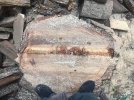
If you want to see how tension and compression wood exist in the same hinge, just look at the pics Rico posted at the top of this page ( and posted below).. the fibers on the back of the hinge are under tension, thus long and stringy whiskers show good holding strength.. the flat broken fibers at the front of the hinge were under compression and did not have much holding ability.... The plane between compression and tension fibers moves forward as the back cut progresses forward.
The idea that barber chair happens the way shear cracks happen, in the plane between compression and tension fibers, is ridiculous... It's been postulated here and on other forums, FB etc.. This is another example of just how uninformed the industry at large is on the subject. Tony and Oceans bantering about the speed of the cut causing barberchair while the depth of the notch is inconsequential is another example.
And Mark's assertion that "outer wood" ( likely meaning sapwood) hold better than "inner wood" (likely meaning heartwood) because one is under compression and the other is under tension makes no sense either. again look at Rico's hinge.... there is both tension and compression wood across the length of the hinge in both heartwood and sapwood.. maybe we just need to define our terms accurately.
Especially coming from Mark, who is a bonafide top-tier trainer, this is starting to confirm my suspicion. If he doesn't know what he's talking about NOBODY DOES... The entire industry is clueless on this particular subject...
Tony saying "Given your hypothetical scenario of the perfect saw, I would not be concerned with face cut depth,"
and Oceans comment "
In short, it’s much to do with the amount of time it will take to get the hinge formed, .... a shallow face depth means no time to form the hinge before gravity takes over and pull the tree down while compression wood is still unwilling to bend."
and Sean saying "Thin hinges bend instead of barberchair, whether at 1/3 or 1/5 or 1/10 depth."
all are discounting the fact that shallow hinges create a tendency to barber chair... no matter how long it takes to cut the back cut and form the desired hinge... Trunks often take some time (a few moments up to half a minute or more) to fracture from the time they start popping with the initial indication that a barber chair is in progress. The sawyer may choose to stay at the stump and keep cutting, hoping to cripple the hinge to a point where it becomes weak enough to trip before the trunk splits, and thus avoid the barber chair. So the speed of the back cut can affect BC, but that does not answer the question.
HOW DOES A SHALLOW FACE INCREASE BARBER CHAIR POTENTIAL?
the answer has nothing to do with speed.. it's all about placement....

- Location
- Home of the New Jersey Devils
I can't help feeling that you are using this to attack me here @Daniel So here's some science to choke on.that has nothing to do with the tendency for shallow notches to induce barber chair.
If you want to see how tension and compression wood exist in the same hinge, just look at the pics Rico posted at the top of this page ( and posted below).. the fibers on the back of the hinge are under tension, thus long and stringy whiskers show good holding strength.. the flat broken fibers at the front of the hinge were under compression and did not have much holding ability.... The plane between compression and tension fibers moves forward as the back cut progresses forward.
The idea that barber chair happens the way shear cracks happen, in the plane between compression and tension fibers, is ridiculous... It's been postulated here and on other forums, FB etc.. This is another example of just how uninformed the industry at large is on the subject. Tony and Oceans bantering about the speed of the cut causing barberchair while the depth of the notch is inconsequential is another example.
And Mark's assertion that "outer wood" ( likely meaning sapwood) hold better than "inner wood" (likely meaning heartwood) because one is under compression and the other is under tension makes no sense either. again look at Rico's hinge.... there is both tension and compression wood across the length of the hinge in both heartwood and sapwood.. maybe we just need to define our terms accurately.
Especially coming from Mark, who is a bonafide top-tier trainer, this is starting to confirm my suspicion. If he doesn't know what he's talking about NOBODY DOES... The entire industry is clueless on this particular subject...
Tony saying "Given your hypothetical scenario of the perfect saw, I would not be concerned with face cut depth,"
and Oceans comment "
In short, it’s much to do with the amount of time it will take to get the hinge formed, .... a shallow face depth means no time to form the hinge before gravity takes over and pull the tree down while compression wood is still unwilling to bend."
and Sean saying "Thin hinges bend instead of barberchair, whether at 1/3 or 1/5 or 1/10 depth."
all are discounting the fact that shallow hinges create a tendency to barber chair... no matter how long it takes to cut the back cut and form the desired hinge... Trunks often take some time (a few moments up to half a minute or more) to fracture from the time they start popping with the initial indication that a barber chair is in progress. The sawyer may choose to stay at the stump and keep cutting, hoping to cripple the hinge to a point where it becomes weak enough to trip before the trunk splits, and thus avoid the barber chair. So the speed of the back cut can affect BC, but that does not answer the question.
HOW DOES A SHALLOW FACE INCREASE BARBER CHAIR POTENTIAL?
the answer has nothing to do with speed.. it's all about placement....View attachment 81500
- Location
- Home of the New Jersey Devils
And if you keep this up, I'll get some real "pros" to speak up and shut you up.
- Location
- Home of the New Jersey Devils
Your call.And if you keep this up, I'll get some real "pros" to speak up and shut you up.

Reach
Been here much more than a while
- Location
- Atglen, PA
Thank you for that screenshot, and the previous explanation, I never knew that trees were “prestressed” but it does make sense and explains how they can be so strong. I will have to remember that one, and may have to do some more reading into that. The physics of trees is truly awesome.I can't help feeling that you are using this to attack me here @Daniel So here's some science to choke on.
View attachment 81503
Way back in my early days, we were removing a ~80’ White Pine with 2 fractal tops originating at 10’ from ground level. Both were about 6’ horizontal before becoming vertical, so roughly 60’ of vertical stem standing on a 6’ horizontal arm.Thank you for that screenshot, and the previous explanation, I never knew that trees were “prestressed” but it does make sense and explains how they can be so strong. I will have to remember that one, and may have to do some more reading into that. The physics of trees is truly awesome.
The vertical portion was felled out in 2 sections. I then attempted to cut off the remaining horizontal portion by cutting from top to bottom at the branch collar (about 18” diameter). The saw sank down in nicely until about 6”, when it bound in the kerf too tightly to remove without cutting relief with a second saw.
This was a great lesson for me. The compression wood was no longer holding up the weight of the vertical top, and was now free of the tension wood on top following the cut. After the saw was free, I took a look at how dramatically off center the pith was.
When making a back cut through compression wood, there is some serious pressure being released. The column of compression wood is like layers of bowed wood being released layer by layer. Eventually the layers above the kerf of the back cut will overpower the layers remaining above said hinge. Pop. Time for a haircut.
Reach
Been here much more than a while
- Location
- Atglen, PA
I have had similar issues with sticking saws in released tension wood, it amazes me how much pressure is on that wood. Thanks for sharing your experience!Way back in my early days, we were removing a ~80’ White Pine with 2 fractal tops originating at 10’ from ground level. Both were about 6’ horizontal before becoming vertical, so roughly 60’ of vertical stem standing on a 6’ horizontal arm.
The vertical portion was felled out in 2 sections. I then attempted to cut off the remaining horizontal portion by cutting from top to bottom at the branch collar (about 18” diameter). The saw sank down in nicely until about 6”, when it bound in the kerf too tightly to remove without cutting relief with a second saw.
This was a great lesson for me. The compression wood was no longer holding up the weight of the vertical top, and was now free of the tension wood on top following the cut. After the saw was free, I took a look at how dramatically off center the pith was.
When making a back cut through compression wood, there is some serious pressure being released. The column of compression wood is like layers of bowed wood being released layer by layer. Eventually the layers above the kerf of the back cut will overpower the layers remaining above said hinge. Pop. Time for a haircut.
Daniel
Carpal tunnel level member
- Location
- Suburban Philadelphia (Wayne)
Please do.. bring on your "real pros"... before you do, ask them how many trees they have purposely tried to rip in half with ropes and heavy equipment... I learned a lot from those trials. And not just the trees in the published videos... I've ripped a dozen or more. There is nothing like video to learn from. When trees and rigging starts moving, everything happens in a hurry. It's hard to take it all in and digest it. For years, I've studied videos, sometimes frame by frame, teasing every bit of knowledge out of many extraordinary scenes.And if you keep this up, I'll get some real "pros" to speak up and shut you up.
SO find out what your "pros" know about barber chairs? If they're that good, they don't barber chair trees very often. And when they do, they are guaranteed to be running the other way as fast as they can, with a lot more concern for their lives than the physics involved.
LET'S DO IT.... Like the sword in the stone
Who can answer this question?
HOW DOES A SHALLOW FACE INCREASE BARBER CHAIR POTENTIAL?
You are a world champion tree climber and a great mentor and teacher... BAD-ASS TREE CLIMBER!!! one of the best to ever walk the planet. Plenty to be proud of. So no shame in saying I don't know to the details of some obscure occurrence that you may not have even witnessed...
So don't take this as a personal attack...
Nobody knows it all. Why would you know this? Apparently, no one else does either... You always said you could always learn something from all your own classes. Maybe you can learn something here too...
The larger point to me in this discussion is that the industry has many unexamined rules and guidelines that have been passed from mentor to student for generations. They are not well understood, or in some cases even partially understood. And yet there are MANY individuals, clueless about the physics, yet they have somehow been brainwashed into thinking there is only one "RIGHT WAY" to cut a tree.
ANY DEVIATION outside the rules that they mindlessly accepted as the "gospel of trees" is automatically dismissed as reckless. These dismissals are often accompanied by angry attacks and insults. Yet the attackers don't know the "why". THEY DON'T HAVE A CLUE .. and so basic teachings in the industry are often very slow to change, no matter how antiquated. Total fallacies are commonly believed by a vast majority of workers and still persist in the teachings of many institutions and "trainers"..
The 3 point cut, don't prune anything back to a lateral that's less than 1/3rd the diameter of the parent stem, don't pull with equipment (How long did we hear that teaching right here at TB), fat hinges don't hold, the tapered hinge doesn't work, don't one hand a saw from the bucket, don't leave stubs when pruning large limbs, undercut anything with weight, elevating and thinning trees is good for them, remove suckers because the guy with the chainsaw knows more than the stupid tree, don't make reduction cuts because they don't compartmentalize properly, high tensile low dynamic ropes are better for rigging than true blue. That's just what comes to mind.
So I'm only using you to prove a point... And I learned a lot from you and these forums 20 years ago. You blew my mind in the first 5 minutes I saw you climb. You are a great teacher. I give credit where credit is due... SO thank you for that and for starting this forum.
Now bring on your "pros".. when the answer to this question does get explained, by me or someone else, it's going to seem so simple as to be practically self-evident.. just common sense.. I'm confident I can add some nuances to the understanding that even your pros will learn from. Then the a$$holes are going to come off as they knew it all along. BUT They DIDN'T... or it would have been on the table by now.
Last edited:
Daniel
Carpal tunnel level member
- Location
- Suburban Philadelphia (Wayne)
ps...
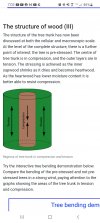
I have no idea what the below diagram means.... maybe I have something to learn here, or we need to get clear on our definitions.
In a straight standing tree the entire crosssection of the trunk is under compression, both heartwood and cambium.
No internal force from dry shrinking heartwood is going to overcome the weight of the entire top of the tree. Whoever came up with this is tripping... or teach show me something I don't know...
This diagram is trying to tell us that the heartwood bears all the weight of the tree and the cambium is being pulled apart under tension (not compressed by the weight of the tree). That is totally counter-intiutive. The only way I could see that working is if tree needs to take the weight off the cambium so water can move up the xylem.
And even if that was somehow miraculously true, the idea that it would stay true when a notch and the back cut are made, leaving the entire weight of the top to bear down on only the hinge's small strip of holding wood, is absolutely absurd. NFW... If that was the case, when you nipped a corner of the hinge, the cut would open... Believe me, I'm going to try it...
then what happens when the tree is dead and all the wood starts to dry out????
Who wants to bet????

I have no idea what the below diagram means.... maybe I have something to learn here, or we need to get clear on our definitions.
In a straight standing tree the entire crosssection of the trunk is under compression, both heartwood and cambium.
No internal force from dry shrinking heartwood is going to overcome the weight of the entire top of the tree. Whoever came up with this is tripping... or teach show me something I don't know...
This diagram is trying to tell us that the heartwood bears all the weight of the tree and the cambium is being pulled apart under tension (not compressed by the weight of the tree). That is totally counter-intiutive. The only way I could see that working is if tree needs to take the weight off the cambium so water can move up the xylem.
And even if that was somehow miraculously true, the idea that it would stay true when a notch and the back cut are made, leaving the entire weight of the top to bear down on only the hinge's small strip of holding wood, is absolutely absurd. NFW... If that was the case, when you nipped a corner of the hinge, the cut would open... Believe me, I'm going to try it...
then what happens when the tree is dead and all the wood starts to dry out????
Who wants to bet????
Last edited:

Stumpsprouts
Been here much more than a while
- Location
- Asheville
This string of posts is like reading a recipe on the internet these days. I don’t need to read a chapter on the origin story. Tell me how many eggs I need.ps...
I have no idea what the below diagram means.... maybe I have something to learn here, or we need to get clear on our definitions.
In a straight standing tree the entire crosssection of the trunk is under compression, both heartwood and cambium.
No internal force from dry shrinking heartwood is going to overcome the weight of the entire top of the tree. Whoever came up with this is tripping... or teach show me something I don't know...
This diagram is trying to tell us that the heartwood bears all the weight of the tree and the cambium is being pulled apart under tension (not compressed by the weight of the tree). That is totally counter-intiutive. The only way I could see that working is if tree needs to take the weight off the cambium so water can move up the xylem.
And even if that was somehow miraculously true, the idea that it would stay true when a notch and the back cut are made, leaving the entire weight of the top to bear down on only the hinge's small strip of holding wood, is absolutely absurd. NFW... If that was the case, when you nipped a corner of the hinge, the cut would open... Believe me, I'm going to try it...
then what happens when the tree is dead and all the wood starts to dry out????
Who wants to bet????
Also. When I did the CTSP training I don’t remember public shaming being a learning style. Certainly doesn’t motivate me. It shuts people down and ends the discussion.
Last edited:
Reach
Been here much more than a while
- Location
- Atglen, PA
Thank you! I will find the advice more credible when it comes from someone whose own website is honest, too. The fact that someone bashes the ISA and yet claims to be a Certified Arborist to the public when he has not been in quite some time seems very hypocritical to me, and takes away much credibility.This string of posts is like reading a recipe on the internet these days. I don’t need to read a chapter on the origin story. Tell me how many eggs I need.
Also. When I did the CTSP training I don’t remember public shaming being a learning style. Certainly doesn’t motivate me. It shuts people down and ends the discussion.

Tony
Carpal tunnel level member
- Location
- Lancaster, PA
You have a point. It is easy to take just the bits, that fit your current schema and apply them poorly to a bigger concept.But I do worry, to a degree (not so much for a skilled professional like yourself), that if we’re not clear on such a wide reaching forum, that some poor soul might get hurt or much worse if armed with the wrong idea. I try to make sure I’m not pointing fingers at anyone in particular with any comment here. It’s also why I appreciate your last post. Thanks for taking the time to write that all out.
Back to the front, and the question of why 1/3 depth…much of what I wrote was in regard to the increased barber chair potential with a shallow face cut. Overall, I am in agreement with your view on hinge wood and it’s role. And also that 1/3 as a rule can be just fine for tree felling situations without any special concerns. But we in time it becomes more like language, and we can strive to find just the right worlds…especially when the gravity of the conversation increases.
So, to summarize.
As for the 1/3rd guideline, it falls short mostly in that not all trees are round. Depending on intended direct of fall, “1/3” may create very different results. The better measure is hinge length as that is ultimately what you are manipulating with face cut “depth” until you pass the center of gravity of the tree.
Since face cut depth and hinge length are proportional this is often a case of one person saying Zebras are black with white stripes and another saying they are white with black stripes!
In my mind, we should just address the variable not how we get there.
As for the addendum conversation about BC
Hinge length is just one variable that we as sawyers can manipulate for many reasons mentioned in this thread. It is one variable of a few involved with the face cut. The others are angle of opening and hinge position in relation to the center of gravity of the tree.
The shortness or longness of hinge will produce different results as will wood type, species, etc. as will the altering the others. Gaining experience with these are making educated guesses about how to deal with them is the “art” behind tree felling.
The back cut is yet another variable to be controlled. Like the face cut. As for BC reduction there are far better methods for reducing the chances available to the sawyer. These methods involve more than just hinge length. However, the original question was about 1/3 notch depth.
Tony




















