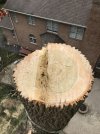
Why 1/3 notch depth?

The argued depth of scarf is not so much a “smoking gun” for “Barbers chair” that some declare.
Graeme McMahon
Thank you for taking the time to write that up. And always good to hear from you.. the true experts don't come around much anymore. There's a lot to digest there... so much that I'll have to get back to it..

and just to be clear.. I only said that a shallow notch (less than the prescribed 1/3 depth) increases the TENDENCY to BC. This is just a tendency and far from a smoking gun, or major factor. However, a complete understanding of ALL FACTORS offers the greatest potential for success in planning and execution.
 
Strength of the fibers across the hinge This varies between species, their age and across the hinge itself. In our Australian hardwoods the strongest fibers to hold and control the direction of fall are either side of the hinge. These two extremities must remain intact. For this reason the recent and novel introduction of “wing cuts” here by arborists has increased the loss of directional control and mirth from commercial hardwood fallers.
Agreed.. the fibers at the sides of the hinge have the most holding ability...

An important distinction though,,,, WHAT DOES HOLDING ABILITY MEAN?

most would say.. the ability to control the tree to ensure it makes the lay or desired direction of fall. That's true by definition, but from a practical perspective, there is an important distinction to be had here.


Here's my take on it...
Trees don't go over backward (except when cut by backyard weekend warriors)..
when a pro-faller "loses" a tree or the "hinge fails" or the holding wood wasn't strong enough to "Control the fall"... that only means one thing... THE TREE MISSED THE LAY TO THE SIDE.... HE LOST THE TREE TO THE SIDE WEIGHT

Hinges only fail to side lean or side weight. So the holding ability of the hinge means only one thing, its ability to hold against side weight. From strictly a mechanical perspective, the fibers on the sides of the hinge are going to have the most ability to hold against side weight. The sides of the hinge have the best leverage to resist side weight, whether it be in tension or compression. It's the position of the fibers that has the holding ability, NOT THE RELATIVE STRENGTH OF THE SAPWOOD FIBERS compared to heartwood fibers.

That's so simple as to be almost unarguable common sense, yet I've never heard it put like that ANYWHERE, BY ANYONE. On the contrary, the so-called "experts" and "trainers" here and elsewhere are convinced that the sapwood fibers have better holding ability because of the strength of the fibers themselves, not their position.

I also rightly pointed out that the ONLY reason sapwood fibers rip down the trunk is because of their position. That has nothing to do with their relative strength. Again, it's so simple yet I've never heard that explained by anyone else in the industry.

I did mention wing cuts being used to avoid side tears down past the hinge when that was mentioned on this thread, but I almost never use the technique. I've seen it used on Youtube videos, especially by climbers to avoid a side tear ripping down into the climbing line or lanyard. But in 667 videos I've posted on YouTube, you won't see me using wing cuts on anything with side lean. I generally will just open the face cut up to 50-70 degrees if needed, so by the time the face closes and hinge fibers get ripped apart, the momentum of the tree will overcome any pull from fibers tearing down the side of the trunk.

In the case of the sizwheel, the faller wants hinge fibers to tear down the trunk and uses that to his advantage.
 
Last edited:
Over cutting either of the two scarf cuts also encourages “Barbers chair”. As the overcut closes the hinge thickness is artificially increased. The uncut hinge wood to the rear must pull vertically up to break. The momentum of the tree tipping forward can either break the hinge or initiate the trunk to split up. In our hardwoods this outcome is likely. Softwoods and smaller trees can react differently.
as explained in this video which I published on March 30

 
At 63 I continue to be a clear fell faller in Australia (Native Harvest) and I think experienced enough to add to this thread. Most of my work is in steep rocky terrain felling the split prone “mountain” and “alpine ash” (E. regnans and Delegatensis). The trees are all 50 – 60m tall and the “alpine ash” develops heavy leans downhill and into the side gullies. As a result every tree has the potential to “barber’s chair”.

I pour just under 20L of bar oil through my 661each week with no bucking or limbing. Eight thousand ton of wood on trucks is a big month whilst I am the only hand faller on the crew it is a credit to the logging team to snig, bark, process and load the trucks. On a country or world stage I don’t consider myself any better than any other production faller. Arboriculture stands to benefit from the production logging rather than reinvent the lessons learnt in blood. It is with some bemusement I observe the devising of odd felling methods and “trick shots” when the focus ought to be a pursuit of core skills and safety.

The above is not meant to be a “pissing” contest however I would be the first to want to know the background of a person making comment so it is only fair I give that. I also have a major in biomechanics and have applied those principles to my almost completed book.

I find that practitioners can be lost in technical explanations that at times smack of intellectual snobbery. For this reason I prefer to speak to practitioners in lay talk that we can all understand. I propose to discuss only the accepted general principles of tree falling relating to the thread. Extremes and variations will invariably produce difference and argument.

I would like to discuss three items,

Why the 1/3 scarf? The primary purpose of the felling cuts is to maximize the directional control of the tree. The accepted scarf is aimed between ¼ and 1/3 in depth. At 1/3 depth the front of the hinge is approximately 95% of the diameter of the tree. As a result the directional control is almost maximized when we consider that the hinge is behind this and thus wider.

Strength of the fibers across the hinge This varies between species, their age and across the hinge itself. In our Australian hardwoods the strongest fibers to hold and control the direction of fall are either side of the hinge. These two extremities must remain intact. For this reason the recent and novel introduction of “wing cuts” here by arborists has increased the loss of directional control and mirth from commercial hardwood fallers.

The customizing of the arborist tree felling training likely has poor “Google” influence as some key elements are in conflict with long standing cornerstones for commercial fallers. We are very public on forums now and ought to consider how we influence folk and our displays of professionalism. Many soft wood trees retain reasonable hinge quality across its length. Applying one rule is doomed for reasonable conflict.

I don’t recall where in this thread but there was reference to the tension of the outside fibers of the trunk. This is strongly evident in the straight (vertical) E. regnans prior to falling. When placing the first cut of the scarf it releases the tension on that side allowing the top of the tree to tip gently away from the cut. As the 60m top moves away it bends and pulls further. The head pulling away from the cut exaggerates the release of tension. This clearly demonstrates the dangers of overcutting hinges or demanding “wing cuts” in hardwood trees. Control is reduced.

What causes “Barber’s Chair”?

The primary cause of “Barbers chair” is the uncut wood to the rear of the hinge. Leaving a “strong hinge” despite a “back release” can initiate a “Barbers chair”.

The natural tendency of the timber to split gives a predisposition for the trunk to split up and down the trunk. The balance between the strength of hinge and tendency of the trunk to split can result in either the hinge breaking or a split occurring up the trunk.

Height of the tree (leverage) and the natural lean of the tree. The faller needs to make a decision of the method used to fell the tree that ensures the wood behind the hinge is cut before it encourages the trunk to split.

Step. The greater the lean the more it is beneficial to lift up the back cut. Mark correctly discusses the concept of the hinge bending. If you consider the hinge to be a board. By clamping a board in two positions close together and then forcing the board to bend between them the length of that bend and thickness across the board resists breaking.

Great examples are shown in this thread and others in the break of the hinges. Where you identify very little step of the back cut, the rear of the hinge displays the typical tall “pulled wood” whilst the front margin of the hinge displays the classic crushed broken fibers under compression.

Raising the back cut up higher is similar to separating the two clamps on the figurative board further apart. Now the bending occurs over a longer length for the same width of board (hinge). It will now bend and break the hinge with little or no pulled wood to the rear of hinge. This demonstrates a reduction of exposure to “Barbers chair”.

Scarf. It is preferred to install a scarf with the standard depth however from the above points if the critical wood is severed behind the hinge and the step height of the back cut is sufficient “Barbers chair” will not occur. The argued depth of scarf is not so much a “smoking gun” for “Barbers chair” that some declare.

There will be times with very heavy leaners where placing a 1/3 scarf is very hazardous or not possible because the tree continues tip forward and “sit” onto the saw in the scarf. If the scarf is about 1/3 depth and its length is about 95% this has little value for the direction of fall for a heavy leaning hardwood tree when back released. When the tree is released it falls where it is leaning and the hinge competing with its desired direction with gravity will fail.

Over cutting either of the two scarf cuts also encourages “Barbers chair”. As the overcut closes the hinge thickness is artificially increased. The uncut hinge wood to the rear must pull vertically up to break. The momentum of the tree tipping forward can either break the hinge or initiate the trunk to split up. In our hardwoods this outcome is likely. Softwoods and smaller trees can react differently.

Sorry none of the pictures wanted to load.

Regards

Graeme McMahon
Thanks for sharing your experiences my friend! I've enjoyed every conversation we have had, both in person and online. I'm so looking forward to the next beer and chat! Your place or mine!

Cheers,

Mark
 
Monkey wrench time. I was studying some Mohr chasing around in a circle about stress and strain. ;) Remember when I observed that the barber chair split typically initiates at the edge of the back cut, the location of a stress riser (the back cut edge) and doesn't initiate at the neutral stress plane because that plane's new location after cutting is somewhere above the hinge wood (not equal to edge of back cut)?

Doh!!!

A head leaner is a beam in bending and at the 10 minute area of this video max shear stress is confirmed at the neutral axis, including reference to shear failures in wooden beams at their center!!! Which I'm sure we've all observed in a tree branch at some time or other.

The soup thickens.... Two competing concepts to reconcile.

 
Mark, I found some info about growth stress. (the cylinder diagram) Known since 1938!

'http://svc043.wic023v.server-web.com/pdf/pdf-members/afj/AFJ 2001 v64/AFJJune2001-64(2)/Yang.pdf

It was either this paper or another that confirmed Graeme's observations in some tree species. I think I recall .1 to .3% strain differential inner to outer fibers, but species dependent from the reading.

From the paper:
"There are two leading theories that attempt to explain how growth stresses are generated. The 'lignin swelling' theory proposed that growth stresses arise during the lignification process of maturation of newly formed cells.
Poymerization of lignin causes contraction or swelling of cells in lateral directions and simultaneous elongation or shortening of fibres or tracheids in their axial direction (Munch 1938; Boyd 1972, 1985) depending on the microfibril angles in these cells (Boyd 19739, 19736). The 'cellulose tension' theory states that growth stresses are generated as a consequence of the contraction of microfibrils in the newly formed cells while their continuing crystallization is inhibited by the deposition of lignin (Bamber 1979, 1987)."

So I guess it's not as simplistic as the center wood drying and shrinking.


As someone said on the forum many years ago, always learning or something similar.
 
Phil,

As a long time trainer, I have found the more valuable question is “why not?” Understanding “why” certainly is important as it gives validity to the “how” of a task. However, ”why” questions really, in the end, only address methods.

Asking “why not” questions, forces one into examining the principles of a matter.

Example: When a climber is cutting aloft, she/he should tie in twice. If we ask “why” The answer: if you cut one system, then another is in place to prevent a fall. Cutting system is always a possibility. Therefore, redundancy is a method. Why the redundancy? So we don’t create a greater hazard by exposing the climber to a fall.

Now as production arborists, we all know there are times, not uncommon, when tying in twice might not be the best idea.

Here is one, fairly common. T. I. P in another tree. The tree you are working is dead, dead, dead. Should the dead tree fail beneath you and you are secured to it with your lanyard….you become rigging…

Is it possible in this scenario to cut your line? Yes. But the method, redundancy violates the principle of creating a greater hazard.

So in the above scenario, the better question to ask is “why not?” If you have a valid answer for “why not“ you are addressing a principle. Here the principle is not to create a greater hazard, ie. exposure to fall.

“As to methods there may be a million and then some, but principles are few. The man who grasps principles can successfully select his own methods. The man who tries methods, ignoring principles, is sure to have trouble.”
― Harrington Emerson


Respectfuly,

Tony
deep, brain fodder, thanks
 
A recent client asked "how did you learn all this?"
if he only knew.... :LOL: out in the woods and here at one of the remaining places a lively discussion is found, real questions are posed, considered and replied. One of few industries finding folks reading books in their spare time to improve the craft;
much respect, and thanks ~
 
A recent client asked "how did you learn all this?"
if he only knew.... :LOL: out in the woods and here at one of the remaining places a lively discussion is found, real questions are posed, considered and replied. One of few industries finding folks reading books in their spare time to improve the craft;
much respect, and thanks ~
I love that question. And “where did you go to school to learn all of this?” “Well mam, I dropped out my freshman year and started working….
 
Phil,

As a long time trainer, I have found the more valuable question is “why not?” Understanding “why” certainly is important as it gives validity to the “how” of a task. However, ”why” questions really, in the end, only address methods.

Asking “why not” questions, forces one into examining the principles of a matter.

Example: When a climber is cutting aloft, she/he should tie in twice. If we ask “why” The answer: if you cut one system, then another is in place to prevent a fall. Cutting system is always a possibility. Therefore, redundancy is a method. Why the redundancy? So we don’t create a greater hazard by exposing the climber to a fall.

Now as production arborists, we all know there are times, not uncommon, when tying in twice might not be the best idea.

Here is one, fairly common. T. I. P in another tree. The tree you are working is dead, dead, dead. Should the dead tree fail beneath you and you are secured to it with your lanyard….you become rigging…

Is it possible in this scenario to cut your line? Yes. But the method, redundancy violates the principle of creating a greater hazard.

So in the above scenario, the better question to ask is “why not?” If you have a valid answer for “why not“ you are addressing a principle. Here the principle is not to create a greater hazard, ie. exposure to fall.

“As to methods there may be a million and then some, but principles are few. The man who grasps principles can successfully select his own methods. The man who tries methods, ignoring principles, is sure to have trouble.”
― Harrington Emerson


Respectfuly,

Tony
Tony, time constraints of training tend to pose the 'why' more than the 'why not'. The latter being another avenue of vital study, experiential study.

And anyway, why or why not aside, that dead tree and the choice to not use a lanyard, can be questioned and probed. Technique is a journey, really, never ending. Our context deepens through time.
 
Philosophically i think to see fully, must look at both sides of coin, why and why not. Play scenario forward and backward in head as well. Soundest solution should look sound from all these angles, as perfect storm to key points, like a martial art. If for nothing else than to move most confidently, but then so much more.
Technique is a journey, really, never ending. Our context deepens through time.
(y)(y)(y) very quotable/stolen, ty!
I love that question. And “where did you go to school to learn all of this?” “Well mam, I dropped out my freshman year and started working….
i have an arbo Tshirt that says am using high school diploma to fix what your college degree messed up.
Have had engineers stop me ranting to boss, that i couldn't do what i posing to; but was my butt on the line literally... Afterwards they are all pissy, slamming stuff and leaving usually seems.
.
Daniel's mini-notch is what i call a face within a face, inner face closing earliest and thus ruling.


These few points below i think can give fuller , open door view of the works, rather than the usual peek under the closed door.
.
i think BC is from massive force bound against self w/o relief path that exceeds the capacity of the wood. In my imagery over ruling the constitution of the spar as a container of that force. Noting, that can play the same cuts, angles etc. all the same as dropcut/snapcut , hop a top etc. quite successfully with everything set to same 'volume control'/dial except the mass volume control turned way up in felling then higher leverage multiplier than climbing etc. for sum total leveraged force clear off the scale; for sum total. i also imagine a backcut going so slow(in ratio to relief needed) the massive raging urge of force can't flow forwards and almost seems like then can rush/divert upwards between the 'sheets'/layers urging separation/ungluing. The separation seems to go between the more leathery outer 'skin' and inner 'bone' of the tree wood. Then kinda too hammering if 'stutters' at real slow, mebbe some actual mini stop and restarts to aggravate away from smooth , clean, flowing, committed fall.
.
Most things fail from overwhelming sine/cross forces; not aligned force overwhelm-ment of cosine . Wood is about 70% tension strength of compression as thumbrule. Tension and across shear failing then, seen as expected.
.
Total energy trying to flow cleanly home will be e=mcSQUARED. The squared part is the velocity that is very slow/ not built up to usual squared/compounding volume yet in early closes. Note how formula has just 2 parts: static leveraged mass, and then when that nominal is overcome we are squaring then speed as a compounding, exponential multiplier. The dynamic state, once achieved, rules here and exponentially as that increases in value further from nominal static. This dynamic state can carry tree home with inertia guiding it as the exponential compounding , most determining force, once engaged enough.
.
i think we can see the strongest of these also in the 2 extremes of too much downward force (cosine) in shallow lean X slowness
>>slowness extreme in early full face across close like accidental kerf horizontal across buried in the face as the slated is bypassed.)
Or in the opposite extreme of too much forward lean (sine)tension on fibers, too slow a relief for the building leveraged forces X again slowness. But as all positions between extremes have some of each volatile, and still have to stir in speed to inertia, wood type and condition, can conjure BC several ways to same equivalent sum failure.
.
Other dispositions of CoG (length x lean )are between these antagonistic extremes have some of each , of the 'parental' extreme effects. Scenarios between these extremes are antagonistic as they raise effect of 1extreme at expense of the other (too little lean/massive cosine vs. too much lean/massive sine). But anyway can dialup BC from several combinations to same overwhelming sum total on the scale. Then there is how species and condition slant the benchmark expectations this way or that. But always forward momentum as flow of force and relief of raging forward force (else more likely to then surge up fiber columns then i think ) forsaken in full across early close I think might be most consistent way of conjuring the beast, amidst the rest of the formula to overwhelming the wood capacity.
.

 
Last edited:
I just wanted to thank everyone in this thread for the incredible wisdom and insight you’ve shared on tree felling. This thread has bolstered my confidence in felling because I have a better understanding of the “why” (and “why not”) behind the felling decisions I make.

Today I had to remove two 100’ Tulip Poplar trees. They were too tall to fell from the ground and they were too tall to piece out with my 65’ bucket truck. My boss assumed I would be climbing high and piecing out the upper canopies until they were short enough to fell. He planned for 1.5 days of work.

As I assessed the 2 trees 1 was very straight. I had a decent drop zone and was able to use the bucket truck to fell a 50’ top into the yard. The second tree was more complex. There were 2 leads that branched apart around 45’. One lead had a slight back lean, 1 had a hard side lean over the house. I roped off each 1, felled the back leaner first then felled the side leaner. I’ve never attempted felling from such heights on such large trees (I rarely come across 100’ trees in Northern Indiana.) Thanks to everyone who provided input on this thread. I really appreciate it!3BD1C0FD-E03B-4961-AD94-0B90D1B34FAB.jpeg
 
Last edited:
Today I had to remove two 100’ Tulip Poplar trees. They were too tall to fell from the ground and they were too tall to piece out with my 65’ bucket truck.
....
I’ve never attempted felling from such heights on such large trees (I rarely come across 100’ trees in Northern Indiana.) Thanks to everyone who provided input on this thread. I really appreciate it!

it's often that what I find here gets called in within a day or two of working. ways of seeing something with clearer ideas.
right on!
 
"conjuring the beast" :) We need the sword from the stone to slay the beast! Wherefore art thou Sir Danielhad? Or Sir Whoeverhad? Clippety clop clippety clop whinney watching too many historical shows...
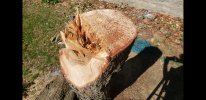
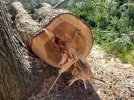
- this is humour - no offence be taken allowed - :)
Grrr
 
Nice job going big!


Keep in mind how the rotation will happen with particular cuts and how far in front or behind the stump the butt can land and bounce.
@rico had some good things to say about this. I'd like to pick his brain some more.
Yes, this was a big concern when felling the last leader with side lean towards the house. I starred at that for so long calculating where my notch needed to be knowing that the piece would be free falling for 50’. I had to aim my notch way off my lay knowing that once the hinge broke the piece would drift and lay in my desired drop zone. So rewarding to take those types of calculated risks and succeed.
 
Arboriculture stands to benefit from the production logging rather than reinvent the lessons learnt in blood. It is with some bemusement I observe the devising of odd felling methods and “trick shots” when the focus ought to be a pursuit of core skills and safety.
There is no doubt that the saw skills of production loggers on average far exceed those of average or even above average arborists. As such arborists have a lot to learn from our big brothers that work in the woods. HOWEVER, there are major differences between the needs, available resources, and priorities of the two trades. SO much as to make them different animals. They may look a lot alike, but they are far different in many important respects.

I made a pretty good living for close to 20 years by falling trees that no one else in my market would even consider without climbing, rigging, or craning. Many of those scenarios called for techniques that are well beyond core skills and fell outside standard protocols. IMO there has been a gross industry-wide failure to recognize the many differences between logging and suburban arboriculture. Many techniques that are better applied in the woods have been improperly accepted and venerated by arborists and their training organizations. Cutting 1/3 diameter notches or 80% hinge width are prime examples. There are many scenarios in falling big and little trees in tight DZs, and rigging where that prescription is far from ideal. ANYONE that says different doesn't have a clue!

There are a lot of factors involved in the task of falling trees. Once one understands them, these prescriptions of one size fits all scenarios become ridiculous. Absurd, yet the industry clings to them with a vengence, rejecting most anything that occurs outside their little box of rules. Failure to understand even the simplest of concepts, such as the tapered hinge, which has been rejected by many trainers and training organizations is mind-boggling. One of my former co-workers. who now works for Tony's company, called me yesterday after I put up a video from yesterday's job of a hemlock fall. The notch, cut from a step ladder, at head height to shorten the fall started with an open face, then a plate cut to get some height to the front of the hinge fibers. Then from the ground, I plunged in a steep snipe almost all the way back to the apex to effectively make it a wide open-face well over 90 degrees. Then I cut my version of a sizwheel to protect against side lean, then I slightly adjusted the gun by plunging in a three-kerf trench cut. For the back cut, I used a tapered hinge, again to protect against side lean. We pulled by hand (which is rare for me) using a two leg pulling system, set up with a 3:1 MA system on one leg, yielding 6:1 minus friction. No wedges.

A production logger would have laughed at all the time I spent whittling away on that notch, while an arborist trainer would have told me that the tapered hinge doesn't work, I should never make a back cut above shoulder level, and likely he had never seen the sizwheel used before, and I was risking my life by plunging in those trench cuts at head height. All I cared about is that the tree didn't hit the house! SO I spent a few extra minutes on the notch. And I've been handling a chainsaw for 40 years, so I can comfortably throw a 461 up to head height for the back cut.

Now back to our story. So my buddy asks a few questions about the cut and then tells me that Tony's company recently brought in a trainer that claimed that "you can't" fall any tree with more than 4' of side lean. So my buddy blurted out.. "yes you can". Of course you can... any suggestion by a professional trainer that it can't be done is completely absurd. Compensation pulls with heavy equipment can make up for a whole lot of side lean. August put up a video showing some big cottonwoods with a lot of side lean getting dropped on a dime with compensation pulls

Unfortunately, that's the state of the industry today. You can learn far more from watching August Hunicke videos than you can from a professional trainer. While the advent of social media has brought a lot of progress in techniques and understanding, the institutions of arboriculture are lagging. The result is that many arborists are stuck in a very limited box in their thinking and performance. That includes those with prominent voices. This thread has confirmed the overall lack of knowledge where the basic fact that a shallow notch increases the tendency for barber chair is in dispute, and no one can concisely explain why.

Necessity being the mother of invention, I have experimented with and devised many out-of-the-box techniques with excellent results and some great successes, and of course plenty of failures and unexpected results. A large part of my learning has come as a result of the techniques that did not work or go as expected. So the failures have been great lessons. Combine that with the ability to study both success and failure on video and I have been blessed to tease out a thorough understanding of many detailed aspects of this work. In the case of the barber chair, I learned a lot from times I tried to barber chair trees on purpose and failed. One of the things I learned was how to prevent barber chair, by taking advantage of the scenarios that lead to the failed attempts.

Purposely barber chairing trees has led to a good understanding of the reasons why a shallow notch under the 1/3 increases the tendency for barber chair. Though some attempted answers in this thread have hit on portions of the mechanics involved, no one has come up with a complete answer. And some self-proclaimed "trainers" actually deny the effect. They prove their own ignorance by spouting fallacies and misunderstandings. So who trained the trainers?
 

Attachments

  • Screenshot_20220501-085111_Gallery.jpg
    Screenshot_20220501-085111_Gallery.jpg
    455.1 KB · Views: 16
  • 20220429_102142.jpg
    20220429_102142.jpg
    1 MB · Views: 16
Last edited:

New threads New posts

Kask Stihl NORTHEASTERN Arborists Wesspur TreeStuff.com Teufelberger Westminster X-Rigging Teufelberger
Back
Top Bottom