













data farm 26
Been here a while
- Location
- Casablanca
I feel safest on a base anchor.
Follow along with the video below to see how to install our site as a web app on your home screen.
Note: This feature may not be available in some browsers.

Is it known, has a rope ever broke on anyone ascending srt in one of these ways?

Those are all great points.The doubled load is inaccurate irl situations. Friction and rope angles greatly reduce the amplified load effect. Also we know that wood is much stronger in compression. Also a base tie can theoretically be caught by lower limbs if the main tip fails. I pretty much always work off a base tie while pruning.
If you are using a saw, you need to have a second life support, such as a lanyard. Never saw without a second life support line. Yes, your hand saw can cut through your climb line, or your anchor line. Always, repeat, always have a second life support when using a saw, hand or power.How about if handsaw teeth somehow accidentally find their way to tied off side of rope, or what about nails in the base missed even if inspected. Is it known, has a rope ever broke on anyone ascending srt in one of these ways? Cuz I feel pretty vulnerable going up like this.
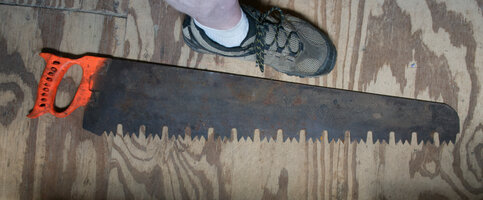

Awhile ago a climber was pushing the idea of using this technique but having several legs of climbing rope anchored to the base leg. Seemed like a great idea for trees where you want to climb in a few different sections, for pruning.I do all my climbing with a base tie, but I do not put my climb line over a crotch. I pull up the climb line with an anchor line until it almost gets to the crotch. Saves wear on the climb line, and I can use just about any good wearing rope as an anchor line. If I need to get higher, I will then switch to whatever means gets me where I need to go.
Comforting to know.I've NEVER heard of a synthetic climbing rope [NOT rigging] breaking in any configuration. Has anyone?

If you are feeling vulnerable maybe you should start climbing on double ropes with a fall-arrest on the second rope. Some arborists are doing that. Just don't expect everybody else to jump on that ship.How about if handsaw teeth somehow accidentally find their way to tied off side of rope, or what about nails in the base missed even if inspected. Is it known, has a rope ever broke on anyone ascending srt in one of these ways? Cuz I feel pretty vulnerable going up like this.
Your body will break before you break a modern rope. And if you are using a saw without being tied in to at least two points of contact you deserve it if you cut one rope and fall.Comforting to know.
Not going to get any thumbs up for that one.That seems a bit harsh. Sometimes out on the end of a branch there's no way to tie in twice.






















