What the bananas

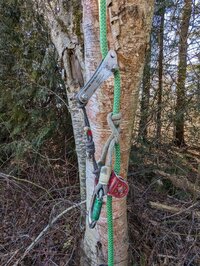
Wait, wait, wait. You mean there's a small metal device, on a floppy tether, that runs above your hitch, putting a bend in your rope, allowing you to climb srt? I can't believe that no one has ever thought of that before!

View attachment 92817
@treebing
I don't know... maybe you could put some kind of easily removable bolt on the front so that it can be installed/uninstalled quickly and easily. That must be the difference.

But seriously, I like the idea for the toolless on-the-fly adjustment. That's an original contribution, and a pin design that might be a nice replacement for the slick pin on the ZK2. I would love to know what that pin is called to try to find one the right size, but I suspect the holes must be machined a specific shape.
 
I believe Carey Gibson (?) with the bat wing lats was the first documented incidence of floppy tether RW/hitch interference causing a fall. Semi stiff tether was using a quickdraw. Stiff tether with hold up angle feature became the defacto standard after that.
 
I totally dig it , would really fit into my style of climbing if it performs well . I have had almost all the devices out there and I love the innovation and the progress over the last 10 to 15 years. I've heard people say we are in the golden age of tree climbing and I tend to agree with that for the most part.
 
I don't know... maybe you could put some kind of easily removable bolt on the front so that it can be installed/uninstalled quickly and easily. That must be the difference.

But seriously, I like the idea for the toolless on-the-fly adjustment. That's an original contribution, and a pin design that might be a nice replacement for the slick pin on the ZK2. I would love to know what that pin is called to try to find one the right size, but I suspect the holes must be machined a specific shape.
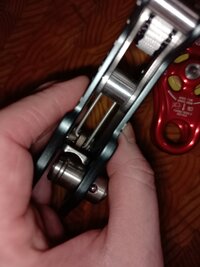
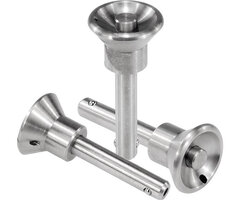
its a ball lock pin. this one is machined with a flange so its captive in the device and you can't pull it out without disassembling the cheek plates. most ball lock pins have the ball bearings towards the end of the pin opposite the button, if you found one the right length it might work with the ends sticking out the wrench cheek plates
IMG_20240225_180611.jpg
also visible: cam spring assembly
 
After a couple of purchases of the newest, shiny new things and then subsequent recalls etc. - I have pulled back and sought counselling for 'Shiny New Thingy Purchase Syndrome' (apologies to Nick Bonner - some of the new TreeStuff stuff is pretty neat). But like the tether comments above, didn't we kind of move away from floppy connections (1st iteration of the RW) and into stiff tethers? For some good reason? I liked that cuz it seemed to keep hardware bits away from my hitch on the way up or during stops.
If something is easier, faster, lighter, safer have at it, but it would be really nice to see iterative inventions being brought to market now with clear statements as to the problem they were trying to fix and why the new left handed screwdriver they've invented really is better, rather than leaving purchaser to figure it out for themselves later.
Simpler is often more better-er if only that it eliminates new points of failure, esp in life support equipment (recalling past discussion of bridge swivels). Just my two cents.
 
Last edited:
Just watched a metal tether review where the fellow complained about getting it in the 'nards during spar work.

Doing a deep dive into how things work can separate the wheat from the chaff. Resurrecting an incomplete RW project as we speak.
 
Last edited:
Just watched a metal tether review where the fellow complained about getting it in the 'nards during spar work.

Doing a deep dive into how things work can separate the wheat from the chaff. Resurrecting an incomplete RW project as we speak.
What does Free Fallin say? Owww.
I've wondered more than once why perhaps the RW tethers aren't made with something like HDPE (HHDPE?) - they're not the life support bit, you could embed metal gromet-ty thingys for wear points if needed and big bonus for working in our parts, they wouldn't be as cold as metal for winter. All sorts of shapes possible then. And cheaper? Just a thought maybe.
 
Plastic wear would probably not be a problem. One of my early Oceans style tethers had an upper block that went on the pivot and did the engagement angle using Delrin. Never showed a smidge of wear just a bit of denting.

Tensile strength of cast plastic is a question for the density penalty vs cordage of preferred type. My Delrin wasn't in tension but worked with dyneema (?) IIRC. The Squirrel Flex is a neat combo of cordage and "shrink-wrap".
 
I seem to remember a video a longish while back where Richard Mumford did some pull measurements on hitches and stuff in single and double rope configurations and I think RW too (early model?) in front of his blackboard I think it was, but I couldn't seem to find it. Or maybe it's the single malt again!

Addenda (02-Mar-2024): This is Richard Mumford's video with some comments on forces on the hitch and the tether . . . .
 
Last edited:
Talk about complacency when something is trouble free. The delrin head is so inconspicuous that I didn't even realize that's the tether I'm currently using! The brown color might be a bit sun faded, that's all. The head does the RW alignment function that was "new" to the metal tethers. At the time I just presumed all tethers did the alignment because they ought to and went ahead and designed it in. Who'da thunk.

I ran across the zag wrench tether video where they killed a zigzag. Takeaway was mechanical slippage on the rope well above support requirement but below human body damage is a good thing for fall absorption.
 
Talk about complacency when something is trouble free. The delrin head is so inconspicuous that I didn't even realize that's the tether I'm currently using! The brown color might be a bit sun faded, that's all. The head does the RW alignment function that was "new" to the metal tethers. At the time I just presumed all tethers did the alignment because they ought to and went ahead and designed it in. Who'da thunk.

I ran across the zag wrench tether video where they killed a zigzag. Takeaway was mechanical slippage on the rope well above support requirement but below human body damage is a good thing for fall absorption.
I would like to see that video if you have a link...
 
That's the video. I stole Reon's button/coil spring for a tether I've been working on. I personally don't think a tether needs to be rated as say on a zk2 you split 50/50 and hit it in the range of 100 to 150 lbs. The 50/50 isn't a hard number it depends if your left shoelace was tied tight first. Still, it's easier to overbuild and simply avoid the explanation. I think they should've found a way to lock the rope at the last "bird" link rather than wedge a lumpy knot into the side plates as the zigging part seems the weaker structure to test.

I can't recall if there's a video somewhere slipping akimbo, rope runner, hitch cords etc at max load (?)
 

New threads New posts

Kask Stihl NORTHEASTERN Arborists Wesspur TreeStuff.com Teufelberger Westminster X-Rigging Teufelberger
Back
Top Bottom