what kind of all thread

Unless you use swaged terminations I don't think that cable should be used for tree support.

If there is ever a failure and you're not following accepted standard and practices you're going to be in big trouble.

Take some time reading 20+ years of archived knowledge here.
I’ve been careful to do even better then what I’ve been shown around my area. What are “swaged” terminations, oh there basically a crimped sleeve.
 
Last edited:
well im going with 3/4 rod it is a pretty big tree and the crack is all the way through the trunk already, at the base of the tree, the tree in question is a mesquite tree. the trunk where it is split is 38-42 inches thick and only 3 feet tall from the ground until all the main leaders split off. from looking at it the tree, it had this defect for a quite while and one of the last storms must have been the needle that broke the camels back. the crack is probably 6 inches at the top where the tree changes from one trunk into 5 main multidominate limbs, they vary between 18 to 24 inches thick at the crack. i already did a massive prune on her. its one of those trees that my customer loves and would do or spend anything before removal. there are no targets with in 50 ft and its on the side of the house so there isnt any foot traffic around the tree. its at least 40 ft high and 60 to 80 ft in diameter. i have a roll of 3/8 ehs cable and wedge stop dead ends on their way. im thinking of going with the box configuration cabling it and depending how things go i might put an additional cable from one side of the crack to the other. 3 limbs are on one side and 2 are on the other, the tree cracked almost perfectly right in half. the side with 3 limbs looks like it was the one that moved. there is one limb on that side that is more vertical and longer than the rest and i think was the culprit. while reinforcing it until i can get all the supply's together, the side that moved was moving back the way it came, it has probably moves 2 feet the right way, which was encouraging. all the remaining wood is solid, mesquite is a hardwood at about 58lbs per cubic foot.

here is a question that came up while i was thinking about the all thread. is the all thread going to be wet the whole time inside the tree from the tree moving water to it upper canopy? i would think just the cambium layer would be the wettest with it getting dryer the further inside it is.

would it be best to pull the tree back together first and then drill the hole and put the all thread in?

or can i tighten the all thread as im puling the tree back together?

i will now be going with hdg all thread and hardware. even though its twice the price im sure in the long run it will be worth it.

the tree and i live in tucson, arizona which is a desert.

so what do you think? would you do anything different?

thanks for your time
Can you take a photo of the tree to post?
 
I’ve been careful to do even better then what I’ve been shown around my area. What are “swaged” terminations, oh there basically a crimped sleeve.
It doesn't matter what you've been shown... follow industry standards.

You posted a cable rated (minimum breaking strength) for 1400 lbs. For point of reference, Standard grade galvanized 1/4" is rated for 1900 lbs. 1/4 EHS, which is becoming more and more common in tree care as we have better terminations is rated for 6650 lbs.

Wrapping the cable around a termination and using the u-bolts reduces the capacity more.

Note the ANSI BMP chart lists WLL (working load limit) which is 20% of MBS...so that puts the TSC cable at 280 pounds working load limit.

Translation: that TSC cable can't hold very much in trees. I wouldn't use it at all... certainly nothing bigger than a few inches. The BMP says max diameter for 1/4" common grade is 5"...so the TSC cable would be smaller than that.
 
The cable I've used is here, https://www.tractorsupply.com/tsc/product/koch-industries-cable-galvanized-7-x-19-1-4-in-x-1-ft
This cable is quite resilient, and does not stay bent, I always use the supplied heavy duty thimble and make sure it is held well with the ubolts, so it can't fall out of the eye of the cable termination, where it is, inside the one piece forged eye bolt, here, https://www.treestuff.com/eye-bolt-with-nut/

I always make sure the, the cabling termination and wear attach points, I leave behind, are over engineered.
And, I always leave about 6 to 10 feet of cable nicely coiled up held in place with stainless hose clamps were I finish each cable off.
As said by others, do not use that cable in a tree. That is not cable, by the way, it is wire rope. Very different construction, made for very different purposes, and not near as strong.

You need to be using cable designed for cabling trees, and really should be using EHS cable, not common grade. Any reputable arborist supply can sell you what you need, Gap Arborist Supply has a whole section of their website dedicated to cabling.

I have removed or replaced more than one failed cable because it was not installed to industry standards. If you were a few hours south of where you’re at, I might suspect that I’ve replaced some of yours.

Have you ever considered working a year, or even better a few years, with a good tree service, to learn how to do these things properly? It seems to me that you have plenty of ambition and drive, but not a lot of practical knowledge of the industry you working in. Your customers deserve to hire a professional that knows the proper ways to do the work they’re paying for, and not someone who thinks he knows enough to get by.
 
i will get a couple of photo's when im there next time, which will be a couple of days.

the scanned copy i posted was ansi a300 part 3 2013 a revision of ansi a300 part 3 2006. if you look at the front page its all over it and if you look at page 3 the copyright is 2013. and unfortunately there isnt a more recent version that ansi has come out with for part 3, there are other parts of the a300 that have a newer date revision. i am very surprised that they haven't come out with a newer version of part 3, especially since in the a300 part 3 they dont mention anywhere anything about dynamic cabling practices, maybe it isn't a ansi recognized practice?

what happens when a new technique or technology , isnt in the ansi standards? its not like they get updated yearly or biyearly or even every 5 years. alot happens in a year or two.
 
Last edited:
on that webpage willbur posted for the cable it does say the 1400lbs is the working load and its galvanized, the wild thing about the stuff is that it has the same make up as aircraft cable 7-19. so really we should be trying to show them the right way, which is why this forum exists in the first place to helpt and if one of use doesn't have the proper knowledge in one area doesn't mean that they dont know ish across the board. if we berate someone on here for their practices, more than likely isnt going to change the way they do things, it just going to make them pissed or shut them off to the learning that they need.

in the ansi a300 part three it does state on page 9 "32.11 cabling: The installation of a steel wire rope, steel strand, or synthetic-fiber system within a tree between branches or leaders to provide supplemental support."

it also goes on to say that you can use wire rope clamps on up to 1/8 inch cables, thats on page 12

on page 20 of part three there is a nice little chart, that has what kind and size of cable will work for the diameter of the wood and its average weight it should be
 
Last edited:
As said by others, do not use that cable in a tree. That is not cable, by the way, it is wire rope. Very different construction, made for very different purposes, and not near as strong.

You need to be using cable designed for cabling trees, and really should be using EHS cable, not common grade. Any reputable arborist supply can sell you what you need, Gap Arborist Supply has a whole section of their website dedicated to cabling.

I have removed or replaced more than one failed cable because it was not installed to industry standards. If you were a few hours south of where you’re at, I might suspect that I’ve replaced some of yours.

Have you ever considered working a year, or even better a few years, with a good tree service, to learn how to do these things properly? It seems to me that you have plenty of ambition and drive, but not a lot of practical knowledge of the industry you working in. Your customers deserve to hire a professional that knows the proper ways to do the work they’re paying for, and not someone who thinks he knows enough to get by.
I see this 1/4" Common Grade cable is cheaper than the wire rope. That EHS cable is ridiculously strong. It's almost like a steel rod.

You give a blanket statement, as all the things I do, are improper and unprofessional.
I saw a tree cabled by Northern Arbor Culture, a "professional" outfit. And, they didn't care to prune near enough dead wood out of the tree, and left dirt buildup in the main leader crevasses. Also, they used only a cable through the tree leaders, (not a bolt that would allow for a better seal) then having the termination end with a larger surface area than a decent washer and nut, so now the tree has more area to grow over to seal the termination.

I am very careful to have a tight fit of the bolt through the leader, and and install the opposing bolts as ideally inline as possible, and have a ideal termination on the cut off end of the bolt, with carefully mushrooming the cut end of the bolt, as to create a minimal secure lock for the termination nut.
Besides, the force likely exerted on the tree leaders I've cabled probably are much less than the force the cable would break at.
Btw, I could simply put up this Common or EHS cable using the existing one piece eye bolts, in all the 5 trees I've cabled, eh?

The infamous "Ubolts" I mentioned I used are sold here: https://www.gaparboristsupply.com/Wire-Rope-Clamps
What does Gap say these should be used for, I always use at least 3 of these for each eye, most of the eyes I used 4 Ubolts, making sure the U was impressioned on the tail, NOT high force part of the cable/wire rope.

I've see some really lazy (yes, lazy climbers) dead wood pruning of many trees. Not throughly pruning dead wood and suckers from a tree is the most common detriment to trees.

 
Last edited:
I see this 1/4" Common Grade cable is cheaper than the wire rope. That EHS cable is ridiculously strong. It's almost like a steel rod.

You give a blanket statement, as all the things I do, are improper and unprofessional.
I saw a tree cabled by Northern Arbor Culture, a "professional" outfit. And, they didn't care to prune near enough dead wood out of the tree, and left dirt buildup in the main leader crevasses. Also, they used only a cable through the tree leaders, (not a bolt that would allow for a better seal) then having the termination end with a larger surface area than a decent washer and nut, so now the tree has more area to grow over to seal the termination.

I am very careful to have a tight fit of the bolt through the leader, and and install the opposing bolts as ideally inline as possible, and have a ideal termination on the cut off end of the bolt, with carefully mushrooming the cut end of the bolt, as to create a minimal secure lock for the termination nut.
Besides, the force likely exerted on the tree leaders I've cabled probably are much less than the force the cable would break at.
Btw, I could simply put up this Common or EHS cable using the existing one piece eye bolts, in all the 5 trees I've cabled, eh?

The infamous "Ubolts" I mentioned I used are sold here: https://www.gaparboristsupply.com/Wire-Rope-Clamps
What does Gap say these should be used for, I always use at least 3 of these for each eye, most of the eyes I used 4 Ubolts, making sure the U was impressioned on the tail, NOT high force part of the cable/wire rope.

I've see some really lazy (yes, lazy climbers) dead wood pruning of many trees. Not throughly pruning dead wood and suckers from a tree is the most common detriment to trees.
EHS is very strong, that is why it is used more than anything else. It is strong enough to resist most of the forces in a tree.

You would be amazed at the amount of force that cable is experiencing in a storm, when the tree is in full leaf. It’s likely far more than you would imagine.

I made no blanket statement claiming that everything you do is improper and unprofessional. I did, however, make a subjective statement noting my opinion that you seem to have a lack of practical knowledge in certain areas of your work. Cabling being one of those, as clearly evidenced by your present practices.

I have not remarked on the professionalism of any of the other companies in your area. I know nothing about them, but I am certain there are some that are reputable, with whom you could work for some years to learn the skills that you do not currently have.

I will not pass judgment on a company for not removing all the deadwood in a tree without reading their contract for the work on that tree. We often leave deadwood in a tree, if a customer does not wish to pay for its removal, it stays. Deadwood is not really a big health problem for an otherwise healthy tree, CODIT takes care of that and the tree will do just fine without our interference.

The wire rope clamps on the Gap Arborist website are listed for use with common grade 1/4” cable. I have seen them in use in trees on common grade, and I have seen them move or seen a cable break at that point. We prefer to use dead ends for best strength, or Wedge Grips most of the time, as they are simple and easy to use.

By the way, I have used those clamps myself, for connecting the ends of aircraft cable (which is really a wire rope) for zipline installation. I also inspect each one and check torque on them twice a year, as I want to be sure they do not fail with a rider on the line.
 
Well, the largest of the leaders was half of a mulberry tree, it was 17" in the cross-section where I put the 18" eye bolt.
If you are installing 18” eye bolts in a tree 2/3 of the height of the tree, that little 1/4” wire rope is being severely overloaded every time the wind blows. It’s not even in the ballpark of being strong enough. The wood alone weighs over 100 lbs. per linear foot at that diameter, and the wind force on that much tree is likely to be far more than 1400 lbs, especially considering the leverage of the tree down to the point the bolt is located, and the shock loads that cable experiences as the limbs move opposite each other, such as in a strong gust.
 
  • Like
Reactions: ATH
If you are installing 18” eye bolts in a tree 2/3 of the height of the tree, that little 1/4” wire rope is being severely overloaded every time the wind blows. It’s not even in the ballpark of being strong enough. The wood alone weighs over 100 lbs. per linear foot at that diameter, and the wind force on that much tree is likely to be far more than 1400 lbs, especially considering the leverage of the tree down to the point the bolt is located, and the shock loads that cable experiences as the limbs move opposite each other, such as in a strong gust.
Well, with that cabling I used the 5/16 Koch cable. It has a working load of 1960 lbs.
So, should I replace it with the EHS 1/4" cable, or at least it'll be stronger with the 5/16 Common cable.
I could replace it.
 
Well, with that cabling I used the 5/16 Koch cable. It has a working load of 1960 lbs.
So, should I replace it with the EHS 1/4" cable, or at least it'll be stronger with the 5/16 Common cable.
I could replace it.
For a leader that diameter, we would use at least 5/16” EHS cable. Also, is that cable set at least 2/3 the height of the tree, or higher? That sounds like a very large diameter limb for a high branch on a Mulberry.
 
  • Like
Reactions: ATH
For a leader that diameter, we would use at least 5/16” EHS cable. Also, is that cable set at least 2/3 the height of the tree, or higher? That sounds like a very large diameter limb for a high branch on a Mulberry.
Yes, it's about 2/3 up the length of that side of the tree. It maybe a codominate base that has slowly separated over time. And, if I went higher it branched out too much to cable properly. The leader is half of the mulberry tree.
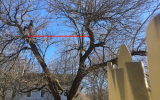
It seemed to be the best place according to standard practice. The cable is about were the red line is. Mulberry Cable.png
 
Last edited:
  • Like
Reactions: ATH
The ansi a300 says for a 18 inch diameter weighing 1200lbs you should use at least 1/2 common grade , 1/4 ehs or 1/4 aircraft. If it weighs 1400 just 200 more lbs it bumps the ehs up to the 5/16.

I'm far from an expert but if that tree is the same now as in the pic I would definitely go with the 5/16. Like reach said the dynamic forces that are applied with wind and outstanding! It has been blowing really good around here a day or two a week and seeing all the trees no matter the size getting thrown around is eye opening. Tops moving at least 5 ft in every direction. When they are full of leaves and over grown they are like sails.

Good night be well my friends
 
Yes, it's about 2/3 up the length of that side of the tree. It maybe a codominate base that has slowly separated over time. And, if I went higher it branched out too much to cable properly. The leader is half of the mulberry tree.
It seemed to be the best place according to standard practice. The cable is about were the red line is. View attachment 80098
I see. From the picture, it seems you could put the cable 3-5 feet higher than it is, but I’m not there so I can’t be certain of that.

Either way though, I would definitely use 5/16” EHS on that tree, not common grade of any sort.
 
I see. From the picture, it seems you could put the cable 3-5 feet higher than it is, but I’m not there so I can’t be certain of that.

Either way though, I would definitely use 5/16” EHS on that tree, not common grade of any sort.
I can't be there looking at all angles, and don't exactly remember to describe exactly why I put it exactly where I did.
And, the redline is about where I put it, it maybe a bit higher than shown in the photo.
I remember I put it where I concluded was best based on the 3D structure of the tree relative to it's wounds (there were many) and large branch joints, while keeping it inline and relatively level.

"Your customers deserve to hire a professional that knows the proper ways to do the work they’re paying for, and not someone who thinks he knows enough to get by."
Here, is implied that the work I do is not as a professional would have it done. And, the customers are getting jypped.
When yes, the cables I used should be stronger. Though could not a through cable you put in a tree fail because the it's not allowed to have the ability to hinge on an eye to eye, or rot occurs from the tree not sealing well enough around a cable's innate open design? Or simply trees that have being cable simply need to be reassessed at a later point?

CODIT is best case scenario, for dead wood to take care of itself. It seems, it's wishful thinking to have the idea that one of the reasons for health decline in trees is, not from accumulative dead branches/stubs in trees and tears that hold more water than if they were properly cut.
When a tree has suckers at or near the bottom of a tree and the has already been significant dead branches especially branches that are facing upwards that will not likely break off in the wind, not to go up there and properly cut the dead wood, would allow the tree to go into rapid decline, to a point of unrecoverable.
Properly cutting dead wood out of the very top of a tree is debatably the most important area to cut dead detrimental out of a tree. Because if the top of a tree dies rapid decline is much more likely than if there is a wound on the main stem. Yes, lower big branches are very important, but they're easier to access.

We know there are other reasons for rapid decline in trees, unrelated to dead wood, although helping the tree by cutting detrimental dead wood, may be just enough to help the immune system(/over use of nutrients from trying to seal over dead branches and stubs), to fight/heal the other aliments the tree is dealing with.
 
Last edited:
The ⅔ rule isn’t applied to the height of the tree

The bottom of the measurement is the point in the tree that you’re supporting

In its simplest application it is where the first two branches form at the top of a single trunk.

There is art and science involved if the tree has included bark or some defect at the first branching.
 

New threads New posts

Kask Stihl NORTHEASTERN Arborists Wesspur TreeStuff.com Teufelberger Westminster X-Rigging Teufelberger
Back
Top Bottom