
Navigation
Install the app
How to install the app on iOS
Follow along with the video below to see how to install our site as a web app on your home screen.
Note: This feature may not be available in some browsers.
More options
You are using an out of date browser. It may not display this or other websites correctly.
You should upgrade or use an alternative browser.
You should upgrade or use an alternative browser.
What forces are applied here. Please.
- Thread starter theXman
- Start date


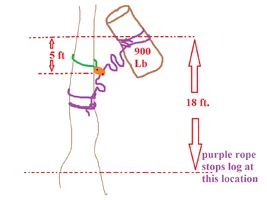
mid point of log is lifted 5 feet above block. then the line that hauled it up is cut and log free falls, to a stop when the "purple" line catches the log. The purple line is 3/4" stable braid, so I know there is some stretch, probably started catching at 15 feet. Mid point of log, start to stop is a total of 18 foot drop to mid point of log.

BigWood
Participating member
- Location
- Toronto, Canada
I've always gone with weight x drop+ weight, dynamometer showed it wasn't far off. In this case, shock load of 17100 +\-

Roger_Barnett
Participating member
- Location
- Seattle, in the PNWet
What is unknown is the energy absorption characteristics of the line, I believe the rope will be subjected to 16,200 lb of force, and the block/sling double that, if the rope is fully static, with near zero stretch.
For an arborist rigging line, say a 3/4" bull rope, which stretches at about 2% at 10% of tensile, and tensile is 20,000 lb, one would need the amount of elongation at break...which is 15-20%, I think. With that rope, the elongation during the rigging would mean the log would drop about 2-3 feet past your stop point, before coming to rest. Peak force on the line would be less, how much would need a dyno.
Given the above scenario, it is clear that an ~1.5" bull line would be needed to stay within 5/1 working load to tensile strength ratio.
For an arborist rigging line, say a 3/4" bull rope, which stretches at about 2% at 10% of tensile, and tensile is 20,000 lb, one would need the amount of elongation at break...which is 15-20%, I think. With that rope, the elongation during the rigging would mean the log would drop about 2-3 feet past your stop point, before coming to rest. Peak force on the line would be less, how much would need a dyno.
Given the above scenario, it is clear that an ~1.5" bull line would be needed to stay within 5/1 working load to tensile strength ratio.
thank you both very much. It took 5 of those drops to break the new 3/4" bull rope. It broke at the half hitch before the running bowline on the trunk anchor. Using a block and our new tool, in combination.
I wanted to know what the current belief was about the forces likely generated.
THANKS!
I wanted to know what the current belief was about the forces likely generated.
THANKS!

flyingsquirrel25
Carpal tunnel level member
- Location
- South East, PA
[ QUOTE ]
I've always gone with weight x drop+ weight, dynamometer showed it wasn't far off. In this case, shock load of 17100 +\-
[/ QUOTE ]
x2. This is always been the calculation that I use for shock load. As seen it shows the peak force that the rope could see (not including energy absorbsion/stretch). That way I can plan for the worse (not do that).
X, why not shorten the drop? Whats the advantage of the block (seems to be more components to fail)? Whats the situation?
I've always gone with weight x drop+ weight, dynamometer showed it wasn't far off. In this case, shock load of 17100 +\-
[/ QUOTE ]
x2. This is always been the calculation that I use for shock load. As seen it shows the peak force that the rope could see (not including energy absorbsion/stretch). That way I can plan for the worse (not do that).
X, why not shorten the drop? Whats the advantage of the block (seems to be more components to fail)? Whats the situation?

[ QUOTE ]
I've always gone with weight x drop+ weight, dynamometer showed it wasn't far off. In this case, shock load of 17100 +\-
[/ QUOTE ]
I agree. It is very close. At a seminar with Ed Carpenter on Rigging, he said that through investigation, the first knot or bend on a piece sees the most shock. That being said, I skip the half hitch and just go with a running Bowline. The research also showed that a cow hitch was the strongest followed by a running Bowline.
I've always gone with weight x drop+ weight, dynamometer showed it wasn't far off. In this case, shock load of 17100 +\-
[/ QUOTE ]
I agree. It is very close. At a seminar with Ed Carpenter on Rigging, he said that through investigation, the first knot or bend on a piece sees the most shock. That being said, I skip the half hitch and just go with a running Bowline. The research also showed that a cow hitch was the strongest followed by a running Bowline.


- Location
- Asheville, NC
Cre said, "I skip the half hitch and just go with a running Bowline."
Are you saying the running bowline is stronger than the half hitch? I guess I never would have thought that, plus I think having a backup is a really good idea.
Can you explain why you skip the backup half hitch?
Are you saying the running bowline is stronger than the half hitch? I guess I never would have thought that, plus I think having a backup is a really good idea.
Can you explain why you skip the backup half hitch?
- Location
- Asheville, NC
Still curious why you would skip the weaker knot, because now you've taken your backup out of the system. Even if it IS weaker (I'm slightly dubious on that, given the simplicity of the knot), removing the backup now puts ALL of the stress on the stronger(maybe) knot. Weak or strong, if the knot fails, you have a busted roof, bush, lowering device, etc.
flyingsquirrel25
Carpal tunnel level member
- Location
- South East, PA
I think the lesson to be learned here is no matter which knot is stronger or weaker. Lets not put these forces on our ropes... EVER (unless you have the 1.5"). We all know ways to reduce the force seen, lets employ them. Stay within our 5:1 safety factor (or what ever you use) and with due dilligence we wont have to worry about breaking a rope and busting things. Stay safe

Daniel
Carpal tunnel level member
- Location
- Suburban Philadelphia (Wayne)
way too much for any reasonable arb..
climber should call the suicide hotline, or change professions
climber should call the suicide hotline, or change professions
BigWood
Participating member
- Location
- Toronto, Canada
So X, some sort of mad scientist type experimentation?
Guys, this was not a job, this was not a working situation.
I'm showing two products to our industry at the TCI Expo. That's why we have been doing a lot of abuse testing.
One product is for rope rigging and is a substitute for blocks in certain situations and various sling configurations. This same product can be used with a block (makes the block retrievable and able to set it from the ground, plus puts the sling in basket form.
The one particular abuse test at the beginning of this thread, was to make sure the bull line did break at the tie, instead of up at the block and "product". Which it did.
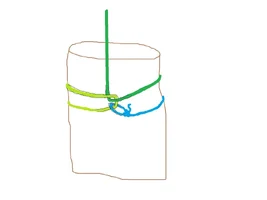
(oh, BTW, I'll have to draw my "hitch" I always tie with my running bowline. I always get marl and half hitch mixed up AND when looking at drawings of both; my tie is different then both. What I tie improves the bend radius where the running bowline chokes on the rope. On our many shock load abuse tests, if I only have the running bowline, it breaks at that point very early. If I have my "hitch" and the running bowline, it lasts much longer.)
I don't want to name the products on this thread. Don't want to get into it here.
I'll start it's own thread after the tci expo when I will have time to discuss things.
I haven't gotten much sleep in weeks. Stupid Sandy storm and trying to get everything ready for the Expo has been very exhausting.
I told tree buzz I would let them know first. So, I've finally finished up the Intro video, made just for buzzers, it won't be available to the public to view.
I'm downloading to youtube right now.
I'll start a post in the "tree free zone" for THIS video.
I'm showing two products to our industry at the TCI Expo. That's why we have been doing a lot of abuse testing.
One product is for rope rigging and is a substitute for blocks in certain situations and various sling configurations. This same product can be used with a block (makes the block retrievable and able to set it from the ground, plus puts the sling in basket form.
The one particular abuse test at the beginning of this thread, was to make sure the bull line did break at the tie, instead of up at the block and "product". Which it did.
(oh, BTW, I'll have to draw my "hitch" I always tie with my running bowline. I always get marl and half hitch mixed up AND when looking at drawings of both; my tie is different then both. What I tie improves the bend radius where the running bowline chokes on the rope. On our many shock load abuse tests, if I only have the running bowline, it breaks at that point very early. If I have my "hitch" and the running bowline, it lasts much longer.)
I don't want to name the products on this thread. Don't want to get into it here.
I'll start it's own thread after the tci expo when I will have time to discuss things.
I haven't gotten much sleep in weeks. Stupid Sandy storm and trying to get everything ready for the Expo has been very exhausting.
I told tree buzz I would let them know first. So, I've finally finished up the Intro video, made just for buzzers, it won't be available to the public to view.
I'm downloading to youtube right now.
I'll start a post in the "tree free zone" for THIS video.
flyingsquirrel25
Carpal tunnel level member
- Location
- South East, PA
X I have always known that as a marl. When taken off the end of the piece you wind up with an overhand knot in the middle of the line.

bonner1040
Branched out member
- Location
- Boston
That is a marl. The marlin has the extra turn.

Norm_Hall
New member
- Location
- Wauconda, (Chicago),IL,USA
[ QUOTE ]
this is what I tie, because it makes sense, improves that bend (in the pea green color).

Now.... What is this called, it does not match marl or half hitch pictures I have viewed in the past. (or maybe I'm wrong there).
[/ QUOTE ]
It's called a "Marline" hitch if it forms an overhand knot when taken off the wood.
http://www.google.com/search?q=marline+h...920&bih=848
It is definitely more secure than a half hitch preceeding a knot or hitch (running bowline or double clove).
this is what I tie, because it makes sense, improves that bend (in the pea green color).
Now.... What is this called, it does not match marl or half hitch pictures I have viewed in the past. (or maybe I'm wrong there).
[/ QUOTE ]
It's called a "Marline" hitch if it forms an overhand knot when taken off the wood.
http://www.google.com/search?q=marline+h...920&bih=848
It is definitely more secure than a half hitch preceeding a knot or hitch (running bowline or double clove).

Why not just terminate with a timber hitch Norm?
jomoco
jomoco
New threads New posts
-
test
-
-

-

-
What's on your mind? TCI Magazine wants to know
- Started by Tree Care Industry Assoc.
- Replies: 24
-
 Apr 09 (Free CEUs) & May 07 - 'Urban Forestry Today' Webcasts @ Noon (Eastern)
- Started by UFT
- Replies: 0
-


