









What’s your favourite lanyard set up

Even when not cutting? Why?

I guess what the thought was by the person who made the video was when you’re repositioning you will always ensure two tie in’s if you have three. Whereas with just a climbing line and lanyard there’s times where you may only be tied in once if resetting.

I’ve always climbed with just a lanyard and climbing line like most but recently after watching that video I started experimenting with the triple tie in for certain situations just to see how it felt.

I will say in some situations it actually allows for better work positioning. Whether you are using two lanyards and a climbing line or two climbing lines and a lanyard.

And I don’t know about anyone else here but I always feel more secure with being tied in twice. Especially if at any kind of height on a spar.

Depending on the situation obviously sometimes you may just be tied in with your line.

I’ve started climbing with two lanyards, and I’ve found it very helpful. Came in hand multiple times during a pruning job today on some large oaks.
 
... And I don’t know about anyone else here but I always feel more secure with being tied in twice...

Does it bother you to hang in mid air from your climbing line? Our systems are designed so we can position off a single line as needed. Two points of attachment are required at work stations, but are optional for getting there.
 
Does it bother you to hang in mid air from your climbing line? Our systems are designed so we can position off a single line as needed. Two points of attachment are required at work stations, but are optional for getting there.

No.

I’m not saying using three points of attachment when moving around the tree or into position. I’ll ascend or descend or limb walk, etc, move around, hang in mid air etc. on just my line. More so for most comfortable work positioning, etc. or if stationary for any length of time I prefer to throw my lanyard around the tree.

In regards to the three tie in points, so talking about positioning yourself in the most secure and comfortable place for performing actual work. I can see benefit of second lanyard or second climbing line. I know a climber in addition to his regular climb line he has like 20 ft or something of line that he takes up with him and he can use it as a climbing line or a lanyard plus his regular lanyard.

I’ve also found two lanyards helpful when ascending up a tree. Like an oak for example where there’s so many suckers it can be hard to get a high tie in point from ground and you have to advance line as you go, as you are re positioning climbing line you can tie in twice with two lanyards, more security and more comfortable positioning.

That’s just my opinion. Did this yesterday on a job.

Think about what situations it might come in handy and try it out on a job.
 
No.

I’m not saying using three points of attachment when moving around the tree or into position. I’ll ascend or descend or limb walk, etc, move around, hang in mid air etc. on just my line. More so for most comfortable work positioning, etc. or if stationary for any length of time I prefer to throw my lanyard around the tree.

In regards to the three tie in points, so talking about positioning yourself in the most secure and comfortable place for performing actual work. I can see benefit of second lanyard or second climbing line. I know a climber in addition to his regular climb line he has like 20 ft or something of line that he takes up with him and he can use it as a climbing line or a lanyard plus his regular lanyard.

I’ve also found two lanyards helpful when ascending up a tree. Like an oak for example where there’s so many suckers it can be hard to get a high tie in point from ground and you have to advance line as you go, as you are re positioning climbing line you can tie in twice with two lanyards, more security and more comfortable positioning.

That’s just my opinion. Did this yesterday on a job.

Think about what situations it might come in handy and try it out on a job.

I don't see anything wrong with this practice.. Can it turn into a cluster fuck, Yes. Is it added weight, Yes. Could you use your climbing line tail, Yes. However, there are pros & cons to each & every technique you roll with.

For example, a few posts back, you saw a DEDA, it looks like a good way to get three points if you want it, but you give up the luxury of a self advancing system by using those particular pulleys.. I'm not not knocking the system at all, in fact i use it regularly, its just a small caveat I've experienced when there's no secondary attachment on pulley/tender. (Btw, JCJC7 , i think you'll like that Sterling thimble, i find they don't bind up as hard as the typical pre sewn dmm thimble loops. I think it's because they make the shrink wrap so long, it doesn't allow the coils to compress together. I kno sounds bat shit.. All i know is my CE lanyard binds hard & neither of my two Sterling thimbles do. Very easy to move up or down line after loading, no fiddling or loosening needed.
 
I see how it could appear off putting at first glance especially if you’re used to climbing with 1 or 2 but for certain situations I think it could have some benefit.

Not saying it’s necessary or that it’s better than 2. Personal preference. Depends what you’re doing.

I’ve only just started experimenting with it on two jobs so far. Before I’ve just always used a line and a lanyard.
 
I used to climb with a DEDA lanyard I worked up. Used it for a few years, and I always felt like it was there for me when I needed it, and bailed me out of a lot of tricky spots.

Then one day it occurred to me that the use of a DEDA lanyard and/or having more than two tie-ins seems to be more of an exception than the rule, so I ditched it to try something more standard. Almost overnight, I became a better climber. I stopped using the extra system as a crutch, and started more quickly working through situations that I would've used it in by simply finding a better position.

On spar work, the only real benefit I'm seeing is the added friction you'd have against the twisting of your hips, helping hold you in place against chainsaw cutting forces, etc. To combat this in a less cluster-cussy way, I personally tie a prussic on one side of my flipline and drop a biner in the loop and clip it to the other side. Effectively chokes the lanyard to the spar, and if I gaff out, it holds me there, rather than letting my face slide down until my lifeline kicks in. Might be worth trying!

Lately, I'm in the habit of climbing SRT on a line with a splice on one end, and keeping a Zigzag stowed on that end as my free end/tail. Today while doing a widespread cabling job on a tri-dom Maple, I used it as a get-me-back-over-there-quick system to aid traversing quickly. If I don't need it...it's just my tail. If I want it, it's available. Might be another option to look into.
 
I like a 30 foot long 9/16 lanyard with hitch climber pulley on each end. It lends itself to 3 tie in points. Some times I get so used to 3 I feel naked going back to 2. I do want to try a bag or something for the slack sometime. One end has a steel carabiner the other aluminum.
 
I’ve climbed with the standard climbing line and 1 lanyard since I first started climbing like most.

This is only something I started experimenting with because I saw the video and was intrigued how it worked.
 
I can understand using extra attachments in a large, wide tree to get around without lots of muscling around. A spar work position just doesn't call to me begging for more security or comfort. Also, increasing attachments will increase your difficulty in getting down in an emergency or rescue.
Its cool if you like it! I would be asking questions tho if I saw it on my job site...
 
It all reminds me of a story. Imagine that.

In 2002 I was climbing with Knute Foppe. We were ascending a 250’ Sitka Spruce on The Olympic peninsula. A rec climb. The pace was what it was. Knute would constantly use his lanyard, even when, in my mind, it was not necessary. Eventually I asked the obvious question, “Knute, what is with using your lanyard so much?”

“Why not.” Was the answer in a heavy German accent.

In this work, I have learned that sometimes we just do things because we can. It makes us feel good. So, we do it. No explination, no basis in past situation or fact. I have learned to call these things “feel good things.” I know, stupid, obvious and prime for a few good jokes.

The reality is we will most likely never know if these “feel good things” help or hinder. Just as we will never expereince the incident averted, the price not paid. Safe action like most unsafe actions leads to...nothing. The dichotomy of being a safety trainer.

I am not advocating overkill, three points of tie-in or any other ungodly redundancy we could dream up. I am acknowledging a maturity in this line of work that allows for individuality, experience and well... just doing something regardless of need for added security even if illusionary or overly redundant in the moment.

Why you ask?

Why not.

Tony
 
Last edited:
I can understand using extra attachments in a large, wide tree to get around without lots of muscling around. A spar work position just doesn't call to me begging for more security or comfort. Also, increasing attachments will increase your difficulty in getting down in an emergency or rescue.
Its cool if you like it! I would be asking questions tho if I saw it on my job site...

Can agree, I have sometimes seen super redundancy in some crews, especially municipal or corporate tree works. However when trained from scratch or done over many years in conjunction with extreme safety propaganda they think that’s how it should always be done and the skill set is diminished.

I have also seen government contracting agents under pressure to deliver send safety inspectors afield, and contract out to crews that violate many of the red tape rules generally enforced so that they can deliver on time on budget. This is not to say that the new contractor was unsafe, but certainly visibly impacting to the safety police perspective seen around a lot nowadays. In the box thinking won’t get the job done in some cases...

I have also worked in teams that you had to have a good reason to use more than one lanyard when spurring up a spar, even without a lifeline due to it slowing production - which I believe is a step too far.
 
Last edited:
Great point! I think as climbers we all have different psychological responses to being in dangerous or risky situations and perceive things differently so whatever you got to do to make yourself comfortable. I rather see someone be cautious and safe than trying to prove themselves or something and do something that makes them feel unsafe. Because then that’s gonna affect their work which ultimately could put their safety and the safety of their crew at risk
 
For the last two months I’ve been working with a company that issues gear from an “approved” list. The positioner is not approved, so I tried a grillon. It’s okay...but I was stoked to use my positioner today on a personal climb. Soooo smooth!
 
For the last two months I’ve been working with a company that issues gear from an “approved” list. The positioner is not approved, so I tried a grillon. It’s okay...but I was stoked to use my positioner today on a personal climb. Soooo smooth!
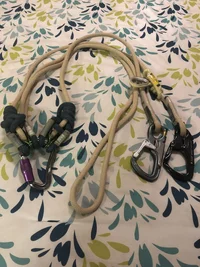
What is the Grillon like? Do you feel you'll get used to it & like it better? I have always wanted to try one but at the same time never really liked the belay style devices that require the tail to come out & over the side..I borrowed a buddies Mad Rock Safeguard thinking it would be similar but I'm still not enthused with it..

I do know i like the function of my Zillon better than anything out there, but prefer the versatility of my CE with the Becket. I'd love to try Gordons Lanyard adjuster, seems to cover all those bases but can't say if it tends the same, as those two above have nice round sheaves for that.
 
Gordon’s is a good device, though it doesn’t allow slack to be tended as effortlessly as the positioner.

The grillon is not my favorite. It’s a little clunky, and the release portion can be engaged by the TM lower d’s. Also, it also has more friction when pulling out slack. If you like thinner lanyards, I’d say the isc rad is a better option, or the camp dryad. However, the positioner is compact, light, smooth, intuitive, beautiful, smart, great sense of humor...wait, sorry.
 

New threads New posts

Kask Stihl NORTHEASTERN Arborists Wesspur TreeStuff.com Teufelberger Westminster X-Rigging Teufelberger
Back
Top Bottom












