Wedgin' n jackin'

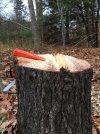
Lots of good info on here. Glad to come across this. I did a small job clearing about 30 dead ash from a lot a few weeks ago. Lots of smaller ones that would be tricky to wedge over but setting a line for each one would be slow going. We got the ol' felling bar out and would set that in after making the backcut. I wouldn't do this for a big leaner but for the little guys it worked like a charm.
 
For small trees, do you cut one side of the back cut, set the wedge tightly, then cut the other side, and insert another wedge?

How much lift does a bar give, angularly speaking?
 
For small trees, do you cut one side of the back cut, set the wedge tightly, then cut the other side, and insert another wedge?

How much lift does a bar give, angularly speaking?

Sorry if I'm misunderstanding the question. The bar won't max out like a wedge, but I guess it would kick out past a certain angle which would depend on the depth of your felling bar head, depth of the backcut and location of your hinge on the stump. I really only use mine on smaller trees (10" or less).
 
Sorry if I'm misunderstanding the question. The bar won't max out like a wedge, but I guess it would kick out past a certain angle which would depend on the depth of your felling bar head, depth of the backcut and location of your hinge on the stump. I really only use mine on smaller trees (10" or less).
I like the idea of a felling bar for that application. Dead small trees, can't fit much wedge and prefer to not bore out face leaving dead strap wood. Haven't had it happen, but heard that aggressively pounding wedges on dead trees can snap the hinge.
 
I cut those close to the ground and push at shoulder height, mostly. Especially with a more centered hinge.


You start to lose leverage as you lift, I think, but the resistance of the tree is less as it tips.
 
I like the idea of a felling bar for that application. Dead small trees, can't fit much wedge and prefer to not bore out face leaving dead strap wood. Haven't had it happen, but heard that aggressively pounding wedges on dead trees can snap the hinge.
Or the top
 
I like the idea of a felling bar for that application. Dead small trees, can't fit much wedge and prefer to not bore out face leaving dead strap wood. Haven't had it happen, but heard that aggressively pounding wedges on dead trees can snap the hinge.

Finesse with a felling bar, finesse with wedges, finesse with a throwline, finesse with a chainsaw.
 
For small trees, do you cut one side of the back cut, set the wedge tightly, then cut the other side, and insert another wedge?

How much lift does a bar give, angularly speaking?
Generally I just do a straight back cut and place a wedge. Make my face and tickle the hinge through the face as needed, pound as needed. When I need more lift, I’ll use two wedges parallel to the hinge from opposite sides.
We are talking fairly damn small diameter trees. For trees thicker than 3 bar widths I will sometimes use a letter box borecut place wedge hard, make face, then a backcut on either side of the wedge.
 
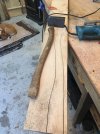
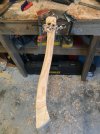
The new one looks like ash

My hammer drawer has a couple residents made from shortened old handles. New life for the old wood and second or third life for some unique hammers, axes and hatchets

Your work looks great! Good bench time for winter
 
I skipped from page 2 to page 6, so I may have missed some discussion about this. Obviously there are times where using wedges is the quickest, easiest route to go. For me, almost any time I have a leaner that needs to go against the lean I use a pull line. It's so much less work, and seems to me to be a lot more certain than pounding wedges for half an hour. Other than trees that have only a small back lean, when do you use wedges vs a pull line?
 
Good topic

Tim Ard showed an expanded version of the back cut wedge.

His method is to bore cut several slots on the back side towards the face side...seperate them about an inch or so. Insert wedges in each slot and pound them in. Each wedge adds a little lift and stretches the wood on the backlean side. make the face and keep tapping the back wedges in to lift. It was an impressive tip on a tree that would have needed a lot of pull
I love this one. Been using it for several years. It’s nice to have equal length wedges for this. The striking faces line up nicely as you tap each one more and more. You can gauge which ones need another whack or two.

Species dependent…the greater the lean and the softer the wood, I like a bit more than an inch for the xylem to remain in tact.
 
I’ll use a very similar method on crane picks with my LMI, I love seeing the number drop as the kerf opens.
That an an old school method that is very similar to using tree jacks. Generally you will start your back-cut first and cut a fair ways in. You then create the notch for your jacks and start loading up the jacks with some pressure. Then you put your undercut in while watching the gauges on your jacks to see if you got it or not. If your PSI goes down you know you are already moving it, and if they go up you know you've still got some serious work to do. Head on back to the back-cut and you start working your hinge, jacks and wedges until you got it.
 
I love this one. Been using it for several years. It’s nice to have equal length wedges for this. The striking faces line up nicely as you tap each one more and more. You can gauge which ones need another whack or two.

Species dependent…the greater the lean and the softer the wood, I like a bit more than an inch for the xylem to remain in tact.
33DC6C1B-3B60-4A43-A9ED-4B57061CB1C2.jpeg

Such a good technique and wedges can’t spit out, pic is couple years old. First read/saw it from @flyingsquirrel25
 
Here's a problem I never solved...must be a solution.

I would buy a stack of basic wedges in various lengths. Sometimes the solution was to stack one on top of another. No space to cross them. Some wedges have slots that correspond to rails on the other side to keep them aligned. Others have a coarse surface molded in. Too often stacked wedges would spit out...scary!

Solutions???
Was just youtubin’ on double stacks. Billy ray has one (
) where he uses this technique:
Pound single in about half way, put double in 2-4” to side of single. Alternate between pounding double(top then bottom etc) then the single.

I was taught to bury 1-3 singles then drive a double, if it spits then you’ve got a fall back. They’d regularly spit out even with dirt/saw dust. Any more accomplished wedgers use his technique?
 
Nothing fancy here but, once removed a smaller tree that had a heavy lean right next to and right over the house and roof. Not a lot of room to work either as it was right on the edge of the woods line with a hill so we weren’t able to just go straight back we had to do it at an angle. This was a few years ago so I don’t remember the details one hundred percent but it went something like:

We secured a line in it and then used a come-along with a prusik style setup to connect the cable to the rigging line...come-along secured to another tree to pull. Made a notch, went in a little with the back cut, and then pulled with the come-along. Tie off the rigging line on a porta wrap when out of cable length for come-along and advance up the rigging line to next cable position with prusik.

Obviously you could also just use a rope jack. Think someone else mentioned that. But if you don’t have one, come-along can come in handy.

Don’t remember if we used ant wedges. But we pulled the tree whole away from the house and got on the ground whole safely.
 

New threads New posts

Kask Stihl NORTHEASTERN Arborists Wesspur TreeStuff.com Teufelberger Westminster X-Rigging Teufelberger
Back
Top Bottom