Vertical Speed Line Methods

Good video Jamin I will stash that in my bag of tricks always looking for new and efficient rigging methods. Very cool. Paul.
 
Compliments on the tip about the 'un-cleated' and 'un-tended' porty to minimize shock to the system. Had not seen that before, gonna use that ... Great Idea! Very professional vid, indeed!
 
[ QUOTE ]
An option would be to have a biner or pulley redirect to a portawrap out of harm's way. Nice video and editing quality.

[/ QUOTE ]

That is how I rigged a VSL most of the time. Instead of using a pulley which could get banged up by chunks I used doubled steel biners. Most of the time the rope was kept snug but sometimes it needed to slack off.

Being able to control the slack is important if long pieces of wood or branches are coming down. Most of the time they are tip heavy. When they hit the ground they can 'pole vault' the wrong way. A good roper can 'let fly the rigging' at the right time and let the load fall dead. Or...keep tension and let the load stand vertical. then go in, manhandle to load and lay it down where you need it.

I used a VSL way more than a horizontal. Doing excurrent pruning/removal is where they shine! Clip a bunch of cuts together with slings and send 'bouquets' or 'chandeliers' down en-masse. The butts are already lined up for dragging too.

Lots of little tricks to add!

Nice vid!
 
[ QUOTE ]
An option would be to have a biner or pulley redirect to a portawrap out of harm's way. Nice video and editing quality.

[/ QUOTE ]

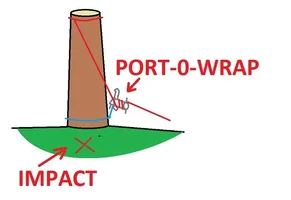
True. It is difficult to see, but what I do (for that possibility) is offset the placement the port-o-wrap and the rigging line. If one could visualize it; this makes the rope spiral down a little. Hence, the port-o-wrap is about 90° from impact.

One may think my illustration is counter intuitive, but in all practicality it works well.

301765-VerticalSpeedLine.jpg
 

Attachments

  • 301765-VerticalSpeedLine.webp
    301765-VerticalSpeedLine.webp
    17 KB · Views: 31
[ QUOTE ]
Jamin .. Is that Jesse!!

Cool Vid , that's the way we take down our palms in open areas

Later in SO-CAL

[/ QUOTE ]

You got it Javi. Tree Buzz's one and only Jesse Huffman! A good guy to work with.
 
[ QUOTE ]
I've used a friction device up top so that when the load gets to the bottom it can be tipped or walked out...

[/ QUOTE ]

It like that idea as well Tom.

[ QUOTE ]
I like your spiral setup. Clever!

[/ QUOTE ]

Thanks.
 
been using a vertical speedline for years. i didnt know that it what called that. instead of a 8 or Porty i have been using a prussik at the base. the cut pieces get a sling and a quick link.

i dont like the risk of metal hitting metal like a crab slapping my porty
bigeyes.gif
 
[ QUOTE ]


i dont like the risk of metal hitting metal like a crab slapping my porty
bigeyes.gif


[/ QUOTE ]


We set a bindind-strap (or similar) trapping the line just above the lowering device each time, to stop the connector hitting the LD (in the video Casey posted). We opt for the lowering device because its so easy to set up each time and apply tension, which might be important in a tight drop-zone....but you can also get good tension by simply setting a half hitch a at the base and then walking it back aginst the bite....and it generally holds just fine on impact. We use a clevis as the sling connector rather than a Krab.
 
What are the advantages of the VSL compared to roping the piece down, letting it fly down then applying tension as the piece hits or is about to hit?
 
[ QUOTE ]
What are the advantages of the VSL compared to roping the piece down, letting it fly down then applying tension as the piece hits or is about to hit?

[/ QUOTE ]

Faster set-up each time, less loading on the tree and equipment involved, very little skill or judgement needed on the groundworkers part.
 
Thanks for sharing, great job on the rigging and putting together the video. I have been rigging a lot of dead trees out recently and that will be a great tool to use. Thanks
 
[ QUOTE ]
... instead of a 8 or Porty i have been using a prussik at the base...i dont like the risk of metal hitting metal like a crab slapping my porty
bigeyes.gif


[/ QUOTE ]

Interesting!
icon14.gif
 
[ QUOTE ]
[ QUOTE ]


i dont like the risk of metal hitting metal like a crab slapping my porty
bigeyes.gif


[/ QUOTE ]


We set a bindind-strap (or similar) trapping the line just above the lowering device each time, to stop the connector hitting the LD (in the video Casey posted). We opt for the lowering device because its so easy to set up each time and apply tension, which might be important in a tight drop-zone....but you can also get good tension by simply setting a half hitch a at the base and then walking it back aginst the bite....and it generally holds just fine on impact. We use a clevis as the sling connector rather than a Krab.

[/ QUOTE ]

And that video Reg shows has a really tight drop zone. So, he did what was necessary. I, on the other hand, had a pretty large drop zone. Hence, the uncleated port-o-wrap.

And thanks for the added ideas fellas!
icon10.gif
icon14.gif
 

New threads New posts

Back
Top Bottom