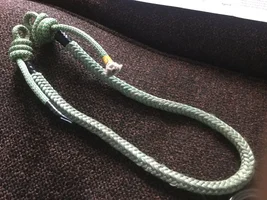
Vectran core, ice tail cover

Many years ago I did some fiber testing cycling under load using Tooldip thinned with trichloroethane on spectra, vectran and kevlar. Anecdotally we didn't see any sudden unexpected failures on the impregnated fibres. I think Tooltip was urethane. Someone has posted common rope fiber types chemical resistance in rope cleaning threads quite a while ago. I believe it was in the context of rope contamination (e.g. fuel spill etc) and nasty sap cleaning. Makes me think of "Samthane". edit for Joey, I think Tooldip also came in clear color.

edit autocorrect said tooltip , brand was Tooldip
 
Last edited:
I’d go with Dyneema!
-AJ
Had always thought length-of-rope in system made dyneema especially dangerous for these cases? (ie cases where dynamic-loading - fall-arrest, here - and short rope-length are both prime factors)

I get that dyneema > nylon for static strength, but nylon hitch cord is plenty strong for all the non-dynamic-usage you're gonna give it....and it's got some cushion/capability if subjected to shock-loading ie you falling, I don't get the logic of "give-up the raw dynamic-strength of nylon, to increase static-strength of a product that already had insanely high static-strength"..

Just curious! Almost every hitch I own is Ice Tail eye&eyes or knotted loops, though if/when I find a comparable hitch made of something more dynamic I'll be swapping (would love if they just did an aramid/nylon blend for moderate heat-resist & high-dynamic strength, just in finding this thread I realize that, unlike my old Epicord//Blue Moon combo, now my hitch is my weak-point in my Ice Tail//Mercury combo -- even though Ice Tail//Mercury are both 8.5k lines, the 3.5% v 1.05% elasticities makes a *massive* difference in effective dynamic-capacity)

(PS- and I know "these are way stronger than your body anyways", and when new and used optimally that's true, but goal should be optimization and, once a hitch-cordage is 5k+ ABS tensile, IMO a better attribute is dynamic-capacity not increased-static-strength AKA swapping from a poly/nylon blend to a dyneema product)

 
Had always thought length-of-rope in system made dyneema especially dangerous for these cases? (ie cases where dynamic-loading - fall-arrest, here - and short rope-length are both prime factors)

I get that dyneema > nylon for static strength, but nylon hitch cord is plenty strong for all the non-dynamic-usage you're gonna give it....and it's got some cushion/capability if subjected to shock-loading ie you falling, I don't get the logic of "give-up the raw dynamic-strength of nylon, to increase static-strength of a product that already had insanely high static-strength"..

Just curious! Almost every hitch I own is Ice Tail eye&eyes or knotted loops, though if/when I find a comparable hitch made of something more dynamic I'll be swapping (would love if they just did an aramid/nylon blend for moderate heat-resist & high-dynamic strength, just in finding this thread I realize that, unlike my old Epicord//Blue Moon combo, now my hitch is my weak-point in my Ice Tail//Mercury combo -- even though Ice Tail//Mercury are both 8.5k lines, the 3.5% v 1.05% elasticities makes a *massive* difference in effective dynamic-capacity)

(PS- and I know "these are way stronger than your body anyways", and when new and used optimally that's true, but goal should be optimization and, once a hitch-cordage is 5k+ ABS tensile, IMO a better attribute is dynamic-capacity not increased-static-strength AKA swapping from a poly/nylon blend to a dyneema product)

A couple of things...

In accidental dynamic loading scenarios the hitch slips which means braided Dyneema cores are fine.

Since load is shared between the two legs of the hitch you're never ever going to break a Dyneema braided core, you'll break sooner.
-AJ
 
Had always thought length-of-rope in system made dyneema especially dangerous for these cases? (ie cases where dynamic-loading - fall-arrest, here - and short rope-length are both prime factors)

I get that dyneema > nylon for static strength, but nylon hitch cord is plenty strong for all the non-dynamic-usage you're gonna give it....and it's got some cushion/capability if subjected to shock-loading ie you falling, I don't get the logic of "give-up the raw dynamic-strength of nylon, to increase static-strength of a product that already had insanely high static-strength"..

Just curious! Almost every hitch I own is Ice Tail eye&eyes or knotted loops, though if/when I find a comparable hitch made of something more dynamic I'll be swapping (would love if they just did an aramid/nylon blend for moderate heat-resist & high-dynamic strength, just in finding this thread I realize that, unlike my old Epicord//Blue Moon combo, now my hitch is my weak-point in my Ice Tail//Mercury combo -- even though Ice Tail//Mercury are both 8.5k lines, the 3.5% v 1.05% elasticities makes a *massive* difference in effective dynamic-capacity)

(PS- and I know "these are way stronger than your body anyways", and when new and used optimally that's true, but goal should be optimization and, once a hitch-cordage is 5k+ ABS tensile, IMO a better attribute is dynamic-capacity not increased-static-strength AKA swapping from a poly/nylon blend to a dyneema product)

Less stretchy hitch cords tie more reliable hitches. A bunch of stretch lets them bind.
It's also true of a tighter braid. I hate how finicky ice tail got for me back when I used it (because it was so strong and heat resistant!)
We're not relying on the hitch to be a shock absorber. The tree and rope will handle that for us. I know hitches slide under extreme load, but how does the rope wrench interfere with that? I just don't expect it.
 
Less stretchy hitch cords tie more reliable hitches. A bunch of stretch lets them bind.
It's also true of a tighter braid. I hate how finicky ice tail got for me back when I used it (because it was so strong and heat resistant!)
We're not relying on the hitch to be a shock absorber. The tree and rope will handle that for us. I know hitches slide under extreme load, but how does the rope wrench interfere with that? I just don't expect it.

Good point that the hitch is not where we're looking for dynamic give. It's worth going back to basic principles: for good hitch functionality we want it overall less diameter than the climbing line and we want the cover of the hitch there for abrasion/heat resistance. That doesn't leave much room for a poly or nylon core to be big enough diameter to meet life support strength requirements. A Dyneema core solves the problem: small enough diameter, sufficient strength, and supple enough for hitch functionality.

I could never get Ice Tail to funtion well for me, always seemed to grab too hard, probably never got the hitch/length combo right. I didn't persist because I don't like how easy it picks.
-AJ
 
Last edited:
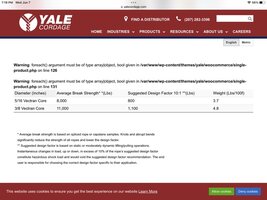
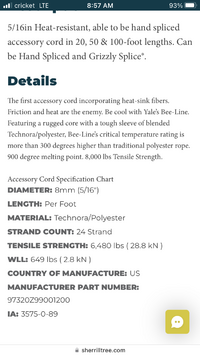
I couldn’t find a topic on Bee Line. Can somebody tell me the MBS tensile strength of the 8mm? I have a catalog that says 8000, and so did the girl when I called. But then I went on the I internet and saw it around 6400, which is what they alway said it was years ago. I called back and this time a girl said “I would go with the lower one”.
 
I couldn’t find a topic on Bee Line. Can somebody tell me the MBS tensile strength of the 8mm? I have a catalog that says 8000, and so did the girl when I called. But then I went on the I internet and saw it around 6400, which is what they alway said it was years ago. I called back and this time a girl said “I would go with the lower one”.
It’s quite possible that the lower numbers are accounting for a naked eye splice and about 80% of tensile, due to the locked brummels.
 
Aren't there about 5 variations of beeline? Used to know a few different constructions, years ago.
 
The 10mm Beeline originally came with a 50/50% of technora and polyester cover, and had troubles with the cover separating, exposing the core, I had a lump developed in the core once. They then made it with the 75/25% of the 8mm. Other than different colors, those are the only ones I know of.
 
  • Like
Reactions: evo
Probably just an error in editing. You can find such errors in just about any catalog or online site for arborist gear. I have sent emails to WesSpur, and Sherrilltree about error I have found, and have gotten emails back saying thank you, error has been corrected, several times. As an example, I just went to WesSpur and found this
WLL (5:1) / (10:1):6,600 lb / 3,000 kg
on one of their rigging block ads. 3,000 kg is the same thing as 6,600 lb. The 3,000 kg should have been 3,300 lb.

My question was more about what are your concerns with the difference between 6K and 8K MBS? Are you using the cordage for something that is going to approach those figures?
 
Last edited:
Brocky, you getting grey hair syndrome like me? Found some guy :) who said this about beeline:

The gold/black in 10mm has a polyester core that can be dbl braid spliced but the cover is too loosely braided and there have been problems of the core popping out of the cover. Your friend's cord is probably the 8mm which has a vectran core and is class II spliced.


You're shaking my confidence, dude!

I'm probably also thinking about the different dyed versions too.
 
Forgot they also changed the core on the 10mm, don’t care what color they are as long as they decide to stick around.
 

New threads New posts

Kask Stihl NORTHEASTERN Arborists Wesspur TreeStuff.com Teufelberger Westminster X-Rigging Teufelberger
Back
Top Bottom