Using Native Plants

Having missed Robert Wells’ 2009 TCI Expo biodiversity presentation, I was delighted to read “The Biodiversity Movement and Modern Arboriculture” article in the November 2010 TCI magazine. I have made an effort to use native plants in my own yard, and I am extremely pleased with the results. After planting beautyberry, winterberry, waxmyrtle, serviceberry, purple coneflowers, sweetspire, yaupon, inkberry, etc…, I have observed a significant increase in insect, bird, and bat visitors to my own landscape.

I also use photographs of these beautiful natives to encourage our clients to incorporate these plants into their landscapes. Customer reaction has been remarkably positive so far, although I suspect everyone will not be happy with deciduous “shrubs” in their front yard.

In the article, the author mentions, Bringing Nature Home, by Doug Tallamy. I highly recommend this book for anyone interested in learning more about the importance of planting natives in our individual gardens.

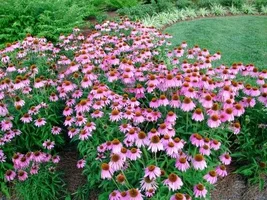
The attached photo shows that natives can help create an attractive landscape. Beautyberry can be seen in the upper left of the photo. I’m taking suggestions for a substitute for the liriope.

Who else is using a proactive approach to encourage native plantings? And what type of customer response are you receiving?
 

Attachments

  • 250399-Purpleconeflowers.webp
    250399-Purpleconeflowers.webp
    78.6 KB · Views: 110
I look forward to reading that article...haven't been home to get the magazine (if it has arrived yet). Although I don't own a home (college kid) I can't wait to have my own property someday and that's all I plan on planting is native plants. I also have other ideas with the apple trees I will have.
 
There was a great article in American Nurseryman on xeriscaping and using natives in the last couple of months. I'm not hung up on the native part but low maintenance and irrigation are prime. Beautyberry pops up everywhere around here and we love it. Even have a couple of variegated varieties.
 
Planting beneficial associates is about the best thing we can do for trees. I'm not sure what "native" means--I use well-adapted plants amap.

Robert's talk, at Expo was delivered very well--he did not hide his feelings.

the Nov issue was interesting--all 5 feature articles written by folks from the field instead of from academia or freelance journalists.
 
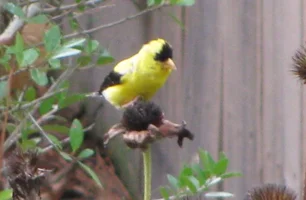
Attached is a picture of an American goldfinch enjoying thistle from a purple coneflower.

"A native can be defined as any plant that grew historically in North America before the European incursion." TCI mag. Nov. 2010. p. 13. Of course the author is referring to North American plants growing in their natural ranges before the Europeans introduced alien plants.

Alien plant species can be well-adapted to the local climate and soil conditions, yet be virtually useless as a food source for native insects.

Guy, I assume you use "beneficial associates" in lieu of "native" for a reason. Would you elaborate?

[ QUOTE ]
I'm not hung up on the native part but low maintenance and irrigation are prime.

[/ QUOTE ]
Treeco, so... low maintenance and adaptation to local rainfall averages are important, but providing food for local insect populations is less important? Why? I'm curious.
 

Attachments

  • 250439-GoldfinchFeeding.webp
    250439-GoldfinchFeeding.webp
    116.2 KB · Views: 72
I just read the article. Good stuff. Many of these ideas are cornerstones of our company. We promote natives as much as humanly possible. I think one of our biggest issues is client education. Many homeowners have preexisting ideas about the look and the plant material they want on their property. Convincing people to forego their lawn in favor of larger mulch rings and native beds isnt easy. So far we have had many converts but these people have also sought us out due to our being ecologically minded in the first place. I wish he had spent some time discussing the soil food web and how it applies to our suburban environment.
 
[ QUOTE ]

"A native can be defined as any plant that grew historically in North America before the European incursion." TCI mag. Nov. 2010. p. 13. Of course the author is referring to North American plants growing in their natural ranges before the Europeans introduced alien plants.

[/ QUOTE ]Which incursion? The Vikings? Columbus? The Irish after the potato famine? With all the pests coming from China these days, maybe that's the incursion to focus on. Either way it is an arbitrary snapshot in time, with more sociocultural impact than biological impact[ QUOTE ]


Alien plant species can be well-adapted to the local climate and soil conditions, yet be virtually useless as a food source for native insects.
Guy, I assume you use "beneficial associates" in lieu of "native" for a reason. Would you elaborate?


[/ QUOTE ] It's not their past origin, but their present function that matter. Some nonnatives are introduced and feed the birds and bees quite nicely, and behave themselves.

I propagate and plant natives, and prefer them, but when there are none to fill a niche and a nonnative can, would you leave that niche unfilled?
confused.gif


this from the asca newsletter:

ASCA INVASIVES
Agents of a homeowner’s association (HA) entered a resident’s property without notification and removed an autumn-olive hedge, Elaeagnus sp., claiming that it looked messy and was “invasive”. I was asked to appraise these plants after they had been removed, stumps and all. I agreed to inspect photographs of these plants to assess their size and condition, and visit the site to assess their contributions. The hedge was about twelve feet high and at least as wide, running parallel to the road. It was just high enough to screen the screen the clients’ view of the right-of way.

Dirr reports that “Most (Eleagnus species) form nitrogen-fixing root nodules which assures their survival in inhospitable soils. The Eleagnus species offer good foliage color, fragrant flowers and silvery to red fruits…adaptable to varied soils and withstands considerable drought…good for banks, hedges, screens, natural barriers…” Its form and habit resembled Eleagnus umbellata, which was on the town’s invasive list. However, when I inspected nearby urban and wild areas and parks, I did not find one single volunteer.
Based on my appraisal, and lacking any evidence to support their “invasive” claim, the HA offered my clients $10,000 to settle. They refused and went to court, to extract a confession. The judge did not question the plants’ noninvasiveness, but summarily dismissed the case on a technicality. This case showed me a couple of things:
1. Vengeance is not always a good policy. In fact, it’s dumb.
2. Before we call a plant “invasive”, we should look closely at the plant, the region, and future trends.
Dr. Peter White, my old boss at the UNC Botanic Garden and an expert on invasives, recommended focusing our efforts on stopping at the source those species that are proven to be bad actors, and tolerating those exotic plants that can naturalize without major disruption. Many towns’ lists of “unapproved” plants are almost as long as their lists of “approved” plants. The goal of avoiding invasion must be balanced with the higher goal of diversity. The attempt to reestablish an urban forest with native species overlooks the changes in the site that have produced very nonnative conditions.

Native tree lists do engender sentimental feelings, but they are often little more than snapshots in time.
Agencies and consulting arborists must adapt to natural selection and to climate change, by expanding their lists of trees that they can work with. We don’t want a world covered in kudzu, but we also don’t want a world without the beauty and functionality of naturalized plants."

So yes plant thistles for goldfinches, but please don't tell me I should find a native substitute for liriope when there ain't any. Or better yet, show me one!
 
[ QUOTE ]
Which incursion? The Vikings? Columbus? The Irish after the potato famine? With all the pests coming from China these days, maybe that's the incursion to focus on.

[/ QUOTE ]
Guy, this thread stems from the biological consequences of the Columbian exchange. I would say the voyage of Christopher Columbus is arguably the most important event in the history of the world over the last millennium. It was a fundamental turning point with enormous consequences for the Americas and the Old World. The Vikings had minimal impact on North America relative to occurrences after 1492. Pests from Asia are the continuation of the Columbian exchange, a biological exchange that is still being played out today.


[ QUOTE ]
Either way it is an arbitrary snapshot in time, with more sociocultural impact than biological impact

[/ QUOTE ]
Okay, but that doesn't diminish the significance of the biological impact.


[ QUOTE ]
It's not their past origin, but their present function that matter.

[/ QUOTE ]
Well, their past origin is important and does matter. It takes long evolutionary time periods rather than short ecological periods for insects to adapt to specific plants. Yes, there are alien plants that can host some of our native insects, but often those plant families share a close evolutionary history with our native insects in spite of a more recent geological separation. It's what we would expect.


[ QUOTE ]
I propagate and plant natives, and prefer them, but when there are none to fill a niche and a nonnative can, would you leave that niche unfilled?


[/ QUOTE ]
To make this more clear, would you give examples of these unfilled niches and the nonnatives you would fill them with. I don't need a long list, a few will do for the purpose of discussion.


[ QUOTE ]
but we also don’t want a world without the beauty and functionality of naturalized plants."

[/ QUOTE ]
From the article, "American dogwood will support about 150 insect species but Japanese, or kousa dogwood, none. Japanese dogwood has become a highly-prized landscape plant because of its resistance to anthracnose, its beautiful exfoliating bark and its late blooming bracts. In terms of bio-diversity, it does nothing, it is merely a placeholder." Beautiful? Yes. Functional? Not so much.


[ QUOTE ]
So yes plant thistles for goldfinches, but please don't tell me I should find a native substitute for liriope when there ain't any. Or better yet, show me one!

[/ QUOTE ]
Where did I tell you to find a native substitute for liriope? I didn't. I asked for suggestions. The liriope pictured are in my personal landscape. If I could find a native replacement that appealed to me, I would replace the liriope. I'm not opposed to minimal usage of non-native plants. But if we cherish our North American biodiversity we will plant natives whenever possible.
 
We have been using native plants for years. And other non-natives too. Just depends.

In Oregon, I had read several articles about natives being more drought tolerant. But that was mainly hype, because there are many moist area natives that need water. The truth is that drought tolerant plants are drought tolerant.

Natives can also get disease. Like Port Orford cedar. So that native plant and some others would be poor choices. But others are good choices: like flowering currant, huckleberry, etc., etc..

So basically, I use a mixture of native and non-native to provide good landscaping. Landscaping is not forest construction. It's "landscaping".

Just like with house plants. Its interior landscaping. And there's no way people are going to become extreme and limit interior plants to just native plants.

So outside, we just use moderation and pick good species that won't be invasive.

If anyone wants to go 100% native, that's fine by me. If they promote that as the best way for everbody though, it would be on par with like painting 100% of automobiles white to reflect the sun's light back into the sky.
 
[/ QUOTE ]
Treeco, so... low maintenance and adaptation to local rainfall averages are important, but providing food for local insect populations is less important? Why? I'm curious.

[/ QUOTE ]

Bird populations third and insects forth. I'm not sold on a mono culture of purple coneflowers as pictured. I'd much rather something that reseeded itself...and coneflowers would to a certain extent. We grew about 75 sunflowers of 4 types this summer and had great bird activity and saved seed for next years planting too. We are on the same page.
 
You guys are getting incredibly picky, it's not a legal argument. Obviously the intent is to use more natives in the landscape where it can work, supporting and enhancing the local ecosystem makes sense. With the right species choice there's a native tree that will work for just about any site scenario - dry, wet etc.

As far as the definition of native goes, we know that the species mix shifts over historical time with some big bumps when plants from other continents are introduced by humans.

When I'm walking in my woods in my area I know that the vast majority of tree species are locally native. When I walk through suburban or city streets and look around, the majority of human planted tree species are non-native, hybrids or North American species planted way out of range. It's a no brainer.

Funny thing is seeing a sugar maple for example of nursery origin with a completely different leaf out/leaf drop schedule than local sugar maple. Put another way, a northern red oak from Michigan is going to be very different genetically from a northern red oak from western North Carolina, same species, very different genetic adaptation to site, soil type and climate.

In the spring when birds are migrating back north from the tropics they're following flowering and early leaf out to hit maximum caterpillar hatch and insect activity around tree flowers. Non-native or out of range tree species are out of sync. You'll see spring migrating birds focusing on white oak and red oak for example but not touching norway maple which has finished flowering and is almost finished leafing out way ahead of the natives.

Of course with climate change on the move there's a whole 'nother problem, how well will locally adapted native tree species handle it? In some cases not so well (thinking pine beetle devastation in the Rockies). Same thing in the PNW and Canadian boreal forest, it's getting too warm for many of the conifer species in these areas.
-Andrew
 
I always try to encourage all native plantings when possible, we need to, we have the pollinators,birds, insects, monarch butterflies, all of these creatures depend on native plantings, it is really rare that you will see any of these munching on an invasive. i also think it is the invasives that all of us are trying to replace with more natives. i think everyone of us will use a kousa dogwood for example, like glenn said beautiful yes, beneficial to wildlife, no. with native plantings you use less fert. if any, they adapt. without the extra boost of chemicals. when is the last time you saw a bird/any wildlife chewing on oriental bittersweet? not going to happen, but it chokes out all the native plantings that they do eat. i believe these are the points everyone is trying to make. by the way i did not see any liriope in the picture. nice finch though.
 
moss, attempting to be accurate and precise in not quite the same as being picky.

[ QUOTE ]
Put another way, a northern red oak from Michigan is going to be very different genetically from a northern red oak from western North Carolina, same species, very different genetic adaptation to site, soil type and climate.

[/ QUOTE ]
This is an excellent reason why we should be mindful of seed source. This is especially important for plants with broad natural ranges.

[ QUOTE ]
i did not see any liriope in the picture.

[/ QUOTE ]
It's in the upper right of the photo attached to the original post.
 
[ QUOTE ]
moss, attempting to be accurate and precise in not quite the same as being picky.

[/ QUOTE ]We are all accurate, and we are all working on precision, but will seldom get it. I think moss was right.

'would you give examples of these unfilled niches and the nonnatives you would fill them with.'

Liriope for a groundlevel evergreen runoff buffer that is a beneficial associate of oak.

Next time i see a kousa dogwood i'm gonna snap some pics.

Zero species use it? time for a data check.

but i heard a story that discula destructiva was introduced on it...
 
[ QUOTE ]
Next time i see a kousa dogwood i'm gonna snap some pics.

Zero species use it? time for a data check.

[/ QUOTE ]
Yes, it would be nice to have a citation for the author's claim. Nevertheless, most North American insects have very little use for most alien plant species when compared to their usage of native host plants. This is the author's point and one which I trust you don't seriously doubt.

[ QUOTE ]
Liriope for a groundlevel evergreen runoff buffer that is a beneficial associate of oak.

[/ QUOTE ]
Christmas fern doesn't/can't fulfill that role? I realize some won't find it as attractive.

In any event I will promote the use of natives as often as practical. As Mike and others have noted, some customers will resist because of preconceived notions about how their landscapes should appear, but I think it's worthwhile to guide them towards plants that provide superior ecological benefits.
 
[ QUOTE ]
...most North American insects have very little use for most alien plant species when compared to their usage of native host plants. This is the author's point and one which I trust you don't seriously doubt.


[/ QUOTE ] mmm...is alien a new synonym for exotic? sounds a bit xenophobic...i used to work for a bot gdn that focused on natives. i don't disagree with the preference. Good idea to use more native ferns--i got xmas and netted chain and a few more i can't name in my woods. have tried to get them to propagate more but it is not easy. Liriope is easy, and more drought tolerant, and yes more consistently attractive in their way.

but it would be good to get better at growing ferns, to give them a better chance.
 
There's nothing xenophobic about referring to non-native plants as alien.

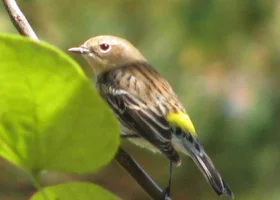
Attached is a snapshot I recently took of a yellow-rumped warbler. I had perhaps a dozen of these backyard visitors devouring waxmyrtle berries while avoiding that invasive, alien, exotic, but lovely creature, the house cat.
 

Attachments

  • 250563-IMG_1264.webp
    250563-IMG_1264.webp
    128 KB · Views: 50
We used to have 6 cats outside. 2 were good hunters. We now have 4 cats outside, and 2 locations where the trees got a deep root feeding. The wife gnashed her teeth, but those semi-feral felines were killing way too many lizards and snakes and other beneficial associates, so I returned the favor.

You make compromises because your cat is lovely to you. Others compromise because "exotic" plants are beautiful, and functional. "Alien" means unnaturalized, in one dictionary. Waxmyrtles are great plants.
 
[ QUOTE ]
those semi-feral felines were killing way too many lizards and snakes

[/ QUOTE ]
Exactly. Another example of non-native species causing ecological harm.

[ QUOTE ]
You make compromises because your cat is lovely to you.

[/ QUOTE ]
Why the assumption it was my cat? Where did I state this? I can acknowledge the beauty of any plant or animal species without encouraging their use in alien environments. The fact is most non-natives will never provide the ecological benefits that a native plant provides. This is not a debate about aesthetic values and personal ethics, it is one about scientific fact.

Recommending and planting non-natives in lieu of native plants will reduce the habitat and food supplies of our local animals. It might be time to end our love affair with alien ornamentals.
 

New threads New posts

Back
Top Bottom