UK. Two ropes at all times(USA next?)

  • Thread starter Thread starter TC
  • Start date Start date
I'll be testing the new Clogger lanyard sheath in the next few weeks and will post a review here. It is a sheath filled with dyneema just like your chaps. After seeing it, I think it is a good concept that like many new ideas posted on here will need refining and will likely go through various stages of development. It will likely also be used in many ways yet not thought of by Brett when he came up with the idea.
 
For the ultimate in protection could always just use chain as a lanyard. May even balance a 660 on the other hip.... :)


Chain lanyards were a palm climber's regular, I've heard.
Even for trees, my old supervisor, way back in the day used two carabiners, maybe even locking, to tighten up or loosen the length of an unweighted chain lanyard. Pretty cut-proof.

Judgment is extremely lightweight.
"No blind cuts" is free.


Along with a lanyard protector, you could wear a full body kevlar suit, with built-in cooling system. You can get kevlar boots for people who like to cut at their boots wildly.

 
It's happened. Looks like the UK is going to be the canary in the coal mine for two rope working.

https://www.trees.org.uk/News-Blog/Latest-News/Two-rope-working-–-an-update

It's not gone down well with the industry for obvious reasons the main one being very experienced long time pro treeclimbers have suddenly been delegitimized over night.

We are being told by the UK Health and Safety Executive and the UK Arboricultural Association that our systems that we've been using for over 20 years etc are now suddenly unsafe.

Facing up to the reality - people are now starting to think about wether to use two similar arb setups (2 DdRT lines or 2 SRT lines or one of each OR a main line (DdRT or SRT) with some kind of back up rope using a fall arrestor like the ASAP or Camp Goblin etc.

Some people will of course continue to climb off their usual single line system (DdRT/SRTWP) with the tie in twice (flipline/lanyard etc) when cutting/work positioning. However, there are now issues surrounding insurance and the potential for fines if there is an accident and it was discovered a two rope system was not in place.

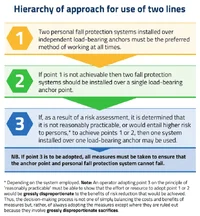
From the Arb Association link - 2 ropes at all times from the ground up to the moment you exit the tree.

Access
1. Rope Advance System

  • Have 3 viable systems prior to leaving the ground (2 climbing lines, 1 lanyard). Install systems 1 & 2 (2 climbing lines) from ground. Test each system. Ascend to first anchor.
  • Maintain 2 climbing systems at all times
  • Repeat to final anchor point.
2. Throw Line
  • Install 2 separate climbing systems and if possible do so on independent anchors. Test systems independently. Ascend.
Working in the tree
  • Select 2 separate load-bearing anchors where possible and install 2 separate climbing systems. Test systems independently.
  • Work using 2 independent climbing systems.
Descent
Both primary and secondary working systems should be long enough to descend to the ground.


1020238852_ScreenShot2019-12-02at12_46_02.png.4e6b6f35a0ab70283314accdcf375288.png


Watch this space, will be interesting to see how it pans out.


.
 
Last edited:
Advance System
  • Have 3 viable systems prior to leaving the ground (2 climbing lines, 1 lanyard). Install systems 1 & 2 (2 climbing lines) from ground. Test each system. Ascend to first anchor.
  • Maintain 2 climbing systems at all times


This part right here is really concerning to me. The way I'm reading it, you need 2 systems at all times, meaning if you want to move one, you need to install a 3rd, so you can uninstall and move one of the others... Unless a lanyard is going to count as a "system" in which case, why wouldn't 2 lanyards one climbing line count?
 
This part right here is really concerning to me. The way I'm reading it, you need 2 systems at all times, meaning if you want to move one, you need to install a 3rd, so you can uninstall and move one of the others... Unless a lanyard is going to count as a "system" in which case, why wouldn't 2 lanyards one climbing line count?
It should count..
 
Interesting that the UK regs make an exception for rescue so that two ropes are not required. It was obvious watching the training at the WesSpur Aerial Rescue thing this summer that the second rope and its gear was a constant source of confusion, extra time and trouble, and was seriously slowing down the main operation in a situation where speed is of the utmost importance. Looks like the Brits made an allowance for this.
 
I have a feeling that this isn't going to work out for them... it's a lot of work to drag one line around a tree, keeping it from snagging up on stuff and trying to keep good rope angles and a clear path for the rope. Using two lines, it is NOT twice as much work. It's about four times as much work. I regularly climb with multiple lines, all of which I can set from the ground, but the price isn't a little bit more work to keep a couple of climb lines with me... it's a LOT more work. In my case, I'm not on a production schedule, and the great work positioning makes it worthwhile. But, that's not the case for most climbers.

The worst thing about this whole notion of dual systems is that I'm not convinced it will increase safety at all. I've personally never seen any data for tree work that would lead anyone to believe it addresses the biggest killers... lack of attention to what you're doing, stupid mistakes and decreased attention to the details when you're tired and getting cranky.

I saw one article that indicated that falling out of a bucket truck or lift was MUCH more common than a safety line or equipment failure. The whole thing smells of a "make some rules, whether they actually will make a difference or not" attempt to look like they're making an effort to reduce injuries and deaths, without any real research into the most likely things to cause them. I know that's human nature, when you're put in a position to address the problems, to at least try to do something. Really, though... this problem needs a lot of research and analytical reasoning to solve, not a quick-fix regulation.

Personally, I've found that the more stuff you have to deal with while trying to work, the more likely you are to get sloppy and make an innocent, but dangerous, mistake. If two or three of those things are what is holding you up in the tree, that can get pretty scary.

 
I’m right there with you! The basics work, always. The more complications you add, the more likely you are to get confused and cause more trouble than this is going to solve. In a way, it’s like all these newfangled cars with all their safety nonsense. There’s so many safety features you’re more likely to crash because of all the buzzers and blinking lights than you are from a real emergency!
 
I have a feeling that requiring only full body harnesses will be next, suitable for "fall protection". What about dynamic lines? This truly could open up whole cans of worms, SPRAT or not. Re-write of Tree Climbers Companion, etc.?
When I'm up a noodle conifer, we have a single climb line installed (SRT) and use a lanyard and spurs on the way up for a dismantle - arbitrarily making us install two climb lines while still using a lanyard (sometimes even choked) seems pretty daft. And for pruning these - well good luck trying to work two climb lines thru the jungle of branches so they're usable on the way up. I think the UK HSE has gone off the bureaucratic deep end this time. What are grossly disproportionate sacrifices defined as anyway? I've worked as an enforcement monkey in the past (including in court) but really have trouble with this on a working basis, both complying with it and if you're trying to enforce it. Really.
I can also see many municipalities, etc. will just ban climbing altogether now as too slow and unworkable and go to mechanized means of removals/ cranes/ pruning with buckets. Wow.
I assume this applies to forestry workers as well then. Wait till all the BC loggers heads explode!
 
I disagree. A canopy anchor may be best when there is cutting on the ground.


What is the rule about having people working near others' life-support systems that are dumb enough to cut their rope.


Canopy anchors mean a trailing rope. An extra rope to get into the chipper.


Expect less work to be requested because of higher costs, and more under the table work. Trees needing work for safety reasons will not be done as much, leading to less-safe trees.
 

New threads New posts

Kask Stihl NORTHEASTERN Arborists Wesspur TreeStuff.com Teufelberger Westminster X-Rigging Teufelberger
Back
Top Bottom