I’m starting this thread as a continuation of other discussions about backing up a double ascender on a doubled rope.
I was never satisfied with placing a friction hitch above the ascenders as it increases friction in a significant way, so I finally came up with a very simple idea which I will call “True Double Rope” or “TDR”. First of all, it must be said that is meant for footlockers. So, if you aren’t one, forget about it. But if you are a footlock lover (like I am), it gives you the opportunity to use always the same ascent techniche even in those trees where making a throw for a doubled rope it’s just not possible. The only real disadvantage is that one needs a very long access line (preferably 10 or 11mm of diameter).
This is how it works:
1. Throw the weight as for SRT. No need to have the ropes parallel. Yes, the branch will be doubled loaded, but that’s rarely a problem. I’ve always considered SRT rope installation to be safer than doubled rope regardless of the double loading. I think that branch failure can happen to an experienced (and prudent) climber only in the presence of an invisible defect, so it’s preferable to double load a branch that has many back-ups (other lower branches) than trusting one’s life to a single one.
2. Now tie your access line (which must be a bit over thrice the height of the limb) to the throw line and start pulling it up. When it has gone over the access limb and down a few feet, stop!
3. Take the tail of the access line which is down on the ground and tie it with a blake’s or other knot to the access line which is coming down from the tree. One can also use a separate line - which can be half the lengh of the first one – instead of folding in the tail of the same one. It makes no difference.
4. Resume pulling down the throw line. The blake’s will start going up with a “second” rope. Pull till the blake’s touches the limb (consider that the line will go a bit down when the system is loaded) and tie up the single line to the base of the tree.
5. Voilà! You have easilly installed a TDR system in which both ascenders are independent and it might take you a few seconds even to notice it if one of the two fails. No need to back it up with a friction hitch.
I’ve been using this for a few months now and find it just perfect. That doesn’t mean I don’t use doubled rope anymore, but if I can’t isolate the rope over a single limb or feel like having the extra safety, I go for TDR.
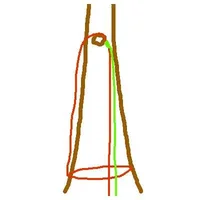
I’m attaching a horrible digital drawing to give an idea. To make it simpler, it’s drawn as if one used two separate access lines.
It’s very simple, but somehow difficult to explain. Try it and let me know what you think…
Sergio
I was never satisfied with placing a friction hitch above the ascenders as it increases friction in a significant way, so I finally came up with a very simple idea which I will call “True Double Rope” or “TDR”. First of all, it must be said that is meant for footlockers. So, if you aren’t one, forget about it. But if you are a footlock lover (like I am), it gives you the opportunity to use always the same ascent techniche even in those trees where making a throw for a doubled rope it’s just not possible. The only real disadvantage is that one needs a very long access line (preferably 10 or 11mm of diameter).
This is how it works:
1. Throw the weight as for SRT. No need to have the ropes parallel. Yes, the branch will be doubled loaded, but that’s rarely a problem. I’ve always considered SRT rope installation to be safer than doubled rope regardless of the double loading. I think that branch failure can happen to an experienced (and prudent) climber only in the presence of an invisible defect, so it’s preferable to double load a branch that has many back-ups (other lower branches) than trusting one’s life to a single one.
2. Now tie your access line (which must be a bit over thrice the height of the limb) to the throw line and start pulling it up. When it has gone over the access limb and down a few feet, stop!
3. Take the tail of the access line which is down on the ground and tie it with a blake’s or other knot to the access line which is coming down from the tree. One can also use a separate line - which can be half the lengh of the first one – instead of folding in the tail of the same one. It makes no difference.
4. Resume pulling down the throw line. The blake’s will start going up with a “second” rope. Pull till the blake’s touches the limb (consider that the line will go a bit down when the system is loaded) and tie up the single line to the base of the tree.
5. Voilà! You have easilly installed a TDR system in which both ascenders are independent and it might take you a few seconds even to notice it if one of the two fails. No need to back it up with a friction hitch.
I’ve been using this for a few months now and find it just perfect. That doesn’t mean I don’t use doubled rope anymore, but if I can’t isolate the rope over a single limb or feel like having the extra safety, I go for TDR.
I’m attaching a horrible digital drawing to give an idea. To make it simpler, it’s drawn as if one used two separate access lines.
It’s very simple, but somehow difficult to explain. Try it and let me know what you think…
Sergio