TRT

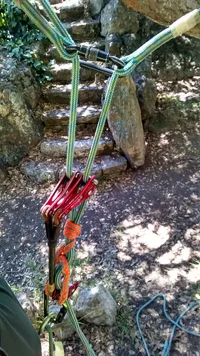
I just watched Jonny's TRT video again and I'm down with everything except all the ropes running through a single carabiner. Is it possible to use a rigging hub? I'm visualizing terminating each rope in the outer holes with stopper knots and running both lines through the center hole. Just wondering how you guys are setting the central anchor up. Thanks!
 
I just watched Jonny's TRT video again and I'm down with everything except all the ropes running through a single carabiner. Is it possible to use a rigging hub? I'm visualizing terminating each rope in the outer holes with stopper knots and running both lines through the center hole. Just wondering how you guys are setting the central anchor up. Thanks!

I imagine that you want rounded edges like the biner has, but beyond that I assume that anything rated for life would work. If feeding the tails through isn't a big drawback, you could probably just use a big ring with any life rated termination knots.
 
I just watched Jonny's TRT video again and I'm down with everything except all the ropes running through a single carabiner. Is it possible to use a rigging hub? I'm visualizing terminating each rope in the outer holes with stopper knots and running both lines through the center hole. Just wondering how you guys are setting the central anchor up. Thanks!
This is the potential danger zone of the TRT system...and this post could take a while, so bear with me. It should be useful.

I was always curious where the floating biner would go to in terms of height to each TIP, depending on the relative distance to each TIP. There's a lot going on here with forces. What looks like a nifty load sharing system is actually a load magnifying system!

If the biner floats half way between two TIP's of the same height, the rope angle leading to each will have roughly 120 degree interior angle. We all know this to be a critical angle, at which 2x climber weight is introduced to each seperate TIP. So, climber weighs 200 lbs. and each TIP sees 400 lbs. creating leverage to torque the TIP in line with the rope (towards the floating biner).

In my opinion, what is very useful about the system is not to float in between, but to select one or the other TIP. If the biner floats all the way over to one of the TIP's, the load becomes very close to 1:1, and the more distant TIP goes quite below 1:1. This is an important concept to understand when evaluating Anchor points and maintaining a suitable margin of safety.

If you really plan to float between to TIP's, it's probably better to use a true DSRT system, in which the wood is loaded in compression. If using the TRT, the safety margin of each TIP has to be increased, thus tying in lower, thus losing potentially valuable rope angle, etc...

I hope this is enough to stimulate conversation, or at least important concepts to climbers that may be wanting to employ this. Use it wisely and have fun!

 
If the TIP's strength wasn't a issue where would you expect the weakest link to be ? Thanks


Sent from my iPhone using Tapatalk
Could really be anywhere. The carabiner also resists the forces of each TIP, so it sees more than 1:1. A true saving grace is the Runner will slip if shocked, so potential peak forces are reduced, but not out of the equation.

Again, there's really a lot going that hasn't been measured or tested in reality. It's all just based on paper, without all the friction accounted for. Still, best to be wise and use with good understanding and judgement.
 
Another factor that could be a real issue is that when floating between TIP's, the fall of each line become unequal. It all depends on where the floating biner is located and overall distance between the two TIP's, but there is the potential to be unable to fully descend to the ground.

The falls should always be accounted for when using two TIP's, and suitable stopper knots tied in each.
 
Good information and questions rightly asked as the floating adjustable (not retrievable without additional rigging) high line is a bizarre and for me rarely used thing. it is fun and can be bang-on useful in some situations. I put the enforcer on it last year and will re-visit this with Eric in November so will certainly fill any interested ears with the results. The connector seems inappropriate and I went for an anchor ring at first but this is a complete arse to rig and de-rig so I have used a duro-lock boa more recently. How much force and the weird 4 point off-axis loading is a little worrying. I stretched out a stainless steel biner last week by letting slack dynamic load into the nose, the piece of wood was no more than 200kg but the long pendulum resulted in disaster. Forces - quickly - multiply. How much force is going into the karabiner certainly needs some checking as does exact rope settings. Some additional thoughts.....The high line doesn't need to be horizontal (whatever the interior angle) and in some settings the rope will LIFT at the anchor, moving it toward weaker wood.
Dave, sorry for my curt replies yesterday, I was running all over the place picking fruits and vegetables in the summer heat, this is old ground for you and I, no reason to hash it out in this thread.
I am so busy these days and while I would love to take some time to get drawings and videos made of my ideas....well, as soon as I can I will.
 
Good information and questions rightly asked as the floating adjustable (not retrievable without additional rigging) high line is a bizarre and for me rarely used thing. it is fun and can be bang-on useful in some situations. I put the enforcer on it last year and will re-visit this with Eric in November so will certainly fill any interested ears with the results. The connector seems inappropriate and I went for an anchor ring at first but this is a complete arse to rig and de-rig so I have used a duro-lock boa more recently. How much force and the weird 4 point off-axis loading is a little worrying. I stretched out a stainless steel biner last week by letting slack dynamic load into the nose, the piece of wood was no more than 200kg but the long pendulum resulted in disaster. Forces - quickly - multiply. How much force is going into the karabiner certainly needs some checking as does exact rope settings. Some additional thoughts.....The high line doesn't need to be horizontal (whatever the interior angle) and in some settings the rope will LIFT at the anchor, moving it toward weaker wood.
Dave, sorry for my curt replies yesterday, I was running all over the place picking fruits and vegetables in the summer heat, this is old ground for you and I, no reason to hash it out in this thread.
I am so busy these days and while I would love to take some time to get drawings and videos made of my ideas....well, as soon as I can I will.

I, and I am sure some others, would love to see them when you find the time to make them.
 
Thanks [emoji106], look forward to seeing some enforcer readings when you do some , I've only rec- climbed this system up to now ...


Sent from my iPhone using Tapatalk
 
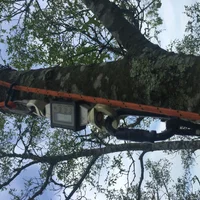
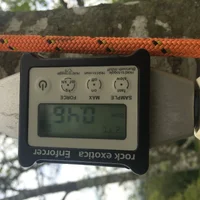
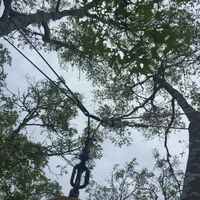
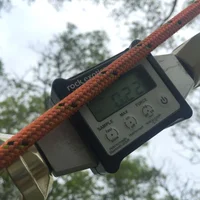
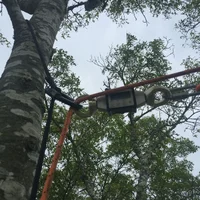
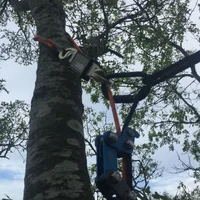
Here's what I was able to grab today with the TRT and Enforcers. Readings should be doubled to determine loading on Anchor Points, as the Enforcer is only reading 1 of 2 parts of line.

Photos will show config and respective reading. Apologies if photo quality is not very not bad...

Config 1) Hanging plumb from one Anchor Point.
image.webp

Reading 1) 0.46 kN
image.webp

Config 2) Floating biner centered between two Anchor Points. Interior Rope Angle between Anchor Points is roughly 120 degrees.
image.webp

Reading 2) 0.22 kN
image.webp

Config 3) Floating between two Anchor Points, biased to one side.
image.webp

Reading 3) 0.12 kN on distant Anchor Point.
image.webp

Config 4) Floating between two Anchor Points, biased to one side.
image.webp

Reading 4) 0.34 kN on close Anchor Point.
image.webp
 
I was experimenting with this type of TRT set up and instead of a biner I was tried using an upside down tandem pulley. My thinking being to reduce the friction. Looking at the increases in force i am now wondering if this is the wrong approach. My next step was to order a double sheaved pulley to replace the tandem to make the install simpler. Think I need to start saving up for an Enforcer.
 
Thanks for doing that Eric.
It seems to be a true load share with only tensile vector to consider. As I use steel/aluminium rings on both sides my lateral angle will be greater than yours, good job I am a few kilo's lighter !
You can firmly set the vertical lines either side of your eyes so that they will lay to the karabiners spine or gate.
 
I was experimenting with this type of TRT set up and instead of a biner I was tried using an upside down tandem pulley. My thinking being to reduce the friction. Looking at the increases in force i am now wondering if this is the wrong approach. My next step was to order a double sheaved pulley to replace the tandem to make the install simpler. Think I need to start saving up for an Enforcer.
I strongly recommend not using a pulley for this application...though if you are trying to snap branches....?!!
 
IMG_20160605_150201680_HDR.webp
lots of good points made on this thread. i've been trying variations of this set up since i am not keen on buying 2 more pricey ropes that can only used for this technique. ;) i also wasn't thrilled about two lines in a mechanical device (RR) & you totally having to unweigh to do anything. At least in this RW set up you can partially have your weight in it (standing on a branch) and shift the lines.
with all techniques there are trade offs. what you must figure out is if those trade offs are worth it in your particular trees with respect to the work you have to do. if we're talking rec, then do whatev, have fun & don't get stuck up there.:p
anyways, for me, in the trees i have here & where the work usually is in them, the floating redirect wasn't worth the hassle at all. ascent also wasn't as smooth & fast as i'm used to on regular SRT, even DSRT. there was strength in it's 1:1 at the canopy anchor point and being able to move it to another anchor point if need be. i ended up not using the 'biner as a connector, btw.
the major benefit i derived was being able to take a natural crotch redirect without pulling all the tail of my line up to drop it thru, i just shifted the connection point down to me. how you proceeded at this point depends on if you intended to come back out of that redirect or not, it was a bit slower if you wanted to go back the way you came. either way you could set it up to be retrieved with a lil strategizing.
all in all tho it wouldn't be helpful enough for my work in the trees around here. in fact a lot of my east coast techniques aren't as useful here either. for work, you just gotta go with what works. but for rec climbs, have fun.
 
all in all tho it wouldn't be helpful enough for my work in the trees around here. in fact a lot of my east coast techniques aren't as useful here either.

Is this because you do not have the broad, spreading trees out west that you have in the east? And therefore most of what you are currently doing is up and down, with a great deal less of the limb walking stuff?

If that is the case, it would seem to me like it might be more fun working on the east coast. I'm losing track of how long you've been out west, now, Pfanner man. How are you liking it, so far? And do you miss the trees of the east coast?

Thanks for your time. Also, I did end up purchasing the right to view your video series, so thanks for that, also.

Tim
 
Is this because you do not have the broad, spreading trees out west that you have in the east? And therefore most of what you are currently doing is up and down, with a great deal less of the limb walking stuff?

If that is the case, it would seem to me like it might be more fun working on the east coast. I'm losing track of how long you've been out west, now, Pfanner man. How are you liking it, so far? And do you miss the trees of the east coast?

Thanks for your time. Also, I did end up purchasing the right to view your video series, so thanks for that, also.

Tim
quite the contrary, trees are more broad spreading, lot's of end weight reduction work (as far as pruning goes), lots of limb walking. lots of species out here are also much thicker so remotely retrievable or settable redirects don't work to well. with the work being at the tips there isn't much reason for a shifting floating redirect point between there and the trunk. you have to get out to the ends to set it up anyways.
i've been out in Cali about 8 months. i do really miss some of the trees out east, American Elm, various Oaks, Lindens, Maples, heck even the freakin Ailanthus :p there are really cool trees out here but not much variety in the mid to larger size and even less variety in the types of trees that most work is available for. many trees have just been hacked/ topped/ lion tailed for so long that it's seems to be the only way people know. there's also a crazy fear of sudden summer limb drop. they don't get half the storm damage or sudden summer limb drop that the east gets. idk, the weather in the area i live is great, the views are great and so much nature is easy to get to, those are the ONLY positive things i can say about the Bay Area really. Pardon the rant. If i've offended any Bay Area arborists then please, show me the light.
Hope you enjoy the Schultz Effect. if you have any questions about any content, comments or criticisms hit me up at theschultzeffect@gmail.com
 

New threads New posts

Kask Stihl NORTHEASTERN Arborists Wesspur TreeStuff.com Teufelberger Westminster X-Rigging Teufelberger
Back
Top Bottom