chris_girard
Branched out member
- Location
- Gilmanton, N.H.
This post comes as a result of questions asked about Pancake’s injuries suffered as a result of tripping a bore cut. I wanted to discuss this separate from Keith’s post. We’ll hear his story when he’s ready to talk about it more.
First, I want to tell you about what happened to me this past spring while working in the same storm damaged trees in southern NH where Keith was injured.
I was removing (felling) a white Birch that was around 10” dbh and bent over at 90 degrees from the Dec. ice storm. The tree had suffered a primary failure (permanent deformation of the load-bearing structure), but had not suffered a structural failure (load-bearing geometry). There were no visible signs of cracks or splits in the stem.
The tree was basically one large spring pole that was too high off the ground to remove in a conventional spring pole fashion. I decided to set up a bore cut and fell it that way, rather than use a conventional notch and backcut and risk a barberchair.
I made a small face notch of around 2”. I did not want to go 1/3 of the way in, as that would not have left enough room for the bore cut and hinge. I bore cut in and set a hinge of around 1”. This left me with around 3” of uncut wood in the back. I tried to cut out towards the back to get around 1” of uncut wood, but the tree started setting down on the saw and I had to stop.
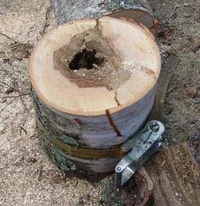
I decided to trip the bore cut holding wood to release the backcut. I no sooner touched the holding wood when the tree exploded and barberchaired on me. I wasn’t standing over the cut, so when it slabbed up, it did not hit me. I was more pissed off than anything. When I got the tree off at the stump, I had a need little bar stool, or barberchair if you will.
After the “incident”, Dan Tremblay from Broad Oak Tree showed me another way to make cuts on a tree like that without making a bore cut. I also kept my eyes opened for any other methods that would make this situation safer in the future.
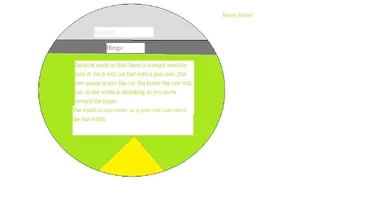
The Ontario Forestry Safe Workplace Association describes one method in the book THE CUTTING EDGE. The method can be used on large “light leaners”. First, make a notch (about 1/3 dbh if you have room) and corning cuts. Then start the backcut by making one cut at a 60-degree angle to the hinge. Next, make a second, similar cut from the other side, so that a triangular section of wood remains uncut. You have now severed the strong outer wood fibers while leaving enough wood to keep the tree from starting to fall. Finally, make the backcut from the apex of the triangle of wood until the tree starts to fall.
The second method I found was in a manual that Tim Walsh gave me. It is the Husqvarna Working with a chain saw manual for safe and effective use. The method is called the V-cut and is used on smaller more heavily forward head-leaners. First, make two directional notches so that the tip points in the direction of the lay (i.e. the direction of lean). Make sure that the cuts intersect inside the bark edge of the tree. Second, saw the felling cut in stages from the back. The tree will then fall relatively slowly.
Now I’ll be the first to admit that I haven’t used either of these methods yet. I just haven’t had the situation that warrants their use. I would like to give it a chance though and wanted to pass the information on to others for further discussion.
I will try to make up a couple diagrams that better show what I am trying to describe in these methods.
First, I want to tell you about what happened to me this past spring while working in the same storm damaged trees in southern NH where Keith was injured.
I was removing (felling) a white Birch that was around 10” dbh and bent over at 90 degrees from the Dec. ice storm. The tree had suffered a primary failure (permanent deformation of the load-bearing structure), but had not suffered a structural failure (load-bearing geometry). There were no visible signs of cracks or splits in the stem.
The tree was basically one large spring pole that was too high off the ground to remove in a conventional spring pole fashion. I decided to set up a bore cut and fell it that way, rather than use a conventional notch and backcut and risk a barberchair.
I made a small face notch of around 2”. I did not want to go 1/3 of the way in, as that would not have left enough room for the bore cut and hinge. I bore cut in and set a hinge of around 1”. This left me with around 3” of uncut wood in the back. I tried to cut out towards the back to get around 1” of uncut wood, but the tree started setting down on the saw and I had to stop.
I decided to trip the bore cut holding wood to release the backcut. I no sooner touched the holding wood when the tree exploded and barberchaired on me. I wasn’t standing over the cut, so when it slabbed up, it did not hit me. I was more pissed off than anything. When I got the tree off at the stump, I had a need little bar stool, or barberchair if you will.
After the “incident”, Dan Tremblay from Broad Oak Tree showed me another way to make cuts on a tree like that without making a bore cut. I also kept my eyes opened for any other methods that would make this situation safer in the future.
The Ontario Forestry Safe Workplace Association describes one method in the book THE CUTTING EDGE. The method can be used on large “light leaners”. First, make a notch (about 1/3 dbh if you have room) and corning cuts. Then start the backcut by making one cut at a 60-degree angle to the hinge. Next, make a second, similar cut from the other side, so that a triangular section of wood remains uncut. You have now severed the strong outer wood fibers while leaving enough wood to keep the tree from starting to fall. Finally, make the backcut from the apex of the triangle of wood until the tree starts to fall.
The second method I found was in a manual that Tim Walsh gave me. It is the Husqvarna Working with a chain saw manual for safe and effective use. The method is called the V-cut and is used on smaller more heavily forward head-leaners. First, make two directional notches so that the tip points in the direction of the lay (i.e. the direction of lean). Make sure that the cuts intersect inside the bark edge of the tree. Second, saw the felling cut in stages from the back. The tree will then fall relatively slowly.
Now I’ll be the first to admit that I haven’t used either of these methods yet. I just haven’t had the situation that warrants their use. I would like to give it a chance though and wanted to pass the information on to others for further discussion.
I will try to make up a couple diagrams that better show what I am trying to describe in these methods.