Tree Huggers

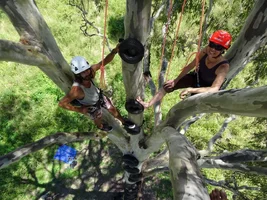
Hello, I have a question regarding tree health although it does not relate directly to commercial arboriculture. I am a tree-climbing arborist with an interest in recreational tree climbing. I have been experimenting with different ways to enable people to climb trees directly for recreation. I am using a method of inflation of a modified tyre to provide a climbing hold for the parts of the tree that have no natural holds. The tyre is deflated and lightly cinched against the tree with two load-rated straps. The tyre is then inflated to 25psi where it forms a strong, immovable bond with the tree and a solid shape to climb upon. I have concerns about the tree's health, being strapped-up like this with multiple tyres. I would appreciate feedback on this please if anyone knows what this means for the tree, if anything? Best Regards, Matthew

 

Attachments

  • Mick and Renai.webp
    Mick and Renai.webp
    361.2 KB · Views: 32
Are you planning on leaving them there long term or temporarily? If temporary I see no issue if there is no abrasion. If long term, I think you would just need adjustable straps that you monitor and adjust as needed. Or move every once in a while
 
I'd avoid it in the spring on thin barked trees, but it may be fine lower down the trunk. In your photo it looks like a free climb with belay, so the climber doesn't have any weight on the rope and at times all their body weight on the tires. If that's the case I'd use 2" or greater webbing straps to avoid it stripping outer bark off. You could get away with leaving them slightly loose while not using them, and cinch them up for the climb.

Nice condom jokes, just make use they are used with care in the branch unions to prevent seedlings.
 
I find it very clammy...and i wonder how much weight the tyre (a Brit, wot?) would support before the straps slide. These rec climbers are secured, right? As always, pics would tell a lot.

TMI. TMI.

And I think Canadian--remember, we Yanks are the ones with the odd spellings, the rest of the English-speaking world write "tyre" and "colour" and "recognise".
 
I'm going with Aussie or Kiwi, that looks like one of those Eucs of theirs. My advice would be to avoid on thin barked trees and use them as temporary points, moving/removing them periodically, like others have said.

-Tom
 
Hey thanks everyone, I was thinking the same thing about this...rotation, species selection etc...agreed I need to determine an upper limit for weight...no damage depends upon no slippage however since they don't move at all, they will probably accommodate even heavy climbers...Tom and Evo please can you give me some examples of thin-barked trees in your area that may not be robust enough?

I saw a scientific paper recently that claimed that sap pressures inside large trees may be in the order of 50 atmospheres below atmospheric pressure...this surprised me initially however I remembered that the water-maker on my boat runs at about the same pressure...so the 25psi inflation pressure is an order of magnitude below the sap partial-pressure...and considering that the values for treated wood compressed perpendicular to the grain also start at about 25 atmospheres...the strapping pressure is unlikely to compromise the tree's ability to provide such high partial pressures for it's sap...there are two straps for redundancy which equates to four straps against the tree, which additionally reduces the pressure...

ps I'm in Townsville, Queensland, Australia...Matt :)
 
I have concerns about the tree's health, being strapped-up like this with multiple tyres.
Oh, there's the pic...yes I would be concerned too; and perhaps more inclined to drill in and install steps, and a lot less work. I doubt those sap-pressure data are universal...there's more seasonality in temperate trees--Acer, Fagus, Liriodendron etc. bark slips early in our growing season.

Townsville--that's Sean Freeman's old stomping grounds. I wonder what he might say...
 
Back
Top Bottom