- Location
- Victoria , B.C.
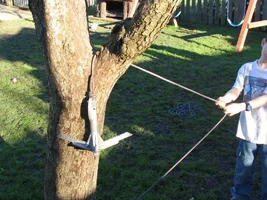
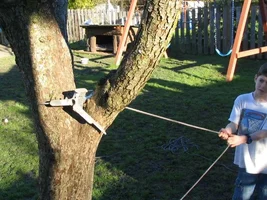
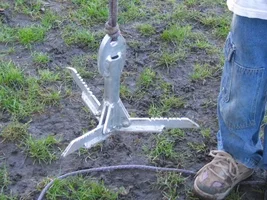
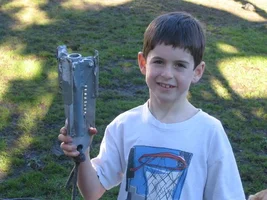
With the help from a friend who welds, i have just recently built my own tree claw......and it ROCKS ! It has three arms that open and close, and is made of aluminium. I have a 8mm thick, 20m long , polyester cord attached to its head. The idea of the claw is to aid the climber during a traverse between far apart codoms or between trees themselves. The climber, who is positioned in one tree will look for a suitable crotch or branch scaffolds (conifers)in the neighbouring tree. With a good toss, the claw will pass through the crotch and then be retrieved back to the crotch where the open arms will lock into the crotch. Keeping tension on the line the climber will attach a hand ascender to the claw line which will be attached by a short cord to the harness. the climber will remain tied into the original TIP. The climber will now start to descend off his primary line and start to pull himself across on the claw line until he/she reaches the tree where the claw is. The climber will lanyard in and untie primary line and reset line in new tree. Wrap up claw, attach to harness and off you go.
Flipside : 1) Tricky but possible to manipulate if you hit the wrong target. 2) If claw insuffiecently attached to crotch , you could be in for a LONG dangerous swing ! 3)Being homemade, i am unsure of its strenght rating.
The claw has its origin in helilogging operations. I worked with a company here on Vancouver island for a couple of weeks last year. There were days where i would spend the entire day off the ground , clawing / topping. A truly amazing experience. Those claws were made of steel. I designed this claw a little larger so that i could apply it in decurrent trees with larger open crotches. To compensate for subsequent increase in weight we made this claw out of AL.
Traverses up to fifty feet are possible. Really adds fun to climbing and saves on time too.
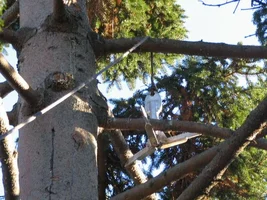
Attached are photos which i took in my backyard tossing the claw from the ground in to trees just to demonstrate how it looks and works. Note in conifers, the idea is to go over a branch,and connect further down on a lower branch.
Flipside : 1) Tricky but possible to manipulate if you hit the wrong target. 2) If claw insuffiecently attached to crotch , you could be in for a LONG dangerous swing ! 3)Being homemade, i am unsure of its strenght rating.
The claw has its origin in helilogging operations. I worked with a company here on Vancouver island for a couple of weeks last year. There were days where i would spend the entire day off the ground , clawing / topping. A truly amazing experience. Those claws were made of steel. I designed this claw a little larger so that i could apply it in decurrent trees with larger open crotches. To compensate for subsequent increase in weight we made this claw out of AL.
Traverses up to fifty feet are possible. Really adds fun to climbing and saves on time too.
Attached are photos which i took in my backyard tossing the claw from the ground in to trees just to demonstrate how it looks and works. Note in conifers, the idea is to go over a branch,and connect further down on a lower branch.