Transplanting a Red Bud (Cercis canadensis)

Thinking about digging a Red Bud up from behind my shed and transplanting it in my front yard. Soil shouldn't be any different. I'm just looking for any tips to make sure I dont kill it. It's surrounded by shell rock so it's going to be some fun digging. I will attempt to get the entire root ball out without harming it too badly. How far should I have to dig? It is roughly 6 foot tall. And is there any fertilizer or soil additive I should use for this species. Or do they do good just planting them as is. Thanks in advance!
 
Good time of the yr. Dig it up. Trim back crown in respect to roots you cut off. I'm speaking from experience, not books. No fert! Good soil. Redbuds easy.
 
I know zip about redbuds but I do know that chemical fertilzer is a bad idea to apply to transplanted trees. It can harm more than help damaged roots.
Make sure the soil is amended with some compost instead, but not overly much and topdress with more compost and a good surface mulch.
 
Another recent line of teaching is to not cut back the top.

Glad you posted this. Reminds me I want to go a couple of miles this week to see how the buds are swelling on a weeping Japanese maple I bare root transplanted around January.

Should be okay ... but I like to watch stuff like this anyway.

cool.gif
 
[ QUOTE ]
Good time of the yr. Dig it up. Trim back crown in respect to roots you cut off. I'm speaking from experience, not books. No fert! Good soil. Redbuds easy.

[/ QUOTE ]

I also disagree about cutting back the crown. The tree will need to produce as much sugar as possible to recover from the lost roots. The most important thing is to make sure your rootball is 10x the CALIPER not dbh. 3" caliper should be a thirty inch ball. Red Buds have pretty unpredictable root structures so you'll want to go a little bigger than the normal 10 to 1 rule. Do you know how to drum lace? If not, what's your plan for securing to ball?
 
[ QUOTE ]
I know zip about redbuds but I do know that chemical fertilzer is a bad idea to apply to transplanted trees. It can harm more than help damaged roots.
Make sure the soil is amended with some compost instead, but not overly much and topdress with more compost and a good surface mulch.

[/ QUOTE ]

Three years before fert is the rule.
 
[ QUOTE ]
[ QUOTE ]
Good time of the yr. Dig it up. Trim back crown in respect to roots you cut off. I'm speaking from experience, not books. No fert! Good soil. Redbuds easy.

[/ QUOTE ]

I also disagree about cutting back the crown. The tree will need to produce as much sugar as possible to recover from the lost roots. The most important thing is to make sure your rootball is 10x the CALIPER not dbh. 3" caliper should be a thirty inch ball. Red Buds have pretty unpredictable root structures so you'll want to go a little bigger than the normal 10 to 1 rule. Do you know how to drum lace? If not, what's your plan for securing to ball?

[/ QUOTE ]

This is a legitament honest question here, I'm not being sarcastic or belittling in any way:
Do you transplant many trees?

A tree can't produce sugars if it's DEAD.

If roots were lost and you don't take measures to reduce folliage, the leaves will lose more water than the limited root system can supply. I've seen it so many times.

I can rip out a tree with forks or the crane, such as for a tree removal and I decide I might plant at my house. And lose a ton of roots, but if I reduce the crown, the tree makes it. If I don't trim it back, it will die EVERY TIME.

I've got lots and lots of pictures and video showing the various cases with different approaches.

My opinion is from experiences, not what sounds like should work. I'm not saying you are not experienced by the way. Perhaps the trees u have worked on don't lose any roots with the sizes u have done.
 
X while I agree the the don't-prune rule gets exaggerated, but your version sounds pretty extremne too. I move a fair number and seldom have to prune to balance for root loss.
 
Trees are remarkable self-correcting organisms. If the roots can't take up enough water to meet the transpiration rate of the canopy, the tree will abscise and eliminate leaves on its own until it establishes a new equilibrium.

As to amending the soil in the planting hole with compost, that can cause the transplanted tree to sink into the planting hole over time as the compost degrades.
 
Trees are remarkable self-correcting organisms. If the roots can't take up enough water to meet the transpiration rate of the canopy, the tree will abscise and eliminate leaves on its own until it establishes a new equilibrium.

Sometimes. And sometimes they die.

As to amending the soil in the planting hole with compost, that can cause the transplanted tree to sink into the planting hole over time as the compost degrades.

Only if the soil under the stem is amended, which would be silly. Amending the rest of the planting bed is generally a good idea imo, because soil is seldom ideal.
 
[ QUOTE ]
X while I agree the the don't-prune rule gets exaggerated, but your version sounds pretty extremne too. I move a fair number and seldom have to prune to balance for root loss.

[/ QUOTE ]
Guy,

I sure appreciate your input as I know you are one with experience.

My wording was not very clear, as I typed from my cell phone and did not want to type much.

I was using extreme cases, as the extremes are what can teach you what is important and what is not.

I was using the example of say when Joe homeowner, says, remove this Deodara cedar. I think to myself, wow, i wouldn't mind having one of them...

I'm in work mode and don't have time to transplant as I would for a customer, so I just rip it from the ground.

Lots of root loss, maybe even some cambium damage.

If I trim back the tree enough and water it, it will live.

If I do no trimming it will die.

Sure, if a small tree is taken and you get pratically ALL of the roots, no need to trim back and it will progess just a fast as if it was never moved, pretty much.

But how many can do this? Especially on a tree with some size?

So I have learned from experience, some root loss = some trimming back, for success.

 
Hi Banjo,

Wow!

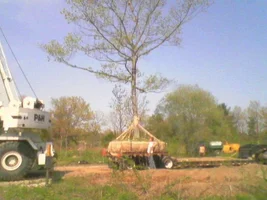
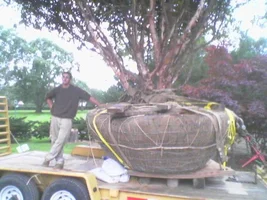
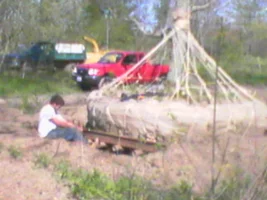
Was there no trimming back on the first two trees?

huge root loss there.

can't tell on the third picture.

Are you in a wet climate?

Thanks for the time for the pictures.

That first tree would struggle for me if not a 10 to 15% reduction.
 
On a large transplant you will lose around 90% of the root structure. If you prune anything close to that out of the crown you won't have a tree anymore.
 
[ QUOTE ]
X while I agree the the don't-prune rule gets exaggerated, but your version sounds pretty extremne too. I move a fair number and seldom have to prune to balance for root loss.

[/ QUOTE ]

Guy ... I can find several documents online referring to research indicating that crown reduction to compensate for transplant root loss actually impedes root generation.

Have any source for a recent, say 2000 to 2012 source reconfirming that?

Reason I ask, just took a college class, TREE CARE II out here, and the instructor, a long time Certified Arborist, added the same thing to the curriculum.

Thanks if you can find one ...

I rarely prune more than what I need to fit the tree through a space, etc., and at worst have lost some leaves on some.

One possible advantage that comes to mind, is less wounds for the tree to compartmentalize. And if all the limbs live, then the 2nd growing season can mean that much more area for leaves manufacturing food.
 
[ QUOTE ]

As to amending the soil in the planting hole with compost, that can cause the transplanted tree to sink into the planting hole over time as the compost degrades.

Only if the soil under the stem is amended, which would be silly. Amending the rest of the planting bed is generally a good idea imo, because soil is seldom ideal.

[/ QUOTE ]

Exactly. Guy's statement about the whole planting bed is important. The soil inside the planting hole should match the soil outside the planting hole, so amend the whole area. Most soils could use it.

I've seen young purchased trees fail completely because someone dug a nice deep hole in a nasty dense clay soil and then backfill with bagged potting soil, which in my opinion is just peat moss more or less. It's like putting the poor thing in an underground pot. The roots just circle in the potting soil until the tree runs out of room and essentially becomes pot-bound.
 

New threads New posts

Back
Top Bottom