Training video - felling a side leaner

i was trying to point out that to get horizontal movement from a horizontal branch; you'd more likely use the side dutchamn push against the 'side lean' to desired path (down) and/or a tapered hinge pulling against side lean to desired path (up).

Weapons/ strategies of choice wouldn't be over gunning or wedging; just the pure powers of the adjustments to hinge/face of tapered pull and dutch push.

These things have been such good friends to me; i feel i should stand up fer'um! And the fact that Mr. Dent writes of them from generations of logging experince reaffirms their validity. Also, i do/ have done/ studied more cuts in air than the single felling cut (sometimes maid after 200 aerial cuts). But, i think lessons from each can be used on the other (felling/ climbing); and even gain more certification and understanding if the models stand the test of these to opposite ends of the same science of load hinging on wood. So after much airplay on hinges, many times the final felling cut is just same lessons at a different angle and to larger scale. Likewise, many lessons then l-earned and re-affirmed in bucking apart etc.

Also, the pull line went slack/ lessened tension as the wedge went 'slack' / lessend tension as the tree moved. The anchored line though; did not slacken or stay the same tension, but rather tightend i think; as the tree fell.

The pull line slackened as the equal/opposite points of pull through line device of man/pull on ground and hitch on tree moved closer together as the tree lunged forward towards the ground pull point. But conversely, the anchored line gained tension at the same time; as the hitch in tree and on ground anchor as equal/opposites moved further apart as the tree lunged forward, further away from anchor point; further tensioning line agianst sidelean during travel IMLHO. Any impact/ inertia gained in acceleration of tree, was also turned against the tree; thru the line device also. Rigging in tree can be similair; just turn this mocel on it's side. You can pretighten a line; then also let the travel on hinge pretighten the line more before load becomes a free agent at tear off. But, being as these self tightening line pulls are a responsive force to weight/length of load used against itself in this 'tree karate' they can take away force of tapered if not used/ timed right. Becasue tapered hinge is jsut a weight/ length responder too (whereas wedge push/ nand line pull are outside forces imposed on tree/ not varied by tree movement). Given only so much weight/ length; tree can only empower so much response from the responding forces of tapered, dutch, anchored line etc.

One way in tree i have found to have your cake and eat it too/ ride the pony twice; is to pretighten line; then let load pretighten line more by cutting down slightly and laying some of load into line. Then use turn saw to cut more across when line is pulling across hard; so that it forces stronger hinge in turn (i think). Then steer across with tight line and strong hinge at spread points on load. Sometimes this entails metering some slack into line to initiate the fold at correct time; to let the higne part of system take some of the load force; then hold line tight.
 
[ QUOTE ]
[ QUOTE ]
proving the tapered hinge does not alter fall direction

[/ QUOTE ]

I can't agree with this one Eric.

[/ QUOTE ]

Well, I have video that shows otherwise, what have you got to prove me wrong?
 
Theoretical diagram, have you seen those illusional ones that aren't possible?

Like I said, 2 slow motion videos with falls showing otherwise.

The hinge breaks from the back, the thicker side just breaks earlier. No change in fall direction.

It's OK, I thought the same till time and time again the slow mode video proved different.
 
[ QUOTE ]

The hinge breaks from the back, the thicker side just breaks earlier. No change in fall direction.

It's OK, I thought the same till time and time again the slow mode video proved different.

[/ QUOTE ]

Ekka, I agree with you on this subject. Time has proven to me that this is true. Though like I said I still want to use the tapered hinge a little bit WITH the Adjusted Gun. Technique sometimes.

Kevin, yeah you're right I'm not necessary weakening the hinge because of the extra wood on the tension side. It's just that I have a hard time relying on that extra wood to be strong enough sometimes, especially with a heavily weighted sidelean.

Spyder, you are right to defend D. Dent. How can you argue with a man with all that experience? But listen to this. A little while ago I was talking with my logging certification instructor about this very subject. He just turned 62 years old this year and has been a logger since he was 18. Twelve years ago he attended a seminar on advanced Swedish Logging Techniques put on by Soren Eriksson and was taught the Adjusted Gun Tecn. My instructor had always used the tapered hinge tech. but after spending a day with the Legend Soren he changed his ways. So even an older timber faller like that has changed his views. Mr Dent may also feel differently too. Boy I wish we could get him to post here on the Buzz.

My instructor has not gone back. Now, up here all they teach is the Adjusted Gun Tech. during certification courses. As a matter of fact he said that he can't believe that we still have these discussions about the tapered hinge vs. the adjusted gun. Like I pointed out to him though is that in an urban setting you have to be exremely careful not to over gun the sidelean while compensating and hit something. He agreed that it is not like in a woods setting, but with enough experience the adjusted gun will work anywhere.

I think this is a great topic and the more discussion the better.

Chris
smile.gif
 
Eric, your face shouldn't be even with the fence, it should be straight across the tree regardless of lean.

I'm all for the adjusted gun and holding rope where needed but adding a tapered hinge only improves and adds to the other two, it's a well documented science and I use it myself with excellent results.
 
Kevin, I know what you mean. That is why I still use the tapered hinge with the adjusted gun (even if it may not be necessary) sometimes. Old habits do die hard.

I guess you can think of using the 2 techniques together as extra insurance. Kind of like doing removals with your lanyard and climbing line. You may never need to have to rely on the backup, but it sure feels good to have it with you!

Chris
 
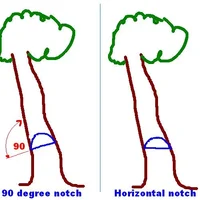
I think you do do what is illustrated here Kevin.

In this scenario your side rope would still have to be adjusted same as mine.

62034-notches.JPG
 

Attachments

  • 62034-notches.webp
    62034-notches.webp
    24.4 KB · Views: 54
A reminder: Using the "90 degree notch" means no adjusted gun. The tree top will land where the notch points, assuming an effective side pull, or tapered hinge that holds.
 
[ QUOTE ]
thats assuming a lot olman, specially if theres targets involved

[/ QUOTE ]

Yeah, what about decay at the point where you make your hinge. Which you can't see until its too late!
 
ekka. obviously you took this video for training purposes, but on a regular work day would you have gone to the effort of setting that up when it would have taken 10 minutes to strip to a pole?
 
In the attached photo, we pulled the 100' White fir down onto the driveway. It had to drop between two trees in the foreground, an oak on the left and Douglas fir on the right. (The d.fir is hidden behind the birch in the extreme foreground). As you can see, the White fir had a slight lean over the house. My priority was to avoid damage to the oak by aiming for the right side of the driveway, allowing the w.fir to brush against the outreaching d.fir limbs. I used the "90 degree notch" and a tapered hinge. It was a tight fit, a margin of error of under 10 feet. The fir landed a bit closer to the oak than I wanted, one low lateral limb broke. (I think you can see it in the photo). We trimmed it out, no effect on the oak's appearance. We also had to protect a flower bed and low retaining wall at the base of the White fir with logs and firewood that happened to be on site. (The lady of the house was so nervous about this removal, she took all her pictures off the walls, fearing the impact would be a small earthquake.)
 

Attachments

  • 62118-100_1710.webp
    62118-100_1710.webp
    60.6 KB · Views: 114
nice fell olman.....personally speaking i'm twice the climber i am a faller....i'd have stripped that one looking at the pics.....good on ya though if you have the confidence to fell it.
 
Thanks, Steve. I might have climbed it 20 years ago, but now I look at the physically demanding work involved up there, and choose less work if I can get away with it. The limbs would have to have been roped down. Too big for me to throw, and no place at the base of the tree to drop them. Of course, sometimes there's no choice, like the picture on the left. We did that this summer. Took a couple of days.
 
Good on you Olman, I would have dropped it to, no worries.

Bullman, if that side leaner wasn't used for the video I would have just felled it going with the lean as there was bags of room, but good opportunites need to be capitalized upon for threads like this.

When I have an interesting job for whatever reason I inform the clients of the training opportunities and refer them to the other videos on my website. Also they feel part of it and many times are involved.

In this video the customer was on the Kanga pulling it over.

Sometimes I get customers to take the vids etc ... they talk and learn and it creates more work for me as they refer me to similar minded people which I like.

There's more to tree work than how fast you get home.
 
Ekka, I liked the video.

But there was one thing on my mind as I watched it.

There was nothing to damage on the leaning side of the tree if this operation had gone wrong, apart from what I could tell was a little palm tree.

I know this was a good tree to use for a training video.

But if there was a $500,000 home on the leaning side of the tree I don't believe for one second that a professional tree company would use this technique to bring that tree down.

You cannot guarantee 100% that that holding rope is gonna work, a bigger tree with a heavier lean could create an incredible amount of force on that holding rope, which could pull the truck or snap the rope.

As the tree starts to go you have no idea whatsoever the amount of force you are going to create on that holding rope, you used a small tree in your video.

Some trees are extremely brittle and the hinge goes very early. The rope may have too much stretch.

I've heard the argument that you can't guarantee anything in treework, but in the the case of a $500 000 home.
I would be climbing the tree or bucket truck or craning and taking it in small pieces.

After all the client is paying for a professional service.......could you imagine if this technique failed.

But I do still think that i could use the holding rope technique in certain occasions. Small trees.

Thanks for the video, it all adds to my understanding of treework.

Springsteen original of 'Blinded by the light' is a lot better than that cover you were playing!
beerchug.gif
 
If there was a 500,000 house there you just over gun it more and move the side rope round more ... easy.

The rope is rate 9300kg breaking double braid, you aint busting that.

Also the rope doesn't experience shock load, it rides tension all the way to the ground.

This is pretty much straight forward stuff, no trickery here.

As far as forces go that's easy to calculate using vectors.

Estimate the weight of the tree, then transpose those figures to verticle and horizontal forces. Or hook up a dynamometer to the side rope and measure it.

If you had a 100' steel pole weighing 10,000kg (10t)mounted on a swivelling knuckle at ground level with 4 guy wires on it holding it straight how much force is on each wire? Not much.

If the pole was on a 10 degree lean how much force would be on the guy wire opposite the lean? Without doing the math I could confortably say ... not 10t. If we were to then let that pole fall forward by releasing the other cables you would find that the force on the remaining guy wire would actually diminish as it headed toward the ground.

Acurate felling and sound techniques are no luck but science, not knowing and guessing are things the tree industry has run on for decades ... but engineers have know otherwise for decades.

So you'd even be able to calculate the force on the truck due to the angle of the rope, you can even calculate the force required to skid the truck on the grass ... it is all math and science.

So knowing these facts makes one more confident in using bonafide felling techniques whilst others just clamber around scratching their heads wondering if all is OK.
grin.gif


The music was by a classic ole band Manfred Manns Earth Band.
 
I'd agree with Ekka here, if the species of the tree isn't prone to early failure of the hinge, I would flop it with confidence.

The tree down the drive, I am too wary of busting the driveway. If it was a gravel driveway then I would likely fell as opposed to climb, but its one picture. The lean doesnt bother me on that particular tree.

I also agree on the "90* notch" as opposed to the "horizonal notch," I am in the 90* crowd.
 

New threads New posts

Back
Top Bottom