Topping Arborvitaes - Something I've Been Staying Away From

climbingmonkey24

Carpal tunnel level member
Location
United States
Will anyone "top" as in take off more than a foot or a couple feet where you woud be cutting into bigger wood of arbs? Particularly the tight, spiral kind that grows into a cone shape at the top?

By standard practice I will trim to tighten and shape but try to stay clear of taking anything major off because I've seen hedges that were topped and while yes sometimes they come back, on the other hand it can destroy them. I'll take as much off as I can without cutting into major wood. And sometimes the customer will say oh well if they die they die but do I want to be the one responsible for doing that? No.

Had a situation today where I turned down a job because it was one of the tight spiral kind of arbs and they wanted to take a foot or so off the top. My impression was that those kind of arbs in particular do not do well topped. Trimming to simply tighten and shape would've been a different story.

Thoughts? Do you think this is the right approach? Anything I'm not taking into consideration here? I know some will say you can take however much off you want on an arb and they will just grow back, and then on the other hand some say you shouldn't top them at all because it risks causing damage.
 
Last edited:
Will anyone "top" as in take off more than a foot or a couple feet where you woud be cutting into bigger wood of arbs? Particularly the tight, spiral kind that grows into a cone shape at the top?

By standard practice I will trim to tighten and shape but try to stay clear of taking anything major off because I've seen hedges that were topped and while yes sometimes they come back, on the other hand it can destroy them. I'll take as much off as I can without cutting into major wood. And sometimes the customer will say oh well if they die they die but do I want to be the one responsible for doing that? No.

Had a situation today where I turned down a job because it was one of the tight spiral kind of arbs and they wanted to take a foot or so off the top. My impression was that those kind of arbs in particular do not do well topped. Trimming to simply tighten and shape would've been a different story.

Thoughts? Do you think this is the right approach? Anything I'm not taking into consideration here? I know some will say you can take however much off you want on an arb and they will just grow back, and then on the other hand some say you shouldn't top them at all because it risks causing damage.
If it’s that kind of arborvitae yes I take the tops all the time. Just don’t punch too big of a hole in it. But taking the top makes them bush out laterally too.
If western red cedar hells no, they will reiterate like crazy!!
 
If it’s that kind of arborvitae yes I take the tops all the time. Just don’t punch too big of a hole in it. But taking the top makes them bush out laterally too.
If western red cedar hells no, they will reiterate like crazy!!

That's interesting. I've read different opinions on the subject and I always went with the approach that taking any more than a light trim at top, as in starting to cut into bigger wood, could potentially harm the tree.

I trimmed some hemlock hedges last year that has previously been topped, and they weren't in the best shape. All bare on the top, the growth never came back.
 
In my younger days I worked for my cousin's father-in-law. We took care of a mini estate in the small town I lived in. This family owned a half block with two homes on it and was completely surrounded by Arb hedges 15 to 20 feet tall. It would take two of us 3-4 days shearing these things with manual shears (no power anything at that company... including mowers). In total we would spend 2 weeks on that property every year. When I was in business, I had a client who had the hedge from hell, 85' long, 24' wide and 16-18' tall hemlock. The client insisted on hand shears pruning and she didn't want it to look scalped. The one end of the hedge was in pretty much full sun, but the last third was shaded. The trunks in the sunny end were 20"dbh trees and I would walk from top to top to prune the top of the hedge until the trunks got to spindly to support me. This would always be a 4 day job. In both cases, the continued "topping" held height and shape. One caution though, it has to be done religiously every year or the plants will run away with growth.
 
In my younger days I worked for my cousin's father-in-law. We took care of a mini estate in the small town I lived in. This family owned a half block with two homes on it and was completely surrounded by Arb hedges 15 to 20 feet tall. It would take two of us 3-4 days shearing these things with manual shears (no power anything at that company... including mowers). In total we would spend 2 weeks on that property every year. When I was in business, I had a client who had the hedge from hell, 85' long, 24' wide and 16-18' tall hemlock. The client insisted on hand shears pruning and she didn't want it to look scalped. The one end of the hedge was in pretty much full sun, but the last third was shaded. The trunks in the sunny end were 20"dbh trees and I would walk from top to top to prune the top of the hedge until the trunks got to spindly to support me. This would always be a 4 day job. In both cases, the continued "topping" held height and shape. One caution though, it has to be done religiously every year or the plants will run away with growth.

I had one arb job like that, hundreds surrounding a huge property. Two sides of long lines, can't even tell you how many ft. it was in length. Then another line on a hill. That was my first experience trimming arbs, and suffice to say it was a good training session lol.

When I refer to topping, I'm more referring to a situation where someone let's their plant get too overgrown, and now they want to try and recapture a smaller shape. So in this sense "topping" would mean taking off a foot or multiple feet and would be cutting into bigger wood, but at that point when a hedge is overgrown typically the approach I try to take is to just trim and shape it and then keep on top of it so it doesn't get much bigger VERSUS taking a lot off the top to try and get it much smaller.

So I'll trim just enough to the point that I'm not cutting any serious wood.

That's part of the problem I feel is people wait until a hedge is so overgrown and then they want to bring it back down to a much smaller size, but is that really realistic?
 
  • Like
Reactions: ATH
We will “top” a row of arborvitae to turn them into a shaped hedge. However, we first explain that this will cause the arbs to need annual pruning to keep them looking nice forever, otherwise they’ll turn into big lollipops. We make sure to explain too how fast they’ll grow, so the pruning cost this year will be an annual fee to keep them looking nice.

Arborvitae will grow broader and more vertical sided once topped, so they can be sheared over time into a squared off hedge that way, but they will always be high maintenance.
 
We will “top” a row of arborvitae to turn them into a shaped hedge. However, we first explain that this will cause the arbs to need annual pruning to keep them looking nice forever, otherwise they’ll turn into big lollipops. We make sure to explain too how fast they’ll grow, so the pruning cost this year will be an annual fee to keep them looking nice.

Arborvitae will grow broader and more vertical sided once topped, so they can be sheared over time into a squared off hedge that way, but they will always be high maintenance.

What is the most you’d take off the top?


Be sure to turn to the right and see the big part of the hedge along the parking lot.


I've had the displeasure of hedging this western redcedar hedge at Peace Arch State Park once. Ridiculously large. We only did the top from the bucket truck. The maintenance department at the park does the sides.


You can hedge about any conifer, if done right, I bet. Not positive.


@climbingmonkey24 pictures, my good man, pictures!

I've definitely reduced arborvitae, of some kind, for view by more than a foot. They look beautiful now (for what they are), without sign of reduction. Manicured waterfront house.
 
2A75FD3F-F9D7-4B85-9B8A-EADBF2ED768F.jpeg

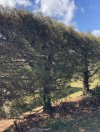
This is a white pine hedge I saw in my travels. I imagine it’s something the homeowner is doing (not the kind of neighborhood people pay someone to do something for them.) Looks better than I would have expected. Hemlock does amazingly as a hedge and does find a way to fill out. As with all pruning of this style, starting early and keeping up with it is mandatory. I don’t really get into this kind of work these days though. You can really lose your shirt on a hedging bid.
 
After working out what you meant by Arbovitae.
Sure you can top them to reduce a hedge, no bother.

I used to do it a lot, but long rows are hard wrk so mostly turn them down now.
 

New threads New posts

Back
Top Bottom