












Navigation
Install the app
How to install the app on iOS
Follow along with the video below to see how to install our site as a web app on your home screen.
Note: This feature may not be available in some browsers.
More options
You are using an out of date browser. It may not display this or other websites correctly.
You should upgrade or use an alternative browser.
You should upgrade or use an alternative browser.
Today....
- Thread starter Mark Chisholm
- Start date


Treetopflyer
Been here much more than a while
- Location
- Coastal N.J
Here’s one we did in SeptemberWe have a giant live Ailanthus coming up that's completely covered in English Ivy so any and all wisdom is appreciated. This tree looks to be able to house a whole forest worth of critters in just the Ivy. We're removing the whole thing
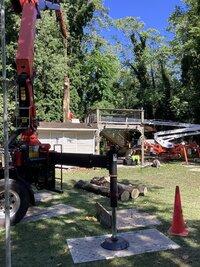
Lucky to be able to get lift and crane on it
The bid spec from other companies attacking it on rope and saddle are adding serious extra man hours to strip a tree like this let only rig it out, I didn’t have time to take pictures until this point it was stripped off down to wood , but look how deep we cut into it shaving it off just to work the tree. When it’s thick you have to just take your time and have extra saws to send up because even the dirt that collects in there beyond the critter nests (we have an over abundance of grey squirrels,) will slow down your saws after awhile
You know how brittle they are so add that extra ivy weight and touch a limb on top watch it snap off barely cutting it. Take your time can’t say that enough with vines , keep lanyard low compared to cutting area , know where it is all time. I remember @warthog years ago on here posting about cutting his lanyard in ivy fest
It’s very easy to make a mistake in that sort of situation trying to fan it off the tree if your not focused intent
Treetopflyer
Been here much more than a while
- Location
- Coastal N.J
I don’t know how that post got mixed up with the photos and reply mixed upHere’s one we did in September
Lucky to be able to get lift and crane on it
The bid spec from other companies attacking it on rope and saddle are adding serious extra man hours to strip a tree like this let only rig it out, I didn’t have time to take pictures until this point it was stripped off down to wood , but look how deep we cut into it shaving it off just to work the tree. When it’s thick you have to just take your time and have extra saws to send up because even the dirt that collects in there beyond the critter nests (we have an over abundance of grey squirrels,) will slow down your saws after awhile
You know how brittle they are so add that extra ivy weight and touch a limb on top watch it snap off barely cutting it. Take your time can’t say that enough with vines , keep lanyard low compared to cutting area , know where it is all time. I remember @warthog years ago on here posting about cutting his lanyard in ivy fest
It’s very easy to make a mistake in that sort of situation trying to fan it off the tree if your not focused intent

ClimbingTN
Branched out member
- Location
- Columbia
I’ve been on a forestry project for over a year killing the TOH. I’ve cut down numerous trees. This property is infested with 100s. We hack and squirt in September so the uptake sends the poison to the roots. The stump gets treated too. If you cut a live one down, several more will pop up. Garlon will get it. They are brittle when dead and have a deep taproot. I will not climb one. Read up on them. CraigWe have a giant live Ailanthus coming up that's completely covered in English Ivy so any and all wisdom is appreciated. This tree looks to be able to house a whole forest worth of critters in just the Ivy. We're removing the whole thing

A single longitudinal cut along E. Ivy can often allow you to pull full sheets off younger growth in the upper reaches. The more mature Ivy on larger trunk wood can be more demanding, and require more effort where masses of tendrils build up.We have a giant live Ailanthus coming up that's completely covered in English Ivy so any and all wisdom is appreciated. This tree looks to be able to house a whole forest worth of critters in just the Ivy. We're removing the whole thing
I will say here same as I say to any client with a poor compartmentalizer covered with E. Ivy…I go by time and materials and will always uncover the entire tree to find ANY structural issues hidden by the ivy before rigging or dramatically offsetting balance with large picks.
Not here to throw anyone under the bus, but I have a close colleague that tied into an Ivy covered tree to access it. He got up 20’ or so and his running bowline canopy anchor ripped off leading to a fall and months of recovery. His running bowline was found on the ground, still tied around the standing part. He and another crew member had double weighted the line before he went up, so the only thing I can imagine is his throwline captured Ivy alone with no actual tree portion inside. Horrible.
Ivy is weak, it is slippery, and in most cases, poorly attached. Slings can slip and slide, wood can slide right out of an ivy sleeve…I could go on. Strip off all you can, or at the very least, clean all rigging and tie off points entirely to clean bark. Leave nothing to chance.

Matias
Been here much more than a while
- Location
- Butte County
That's what I figured. Thanks bud, and thanks for sharing your buddy's misfortune. I'll remember that.A single longitudinal cut along E. Ivy can often allow you to pull full sheets off younger growth in the upper reaches. The more mature Ivy on larger trunk wood can be more demanding, and require more effort where masses of tendrils build up.
I will say here same as I say to any client with a poor compartmentalizer covered with E. Ivy…I go by time and materials and will always uncover the entire tree to find ANY structural issues hidden by the ivy before rigging or dramatically offsetting balance with large picks.
Not here to throw anyone under the bus, but I have a close colleague that tied into an Ivy covered tree to access it. He got up 20’ or so and his running bowline canopy anchor ripped off leading to a fall and months of recovery. His running bowline was found on the ground, still tied around the standing part. He and another crew member had double weighted the line before he went up, so the only thing I can imagine is his throwline captured Ivy alone with no actual tree portion inside. Horrible.
Ivy is weak, it is slippery, and in most cases, poorly attached. Slings can slip and slide, wood can slide right out of an ivy sleeve…I could go on. Strip off all you can, or at the very least, clean all rigging and tie off points entirely to clean bark. Leave nothing to chance.

southsoundtree
Been here much more than a while
- Location
- Olympia, WA
I haven't climbed in two weeks, so to ease back in, we started a new removal job where I set a line/ climbed for 4 hours, until my groundworker left for the day, then burned brush for 4 hours, no break.
No brush left.
No access for a chipper with steep hills.
Still sitting now after a late dinner.
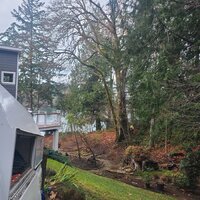
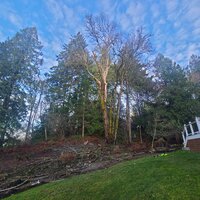
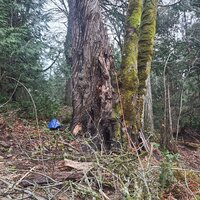
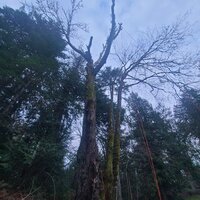
No brush left.
No access for a chipper with steep hills.
Still sitting now after a late dinner.
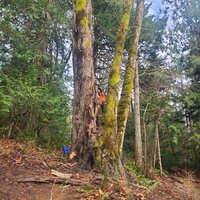
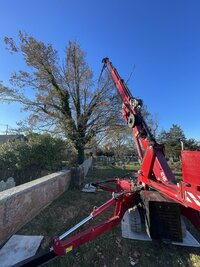
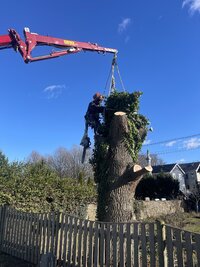
Speaking of English Ivy…here was a bunch in an English Oak. My bro and his mini managed crippling all the picks and forwarding them to the landing except for a final 3,500# pick-&-carry, weaving through the head stones to get out of the cemetery. Great day with a great team!

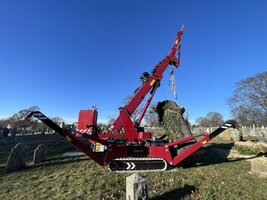
Attachments
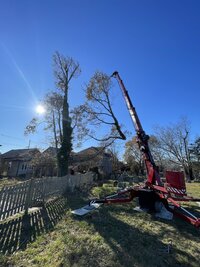
Treetopflyer
Been here much more than a while
- Location
- Coastal N.J
@oceans remind me again your max pick and carry ? That is bad ass !
Max lift is about 8,000. Max P&C isn’t specified as it’s all done in override mode and based on stability/leverage of the load.@oceans remind me again your max pick and carry ? That is bad ass !
The boom has to be in position with the load as close to the chassis as will fit and as low as possible to still allow travel.
You monitor the machine changing angle when raising the outriggers and transferring to the track frames. If the machine begins to tilt into the load, don’t make the pick!
That said, this is possibly the heaviest mass I’ve P&C’d.
Treetopflyer
Been here much more than a while
- Location
- Coastal N.J
Very cool feature for sureMax lift is about 8,000. Max P&C isn’t specified as it’s all done in override mode and based on stability/leverage of the load.
The boom has to be in position with the load as close to the chassis as will fit and as low as possible to still allow travel.
You monitor the machine changing angle when raising the outriggers and transferring to the track frames. If the machine begins to tilt into the load, don’t make the pick!
That said, this is possibly the heaviest mass I’ve P&C’d.

Not all from today but from this week. Some reduction pruning to help mitigate potential failure at basal defects in these Red Oaks, and a little bit of felling too. 2nd picture is with my co-worker in the front, and myself in the back stem. Very tricky climb with the recent snow we got.
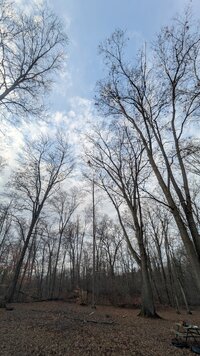
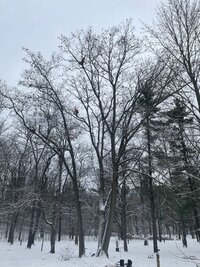
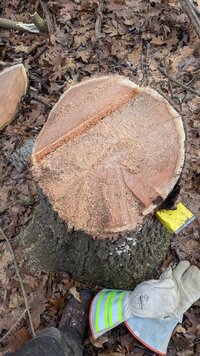
Attachments
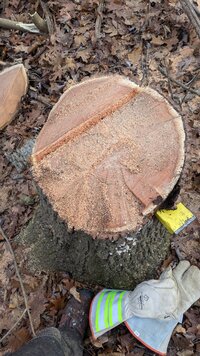

Matias
Been here much more than a while
- Location
- Butte County
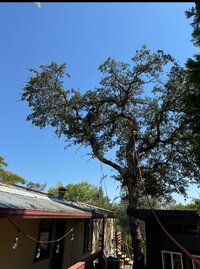
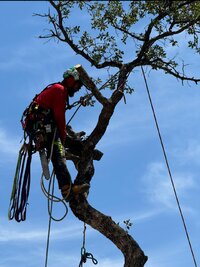
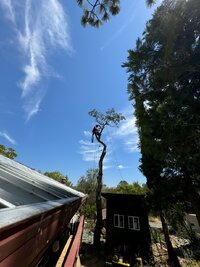
A client called me to ask about trimming his palms, and he mentioned that he had some awesome pictures from the removal I did this last summer. I was really stoked because this was such a tight spot, I really wanted to put them in my portfolio. It was my groundie's first training day, and it got to 112⁰f by midday. It was an awesome gig in between three structures.


chiselbit
Been here a while
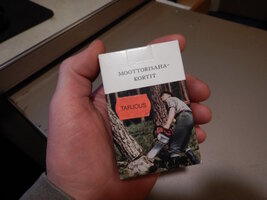
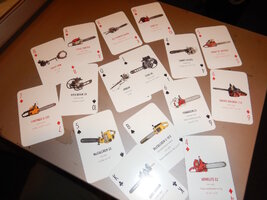
That sally saw looks like it might be kind of exciting to run

Matias
Been here much more than a while
- Location
- Butte County
I have seen a few of them laying around my buddy's place. he has a bad habit of turning saws into lawn ornaments when they piss him off.We used to run so many of those old Macs and Homelite saws, what tanks! When the first small Stihls first became available they had no chain brakes and the hand guards got removed because they just got in the way and hung up on brush, LOL.
Looks like it would be great for limbing sides below you feet as you walk along the top of a large log.That sally saw looks like it might be kind of exciting to run
I like the lightweight bars with holes all over the place.












New threads New posts
-
test
-
-
-
-
 Light 14 or 16" narrow kerf bar for 200t or 201t
- Started by southsoundtree
- Replies: 9
-

-








