TIP setup

72693096372fdd1abc87bd6bbc191ff3.jpg

I don't see anything wrong with that, for years I was just using the buckingham friction savers until it was mentioned at the crane man inc. crane climber course they weren't stamped/rated/tagged . I got this from Dave from American Arborist supplies who had his trailer at the course. 2 same size rings so that if you have a splice it won't get caught up in a smaller ring. Best one I've used yet. At the end of the day comes down to if something ever happened and something was stamped/tagged or rated you could be in deeper water with OSHA or ministry of labour here. Just another issue you don't want to have a deal with if it ever came about.
Devon


Sent from my iPhone using Tapatalk

I use one of these as well. It's very well made, purpose built and rated. All steel makes sense here. And you can take it on and off. You could even use this one the ring that you put floating over the load line. This kicks it out a little to the side and solves the problem of whether or not the shackle fits?

The pinto is a nice and light idea, but I can see that potentially being damaged by the ball swinging against a trunk or something. I wouldn't feel good about using it all of the time.
 
We are thinking of going with a setup like this for our crane TIP. Can we get a critique? If you see something that might not cut the mustard I definitely want to know, but I'd also like to know why it won't.

The set up is on a small crane (2-ton) set up primarily for work positioning on those trees that are not good enough to climb and we cannot reach with a bucket.

Cable is 3/8"the ball is 56#. The rigging ring is forged 1/2"x 4" steel with a 33750# rating. The friction saver is 5/16 Ice Tail spliced onto a pinto.

View attachment 38090

Lot O' ways to skin the crane Tie In Point cat. The one issue with what you have Pictures is that as the ball is lowered through the canopy it can be forced up the cable. Only to be released and coming screaming back down at you! This is generally an issue when it is un loaded, but I have had similar set up get caught and begin to tighten my system on occasion. Perhaps something snugged in between the cable, the wedge and the tail?

Tony
 
Lot O' ways to skin the crane Tie In Point cat. The one issue with what you have Pictures is that as the ball is lowered through the canopy it can be forced up the cable. Only to be released and coming screaming back down at you! This is generally an issue when it is un loaded, but I have had similar set up get caught and begin to tighten my system on occasion. Perhaps something snugged in between the cable, the wedge and the tail?

Tony
That's where I put my shackle. Just have to be careful, I had a groundman hook it up for me once and of course I inspected it before I put my life on it, I called him over and asked him if he saw anything wrong with it. He looked and said "no it looks good" dumbass had it hooked to the tail.
 
Thanks for all the input! Also, thanks for the thoughts on the pinto and ice tail. Pretty much I was looking at it more as an illustration of the concept/configuration/alignment of were I'd be attaching my TIP/FS system to the haul line. I had't even begun to think about the actual FS portion of it so, thanks again for pointing out the concerns on that.

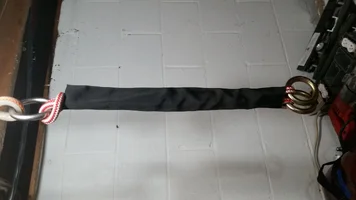
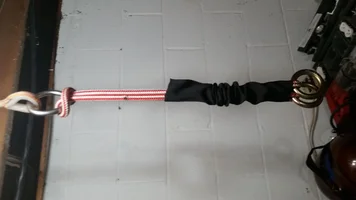
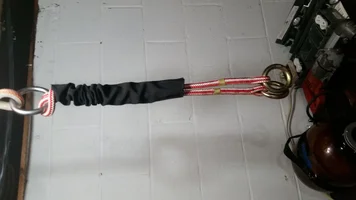
To that end, I put together a steel ring and ring FS (ISC Rings & Yale XTC 16 strand) that can be girthed, or connected with one of he crosby bolt shackles, to the steel ring around the becket and covered it with chafe sleeve. Pics are attached.

I made it long enough so that the rings hang below the ball but slightly above the hook. Any problems with that location? Any benefit to it hanging below the hook?

here are some pics: the first is with the chafe sleeve in position and the other two slide the sleeve away to show the XTC and splices underneath.

20160622_074256.webp 20160622_074306.webp 20160622_074314.webp
 
I think that is a great setup. I liked the bend radius of the rigging ring and the versatility of have the legs of the FS not together but that is not required. I agree with the the sweet spot that is exactly my thoughts as well.
 
So I finally got the crane back from DOT inspection...We Passed!!!!

I also had a chance to try several ways of attaching the TIP/FS. It hangs a bit lower than I expected (error in measuring :() I tried it 3 different ways: First girthing it to the rigging ring at the becket. Second putting a safetybolt shackle through the rigging ring and then running the TIP/FS straight over the shackle and third girthing to the safetybolt shackle.
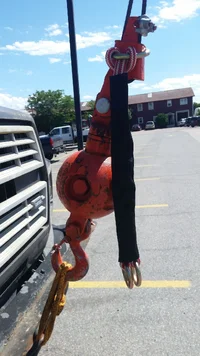
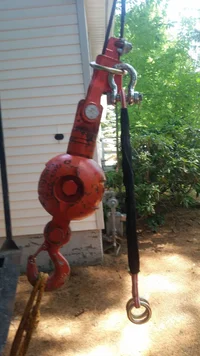
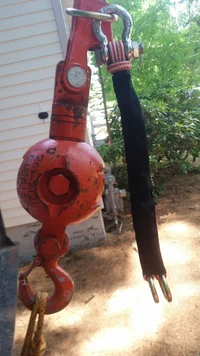
Which method looks best to you guys?

20160623_151221.webp 20160624_141413.webp 20160624_141507.webp
 
Middle picture, I preferr my rope to always be below the hook. Less chance of it rubbing on a sharp edge caused by that 1 time somebody used a metal sling.
 
How long did you make your friction saver? I am going to rig one up primarily for crane work and I am not exactly sure how long to make it, not having a crane sitting in the driveway...
I have always just used two shackles up above the ball but have seen alot of guys just girth hitch a friction saver around the wire rope.
 
So I finally got the crane back from DOT inspection...We Passed!!!!

I also had a chance to try several ways of attaching the TIP/FS. It hangs a bit lower than I expected (error in measuring :() I tried it 3 different ways: First girthing it to the rigging ring at the becket. Second putting a safetybolt shackle through the rigging ring and then running the TIP/FS straight over the shackle and third girthing to the safetybolt shackle.

Which method looks best to you guys?

View attachment 38313 View attachment 38314 View attachment 38315
I like the look of the 3rd best. Girthed to the shackle looks clean.
 
I do too Mark. I did get a comment from one of my own people, though, saying in a "girth" configuration our slings are de-rated by as much as half and he's worried that the same applies to the FS.

Thoughts?


The slings will usally have 3 ratings; Straight, Basket, and Choker with Chocker being substantially less. That is the main problem with friction savers is I don't think they are rated in a choker setup. Not that they don't work that way, but if you use them that way you are not using them in accordance to the manufacturers instructions. That is a big fine if you get a cranky inspector that day.
 
I do too Mark. I did get a comment from one of my own people, though, saying in a "girth" configuration our slings are de-rated by as much as half and he's worried that the same applies to the FS.

Thoughts?
I don't think this would apply here to be honest. For one, we use a10-1 design factor with ropes and slings are typically 5-1, so you are twice the wll to start. Secondly you are using 2 parts of rope, so adjusting for a choker is back to about 1 leg in vertical. Make sense? I hope so because if not I'll blame the jetlag
 
Before we get others confused can I have some clarification on what we are trying to get answered.

1. We are looking for a functional tie-in point?
2. We are looking for a tie-in point that passes the OHSA requirement with our "Arborist grey area" thrown in?

While they "let us" ride the crane now, they have not to my knowledge changed anything else about the ride. I am just as guilty by the way, my lanyard has the snap attached by a scaffold knot and I don't use an OSHA approved tie in system. The Tie-in is an extension of your life line and as such must be rated. Any part of that system, which is used in any manner other than which it is rated, is not compliant. Now I might be getting over critical since Tree work is not my primary job and I might be trying to apply common standards to an Industry where they are not required (yet).

From my point of view @Mark Chisholm the 5:1-10:1 would also not apply. However it would be that I don't think anyone could show me a rating that includes that Girthed configuration. No rating, no safety factor.
 
I don't think this would apply here to be honest. For one, we use a10-1 design factor with ropes and slings are typically 5-1, so you are twice the wll to start. Secondly you are using 2 parts of rope, so adjusting for a choker is back to about 1 leg in vertical. Make sense? I hope so because if not I'll blame the jetlag

I agree since our climbing systems utilize all sorts of knots that have a reduction of strength factor involved. The key, I am supposing, is to have the individual components conform to the minimum tensile strengths. In which case, since my TIP/FS is made of 16 strand climbing line, with Steel Rings and safety bolted shackle all exceeding the minimum tensile for climbing equipment, then this will be more than adequate and defensible.
 
Rick, that's exactly what I'm not sure of. I thought there was talk of the unit as a whole needed to be rated but I can't seem to find any clear definition. Just like them to leave it gray and then yell at you for interpretating the mud as they see it.
 
Before we get others confused can I have some clarification on what we are trying to get answered.

1. We are looking for a functional tie-in point?
2. We are looking for a tie-in point that passes the OHSA requirement with our "Arborist grey area" thrown in?

While they "let us" ride the crane now, they have not to my knowledge changed anything else about the ride. I am just as guilty by the way, my lanyard has the snap attached by a scaffold knot and I don't use an OSHA approved tie in system. The Tie-in is an extension of your life line and as such must be rated. Any part of that system, which is used in any manner other than which it is rated, is not compliant. Now I might be getting over critical since Tree work is not my primary job and I might be trying to apply common standards to an Industry where they are not required (yet).

From my point of view @Mark Chisholm the 5:1-10:1 would also not apply. However it would be that I don't think anyone could show me a rating that includes that Girthed configuration. No rating, no safety factor.
Thats true, there isn't really a reason to talk wll here. I was just saying that nylon straps we use for crane work are typically set with a 5-1 where ropes get placed on a 10-1 . Not important here I suppose.

However, if the rope meets ansi stats of 5400 lbs then it satisfies that part of the requirement. The girth hit h reducing breaking strength was what I was answering and what I was saying is that it is double layered and thus doubles initial breaking strength. Girthing after that is not an issue. And the girth is technically as close as you can get to a choker situation.

We don't require "systems" to be rated as used like the CE standards do. To be usable in ANSI land components have to meet the standard. No?
 
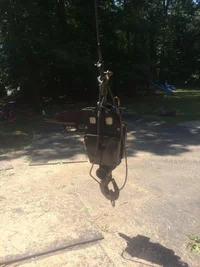
I don't have a picture of it, but I use a screw shackle (safety wired shut) on the cable, a 6' eye-n-eye wire rope choker with both eyes on the shackle, and a large heavy rigging oval on the cable for my smooth tie-in point. Everything is steel and therefore won't get snagged or picked by branches. I'll try to grab a picture.
IMG_0785.webp

This block was a little shorter than many I use, which put my tie in lower down by the hook than I would prefer, but it still works very well. We keep the safety pin in the main hook all the time too, so they can't get cross hooked when banging around.
 

New threads New posts

Back
Top Bottom