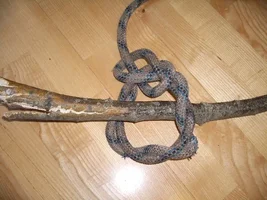
timbowline

hi guys, new to this forum. thought you might be interested in a new knot i've come up with for rigging applications. i've called it a timbowline for obvious reasons. it seems to be more secure that the standard bowline or timberhitch. it appears to have all of the advantages of each knot and yet none of the disadvantages!!! i was motivated to create this knot after all the argument about which is the more secure knot. would be grateful for any feed back on this new rigging knot.
stop topping, start pollarding.
peace and flexability!
 

Attachments

  • 23394-IMGP0443.webp
    23394-IMGP0443.webp
    60.4 KB · Views: 197
Welcome to Treebuzz!

That looks like a much more secure timber hitch.

Why not just use a running bowline with some kind of backup?
What is the advantage of using the TB?

Please don't take the questions as critcism. I'm just trying to see the advantages.
 
Tom,
come on, can't you see, the advantages should be fairly obvious. as i said in the original post this knot combines all the advantages of both the parent knots and very few of the disadvantages. the extra time it takes to tie should be regarded as a strength of this knot as it allows us to assess the whole rigging set-up before commiting to the final cut. and as you know saftey should never be sacrificed for speed!
peace and flexability.
 
[ QUOTE ]
Tom,
the extra time it takes to tie should be regarded as a strength of this knot

[/ QUOTE ]

I know this is nit-picky- but you say strength. Are you really talking about security of the knot, however?

Your adaptation does not make the knot stronger, per se. But it may lessen the chance of it coming undone, right?

love
nick
 
this is a very 2 dimensional veiw you are taking Nick. think not of the physical factors involved here, but of the peace of mind afforded by the TB.
peace and flexabilty!
 
I was not saying this adaptation was better or worse, simply clarifying terms.

But, fwiw, it seems this knot may be overboard. Are there issues with the bowline coming undone? Especially when it is preceded by a marl or half-hitch?

love
nick
 
My rigging setups rarely use a timber hitch. When I do use a TH the eye is only loaded or unloaded. I never use a TH when the load will cycle on and off.

The bowline is used a lot. I haven't had a problem with a bowline loosening, inverting or being the weak spot in a system in over 35 years of rope work starting in Boy Scouts. There are others who always backup the bowline. When I use knots and hitches I account for effeciency [strength] loss.
 
hi Nicky,
i am finding some of your terms hard to understand. what is fwiw? and what is a marl? could you explain a bit more. thanks.
peace and flexability!
 
tom,
dr shigo said (not an exact quote) that most of the problems come from not defining the terms we are using. i think this is what is happening here. WHAT DOES efficiency and strenght mean to you?
peace and flexablity!
 
[ QUOTE ]
hi Nicky,
i am finding some of your terms hard to understand. what is fwiw? and what is a marl? could you explain a bit more. thanks.
peace and flexability!

[/ QUOTE ]

Im dutch so dont shoot the messenger :)

FWIW = For What Its Worth?

Marl = a knot

See the MARL PRIEM STEEK on this page photo serie about a Marl. .
 
Pete Donzelli gave us the idea of rope/knot efficiency. Here's what he shared with me.

A rope has a strength of X. We tie a knot/hitch in the rope. When we untie the rope it has the same strength unless it's been damaged. Let's stay in the theoretical world though and not consider damage. The difference between the rope's load carrying capacity with or without a knot/hitch is the efficiency.

The most efficient anchor is a tensionless anchor. I think Dave Spencer illustrated it in the speedline thread that's active now.

More commonly we think of the rope loosing strength but that isn't as accurate as thinking about efficiency. I know that all this comes down to is a mostly a semantic difference. But, for me, I can visualize the whole system better when I think of efficency rather than strength loss.
 
Okay, real quick-

Strength and efficiency, when talking about knots, are the same thing. One could say that the figure 8 on a bight is a stronger (more efficient knot) than the bowline, seeing as how, depending on the cordage it's tied in, the fig 8 retains 80(ish)% of the strenght of the rope and bowline can be closer to 60%.

The other issue, the one I think we are considering with your adaptation of the bowline is that it may be more secure- less likely to untie itself. Note we're not talking about the rope actually breaking here, but if someone were to tie a bowline in some real slippery rope, it may just untie. But if they were to employ your timber finish on it, they won't make the knot stronger, per se, but it would be more likely to hold the load without untying itself, thus- it is more secure.

But, as Tom has eluded to, and I asked about in one of my first posts on this thread, there really is not a problem with the bowline coming undone. At least not in our industry and not with the ropes we use.

More, importantly- welcome to treebuzz! Don't think we don't like you just because we're being critical of your knot.

love
nick
 
As a strength consideration; i think a timber hitch spiral as a loose eyesplice; in that it's pulls are not leveraged perpendicular across the line to lock with half hitch etc.; but rather the bitterend just spirals down the columnar length of the line device, in the only unleveraged direction down the support of the line; not across.

i don't think that strength is increased either, perhaps decreased; but security would be higher i think as Nick said. i would go with running bowline preceded by half hitch mostly rigging; Timber/Killick on dragging, but consider Timber/Killick 'braid' as a different kind of thing than we usually see (except in the way that VT/MT class pull directly down the length fo the line, instead of half hitching across). i kinda think that bowline/DBY is very flexible utility.

Once again one of my best external sources is KnudeKnoggin. i think that Nick refers to marl as what properly/Ashley is a marling hitch would parrallelle a preceding half hitch except the working end does an underhand rather than overhand loop to finish, reeving thru the bight, not passing around. Whereby, a preceding half hitch slipped off the end of spar would melt into nothing, just like a list of preceding half hitches, slipped off the end would. But precideng a marling hitch would leave an overhand knot in the line if slipped off the end. This grabs better after set properly than a preceding half hitch; also if you have a pulley as redirect, and bowline is untied each time, this overhand can serve to keep line from coming out of pulley on return up. Also according to KnudeKnoggin/Ashley/Cyrus Day; to marl a spar is to run a series of either down it. But in the Arbo sense i guess it is accepted as marl being short for marling hitch; seperate from a list of preceding half hitches. These pull down the length of the host/spar unleveraged(thus make load drag straight on ground), take the primary loading off the weakest link (knot), add more security etc.

i think that all running bowline/ timber hitch etc. single chokes through eye should be used on pulls perpendicular to host spar; but pulls down the columnar/length of the spar should have preceding half hitch/marl. Because the grip of the choke in running bowline etc. is unleveraged on perpendicualr pulls; as the choke secures across the spar, just as the standing end pulls. But always the choke across the spar to secure is leveraged by a pull down the length of the spar, because the loaded axis of the standing part pulls perpendicular to the grip axis of the choke across spar diameter. The perpendicualr pull's choke can be more of a relaxed, unleveraged angle from choke on line.

Arbo gear and rigging advances etc. keep the English Language as an alive and dynamically expanding thing at TB; even in re-calling old words; form the olde world.
 
[ QUOTE ]
Strength and efficiency, when talking about knots, are the same thing

[/ QUOTE ]

Yes and no. To be more clear, I agree with Tom. What I mean is that your terms (Nick) the way you used them are right (to me). But, what Tom said is even more accurate. When you say a knot retains more strength, it is more efficient. When you tie a knot in a line it loses efficiency (not strength) because it isn't a permanentloss. Does that make sense?
 
Fair enough, Mark. But if we take a piece of rope and tie a fig 8 on a bight on one side and a bowline on the other, then break test it, and the bowline breaks, it would be safe to say that the fig8 is a "stronger" knot. This is the way I was using that word.

I think I just resaid what you just said. That was redundant and repetitive.

love
nick
 
The only problem I see with this knot is that the timber hitch requires a choke to load the knot properly. By putting the bowline in it you are removing the choking action and not allowing the coils to properly share the load.

Dave
 
sorry i wont be taking time to learn your knot, a bowline or a a timberhitch work well enough and will not take as long to tie, or be as confusing to untie when buried under a head of a tree.

jamie
 
[ QUOTE ]
Tom,
come on, can't you see, the advantages should be fairly obvious. as i said in the original post this knot combines all the advantages of both the parent knots and very few of the disadvantages. the extra time it takes to tie should be regarded as a strength of this knot as it allows us to assess the whole rigging set-up before commiting to the final cut. ....

[/ QUOTE ]
Tom's direct question was Why use a Timber H. vs. a Bowline Noose,
something preceding the issue of "Timbowline" loopknot.
As I see it, the advantage of the TH is very easy untying, and perhaps
also not having the material of the knot bulking into some abrasion
against a surface (i.e., one has just the dogged tail & wrap protruding
vs. the knot of the (Running) Bwl to bump into something on the ground).
The advantage of either the hitch or noose over TmBwl is that they tend
to draw up more snug to the object and so inhibit slippage along it,
as opposed to the loopknot. In short, what TmBwl offers is just some
way to secure a long tail. How much advantage that is can be seen in
the demand for an end-securing structure--not much, I sense.

This topic of course led me to muse over some other adornments to
either knot. I've previously recommended that one consider tying the
TH with a full turn around the mainline, which will give some friction
hitch-like gripping of the mainline, and enable the hitch to be set up
more snug to the object, thus 1) preventing loosening (easily) and
2) making a kinder-gentler bending of the mainline at that point
under load--and 3) make the end more securely held (recall LuvNik's
shocking experience of dropping a load onto a TH which came undone
and left his clients (fortunately) in awe of his dramatic load-landing
skills (while he & helper were messing their pants :o) ! The full turn
should reduce the force upon the end.

As for my late-night musing, one could tie the TH, then pull the bight
end a bit away from the mainline, and cast a Half-Hitch in that line
around the bight end (forming a sort of Halbmastwurf/Munter'sH./
Crossing Knot structure), and by drawing on bight tip snug up one's
tie to the object!? Effectively, you have a loopknot, but one in which
the encompassing eye can be set pretty snug. YMMV depending
upon rope. I've not played around with this in many materials,
but that's why there's TreeSpyder. (-; (The rope in the TmBwl image
looks to be of an ornery stiffness, not conducive to late-night musings,
or to round turns on the mainline for the TH!)

*knudeNoggin*

 

New threads New posts

Back
Top Bottom