Throw line tricks and tips learned over the years

Of course use two weights to drag two strings worth of friction. One weight is the right weight to get one line to pretty consistently drop. BE SURE to make them close enough to not twist around anything (hickory suckers are dreadful) and make a mess.

A buddy of mine has some tubular webbing isolator bags. He fills lengths with shot for loading shotgun shells (available lead free for waterfowl) and sews hardware store welded rings in the ends. Heat shrink or e-tape to keep the shape.
He made me a 28oz one a few years ago. I have no idea where I lost it.
 
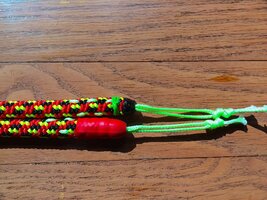
I’ve been looking all over this website… Someone posted photos of a small loop of throw line spliced/whipped/heat shrunk into the end of a climb line. It was more of a permanent thing. Can anyone point me in the right direction if you remember seeing this or know the method?
 
I’ve been looking all over this website… Someone posted photos of a small loop of throw line spliced/whipped/heat shrunk into the end of a climb line. It was more of a permanent thing. Can anyone point me in the right direction if you remember seeing this or know the method?
I have no photos, but this works great. Something a little heavier than a throw line is better, boot lace/para cord. Etc..
or pull a few inches of core out and cut, milk back in, brummel or fold the cover over into a small loop and sew down. This method leaves more of a risk if a mistaken load bearing splice.
 
My throw cube has loops on two opposing outside bottom corners. I store a retrieval ball on each one. When I want to deploy the cube, I stand on the retrieval balls to secure the cube base as I twist open the cube. Saves the cube corners and I always know where my retrieval balls are.

When flaking the line back into the cube after a throw, I feed 12-13 pulls of line in, then rotate the cube 90 degrees, then flake in another 12-13 pulls, rotate cube 90 degrees. Rinse and repeat until it's all in. Seems to greatly reduce the tendency to tangle.
 
If you have a climbing or rigging line in a block or friction saver and want to swap a different line in there, a short piece of throwline with a loop on each end can be used to link the new rope end to the tail of the currently installed one. Girth the throwline to each line so it acts as a bridge of sorts between the two ends. Pulling the installed line out will install the new line.
 
I have no photos, but this works great. Something a little heavier than a throw line is better, boot lace/para cord. Etc..
or pull a few inches of core out and cut, milk back in, brummel or fold the cover over into a small loop and sew down. This method leaves more of a risk if a mistaken load bearing splice.
A moving picture is worth a thousand words . . . one way to attach a loop at a line end termination.
 
If you have a climbing or rigging line in a block or friction saver and want to swap a different line in there, a short piece of throwline with a loop on each end can be used to link the new rope end to the tail of the currently installed one. Girth the throwline to each line so it acts as a bridge of sorts between the two ends. Pulling the installed line out will install the new line.
I've sucessfully taped two ropes together to swap to a heavier rope through a block.
 
I've sucessfully taped two ropes together to swap to a heavier rope through a block.
tape would work well if you have it on hand. The throwline piece is reusable though and almost always on a jobsite. I keep the little one I made on the handle to my gear bag. Its actually come in handy more than a few times for various things.
 
I've always got athletic/ cloth tape, duct tape and electrical tape on hand in my main truck.

I have a little piece of throw line in my cube and will keep it in mind for this need as well as changing ropes through a natural-crotch, should that arise, like changing a climbing rope for a pull rope.
 
Kline tools sells a device that has a "Chinese finger trap" on one end and small cable loop on the other at Home Depot. Two of those linked together works well.
 
Those work for a little while when new, but as they are made out of fine braided wire, as soon as one of the small wires breaks it catches deep into your rope and makes it a pain to get off. Then you put it away in your electrical stuff in case you ever have to pull feed cable through a conduit.
 
I rarely remove my throw bags. I tire an overhand blocker on my climbing line after the metal throwbag ring.


Having the weight at the interface helps do some subtle manipulations, and even gets the rope end/weight to do some productive jumps over crotches by having the interface 1-2' below the crotch and giving a hard, quick pull.

Occasionally, I tie my throwline with clove/ half-hitches to the rope for low-profile needs.


Gith hitching the throwline 2' down the rope will get it through a lot of forks, quick and ez- on/ez-off.
Does not work for leaving a throwline in place of a rope.
 

New threads New posts

Kask Stihl NORTHEASTERN Arborists Wesspur TreeStuff.com Teufelberger Westminster X-Rigging Teufelberger
Back
Top Bottom