Throw bag launchers and DIY…

Sure, this is the one that I bought from Amazon:

I have purchased these lasers a few times, and every time I buy one, I find it sold under a different brand name, located at a different link. I have a feeling that Amazon takes them down once they find out how powerful they are.
 
Scopes and red dot sights are very limiting in that you need to hold the launcher close to your face in order to use them. While that works great on a gun, an APTA is more stable when held against your hip or even the ground, like a mortar.
I believe it would be more stable.


I have shot from the shoulder, successfully for a long time.

A sight would help.

Being more determined not to move the APTA when opening the valve would help more.

Generally, I'm a single or double shooter or thrower, but sometimes it is 10 tries.


I'll see what I can set up and let you know, when I get a round tuit.
 
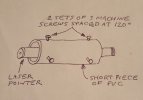
For a laser pointer mount, I'd just make one from a scrap of pvc.
20220514_203931.jpg
After you figure out how to attach it to your launcher, just run the screws in enough to securely hold the pointer. You can adjust one set of the screws (typically the front set) to adjust the aim up/down and left/right as needed to get the laser pointing parallel to the launch tube. A dab of hot glue or something on the machine screw (or thumbscrew) tips may aid holding the pointer. If the laser pointer has the typical button on the side for on/off, you could add another screw that could be used to depress the button and keep the laser on when you're launching. Alternatively, you could cut away part of the tube as required to access the on/off mechanism.
 
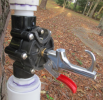
Surely someone has made a mechanical device to quickly open a manual ball valve. Maybe a length of surgical tubing and a cam-like replacement for the valve handle.
 
Surely someone has made a mechanical device to quickly open a manual ball valve. Maybe a length of surgical tubing and a cam-like replacement for the valve handle.
I haven’t seen one yet, but I’m working on some ideas. Most of the manually activated quick acting valves are only for 1/8” or 1/4” line which is way too small for our purposes. I think part of the problem right now is the whole supply chain mess and inflation
 
I've got a quick exhaust valve that I think is 1" from a potato cannon I built a very long time ago. I've been wanting to repurpose it into an APTA style launcher, but haven't made the time to do that. It will shoot potatoes a good 200 yards, so I'm sure there's plenty of flow through the valve to launch a throw bag. To trigger the valve, you just tap a button, so it's a much better trigger than a ball valve as far as maintaining aim while firing.

I like the laser aim idea
 
So I did use my big air cannon a few times and sights are definitely needed. Haven’t yet worked much more on that idea, but I’ll turn some attention to it before long. Apparently it’s quite accurate because I smacked the same branch with the throw weight dead center at least a half a dozen times. I was trying to get over that particular branch though and power for height was not at all the problem (I got mad and tried putting more pressure in which resulted in a nice throw into the next tree over and about twice as high as I was trying for, lol).

Last night I built a smaller version, 1’ long air chamber and 3’ of barrel, but the same basic design as my big one. No testing of that has been completed yet.
 
I did end up doing a little playing around with my little air cannon yesterday. Didn’t really do any specific testing but 40/50 psi was putting the 12 ounce weight up about 75’ so by halving the pressure chamber I doubled the pressure needed for the same results as the big one I built. Didn’t really expect it to be a linear change like that. More testing will be required…

I‘m also going to start poking around for a better valve solution. One thought that crossed my mind was the possibility of fabricating a different lever or a lever adapter to make it easier to quickly open a ball valve. And of course there’s the sighting system to address…
 
Hate to be the guy to pee in your Kool Aid but PVC really shouldn’t be used for compressed air.


Just google PVC compressed air and you get all kinds of OSHA bulletins on this. The main reason I have a problem with it is firstly because it is not meant to be used for compressed gasses. Second, tree guys are hard on things and at times push the limits. Can’t get that shot, keep pumping a little more. How many PSI can it take for how many times? How about when exposed to UV and heat cooling cycles in a vehicle? And how many cycles to failure does PVC have?

I used to do a lot of repair on PVC doing sprinkler system installations and modifications. Saw a lot of broken pipe and often times in shards. As someone legally blind in one eye, I will not work around people using air cannons made with PVC rather than metal and certainly wouldn’t allow it on my job site.

Lastly, don’t you think if PVC was suitable for this, that the manufacturers of these things like Treestuff would be selling you an all plastic APTA assembled in China for $3 and they would charge you $49.99! Have one of these things blow up in your face and no matter how big of a laser sight it has on it you won’t be able to see it.
 
In case reading that link is too onerous, here is probably the best bit in there. This is from a manufacturer of PVC in 1988. The part how he describes the difference between how gasses work when under pressure and how liquids work is likely the most important part in our conversation.


To Whom It May Concern:

From time to time, I receive inquiries as to the suitability of using PVC pipe land fittings in compressed gas piping systems. While the benefits of use may be enticing, it is a very dangerous and, in some states, illegal thing to do. For example, MIOSHA (Michigan's branch of OSHA) prohibits the use of PVC plastic in compressed gas systems unless properly encased in steel, cement, or some other approved material. Please check your local and state regulations.

The main problem with using PVC pipe and fittings for compressed gas is not that it spontaneously explodes but that PVC is a brittle material that can be broken or shattered with external force unless properly protected. Compressed gasses can be best described as being analogous to a coiled spring. When a PVC pipe or fitting fails when under stress from compressed gas it literally explodes like a bomb, sending shards of plastic flying several feet in all directions. Liquids, on the other hand, being compressed by only 1/10th of 1% contain very little stored energy. When pressurized systems with liquids fail, the energy is dissipated very quickly, thereby creating a much lower potential for hazard.

Colonial Engineering does not recommend the use of PVC plastic pipe fittings in compressed gas service.

If you have further questions regarding this matter please feel free to contact me directly.

Sincerely,

Jack Roach


  • ESLON THERMOPLASTICS, INC.
  • P.O. BOX 15894, CHARLOTTE, NC 28210
  • DATE: July 11, 1988
  • 704-889-2431 800-438-7881
 
It's not only the PVC pipe walls giving, which most people think about, but also threaded fittings, turbulence from dimensional changes in the gas path and on and on. If you have a smaller diameter pipe with a larger gas reservoir and say a valve and threaded connections of some sort in your design, consider the force on the plastic surface area and threaded connections and even things like temperature changes due to gas expansion (Joule-Thompson effect) and the like. The stress on plastic parts can add up quickly and especially over time cause fatigue cracking, on the way to failure. Even 80 to 100 psi air is nothing to fool with especially, if it hits exposed skin. Think of injection injuries with sprayers. If you're shoulder launching your bags, well not anywhere near my face and neck thanks. Just my two cents.

(BTW for scary real life demonstrations of the power of a compressed gas, look up some of the steam explosion incidents in process industry - I've seen 2 km of 24" piping whipped off pipe supports and moved around fifteen feet - awesome power as the steam starts moving a liquid (condensate) slug around at near supersonic speeds - why we have steam traps for liquid removal!). In my books, any compressed gas demands real respect and a pause for second thought.
 
Hate to be the guy to pee in your Kool Aid but PVC really shouldn’t be used for compressed air.


Just google PVC compressed air and you get all kinds of OSHA bulletins on this. The main reason I have a problem with it is firstly because it is not meant to be used for compressed gasses. Second, tree guys are hard on things and at times push the limits. Can’t get that shot, keep pumping a little more. How many PSI can it take for how many times? How about when exposed to UV and heat cooling cycles in a vehicle? And how many cycles to failure does PVC have?

I used to do a lot of repair on PVC doing sprinkler system installations and modifications. Saw a lot of broken pipe and often times in shards. As someone legally blind in one eye, I will not work around people using air cannons made with PVC rather than metal and certainly wouldn’t allow it on my job site.

Lastly, don’t you think if PVC was suitable for this, that the manufacturers of these things like Treestuff would be selling you an all plastic APTA assembled in China for $3 and they would charge you $49.99! Have one of these things blow up in your face and no matter how big of a laser sight it has on it you won’t be able to see it.
Listen, I respect where you’re coming from, but hear me out on this all…

What started this was looking on YouTube and such and seeing guys building throw bag launchers out of 2’ sections of 1.5” PVC with a 3/4-1” ball valve and I’m hearing pressures of 100-175 psi, which honestly kinda worried me. Sure, PVC has ratings on the pipe and 1.5 is listed at 320 psi, 4” at 220 psi, the 2” ball valve at 150 psi…

I wanted to build a metal one, galvanized pipe and the works. Stainless would have been really sweet but for sure out of budget. Then I priced out building a metal one and it was not really budget friendly either. I also was undecided as to precisely how I wanted to put the metal one together, do I do a Treestuff APTA knock off? Or do I experiment with modifications?

PVC seemed like a good place to start, for the same money I would spend on an APTA knock off, I could make a couple different PVC ones and some more in-depth testing before I build anything metal. I also thought that I could make some modifications to the design. Granted, what I ended up building, made of metal, would be uselessly heavy, but I’m not done yet with building and testing either. I’m building one, spending time here and there testing and playing around with it, posting it places and gathering input, then moving on to the next. Consider it gathering some more extensive information. R&D stuff.

Back to where I had been looking at how other people did it. The valve I saw as a potential restriction right off. We aren’t trying to power an air tool, we are trying to impel force as quickly as possible to the throw weight before we run out of barrel at which time acceleration stops and deceleration begins. The shorter the barrel, the less time you have. The smaller the valve, the slower (relatively) the air can move past. To some degree higher pressure can compensate. But that brings us to more pressure and something else that I was attempting to reduce, even with a metal one.

So I borrowed a page from pumpkin chucking contests. There are two main schools of thought with the air powered pumpkin chuckers. High pressure/low volume (your typical APTA and knock offs), or low pressure/high volume. I went rather large to start, in an attempt to reduce pressure by increasing volume and to help the bag along in a low pressure scenario, a longer barrel. I was initially worried that a 2’ long pressure chamber would not be enough to yield a significant drop in pressure so I made it modular where I could thread on additional length. I was venturing into uncharted territory with this all so I needed data. I have been rather surprised by the results.

The pressure chamber has always been my worry, it’s naturally the most dangerous part of this. I consider the valve as part of this assembly if you will. The barrel is largely a non-issue as to being of PVC, it really never sees full pressure because the throw weight is moving down it when the valve is released. I did initially have a concern about the space between the bag and barrel possibly being a problem of some sort, but I have a piece of heavy gauge wire at the bottom of the barrel to prevent any chance of the bag potentially getting wedged there which could cause a pressure spike. The lower pressure air then filling the space seems to be a non-issue.

With 70 psi in the first (and largest) I built being capable of putting a 16 ounce weight above the trees here, my concerns about the PVC holding are minimal. I would be a lot more concerned about 150 psi which is what a lot of people on YouTube are doing. That’s a far smaller safety margin. I don’t leave these charged up even being a much lower pressure. The pipe was cleaned, primed, and glued with high pressure solvent and let stand for over 24 hours before use. They are stored out of the sun and heat with the valves open. Sure, eventually even that won’t be enough to keep them from becoming brittle, but they will last long enough for my purposes.

I’m not having a bunch of gorillas manhandle them around a truck toolbox and job site so I’m not particularly worried about damage from rough handling. I’ve always taken great care of my tools and gear and this is being used more on an amateur level. I’m not a professional arborist and don’t really intend to be one. I do however like learning useful things and tinkering/experimenting. Sometimes I’m successful with a project but it’s not practical for everyone. My big PVC air cannon could certainly be made of metal. Heck, to even cut weight down you could probably safely use a PVC barrel even in commercial settings. But the air chamber and valve assembly is going to be a heavy chunk of steel, which likely would ruin most practicality for commercial use. For me however? Well, it would be something I could deal with.

Now, my experiments with making smaller versions does start to open up more possibilities. But I couldn’t just jump down to an APTA size without gathering more information. I wanted to see how a size reduction would affect performance. So I cut the air chamber in half and shortened the barrel by a foot. At that point I was still expecting good performance with reasonable pressures, which I apparently got. I’ll have to test it some more, but I was actually surprised to note that there appears to be a linear change. Half the air chamber size required twice the air for the same results. I sort of expected some non-linear change or an indication of a bell curve. If testing bears that out, there will be another, yet smaller, build. But it will be based on calculations from the first two. If that follows suit and performance is directly related to the first two, then I’ll be able to calculate how to build air cannons, metal or otherwise, to meet certain performance requirements.

I also want to experiment with valves when I can to see what that can do. Maybe I can come up with a design for a metal one that beats everything on the market while remaining practical for commercial use. Maybe I can’t and just end up with a bunch of experimenting and a lot of fun doing it. I haven’t really thought that far ahead yet, I’m just having fun with tinkering and seeing where it leads.

 
In case reading that link is too onerous, here is probably the best bit in there. This is from a manufacturer of PVC in 1988. The part how he describes the difference between how gasses work when under pressure and how liquids work is likely the most important part in our conversation.


To Whom It May Concern:

From time to time, I receive inquiries as to the suitability of using PVC pipe land fittings in compressed gas piping systems. While the benefits of use may be enticing, it is a very dangerous and, in some states, illegal thing to do. For example, MIOSHA (Michigan's branch of OSHA) prohibits the use of PVC plastic in compressed gas systems unless properly encased in steel, cement, or some other approved material. Please check your local and state regulations.

The main problem with using PVC pipe and fittings for compressed gas is not that it spontaneously explodes but that PVC is a brittle material that can be broken or shattered with external force unless properly protected. Compressed gasses can be best described as being analogous to a coiled spring. When a PVC pipe or fitting fails when under stress from compressed gas it literally explodes like a bomb, sending shards of plastic flying several feet in all directions. Liquids, on the other hand, being compressed by only 1/10th of 1% contain very little stored energy. When pressurized systems with liquids fail, the energy is dissipated very quickly, thereby creating a much lower potential for hazard.

Colonial Engineering does not recommend the use of PVC plastic pipe fittings in compressed gas service.

If you have further questions regarding this matter please feel free to contact me directly.

Sincerely,

Jack Roach


  • ESLON THERMOPLASTICS, INC.
  • P.O. BOX 15894, CHARLOTTE, NC 28210
  • DATE: July 11, 1988
  • 704-889-2431 800-438-7881
I have done a little reading and research on this and this particular point was made because people were trying to use PVC and CPVC for compressed air systems in garages and buildings because it was cheaper than the “made for” metal and plastic lines specifically made for compressed air service. Not to mention the oils from a lot of compressed air systems can negatively affect the plastic.

Not trying to say there PVC is safe to use for pressure, just that this particular bit of information came out because of specific circumstances.
 

New threads New posts

Back
Top Bottom