
The use of Static line for working a tree.

countryboypa31

New member
Location
PA
I decided to start a new thread for the discussion of the safety aspect of Static lines for working the tree, as i don't wanna derail my other thread
grin.gif


My feeling is that with the system i use (as well as others) for SRT climbs has very little difference to rappelling. Which is the designed use for these type of ropes. The Kong Robot is a rappel device and i simply have it backed up with a hitch, which allows me to control my descent speed as well as stop at any given point.

There is always the concern of using a low stretch rope that we could be exposing ourselves to a higher risk of injury if we experience a fall. I can go a couple different direction with this, some i covered in the other thread. To refresh, I almost never isolate my line (i actually try not too) as this can create a backup if my TIP were to fail. In SRT this is possible. With Ddrt systems if your TIP fails your headed straight to the ground with little chance of being caught. A low stretch rope might cause a more sudden stop in SRT but is much preferred in my opinion.

Next would be the issue of stretch if you TIP doesn't fail. My understanding is that in a Ddrt system since twice the rope is in the system that there would be greater elongation in the rope. (Maybe its best to make a small video explaining) With SRT since my rope runs the length of the tree and is attached to near the ground there is always going to be more rope in the system. (again maybe i should just make a short video)

I've written enough to start we'll see where it goes from here.
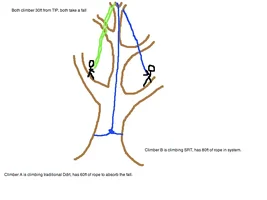
 
Here is a small picture showing that in an SRT system there will always be more rope so it allows the use of a rope with lower elongation with out loose much energy absorption.

I'm not positive on any of this. Part of why i'm hoping to start the conversation so i can learn as well. But this is my understanding. Am i correct?
 

Attachments

  • 246355-Stretch.webp
    246355-Stretch.webp
    21.9 KB · Views: 171
OK, use the same rope in the two systems AND using a zero friction device for the DdRT TIP and the SRT redi.

Now, there will be more rope in the SRT which will mean more stretch. In DdRT the doubled rope system becomes twice as strong but half the stretch.

The consideration with SRT is that the redi has friction. So, depending on the amount of friction there is more or less rope available to absorb the load from a fall. If the TIP has 100% friction then the downfall end of the rope really isn't available to absorb the load.

If the climber is the same distance from the TIP/redi, and the same rope, in each case then the SRT will absorb more stretch.
 
Gotcha, makes sense.

I hadn't thought about in Ddrt since the rope is doubled it is twice as strong so half the stretch.

I guess its impossible to test and compare truly as there are so many unknowns.

Now i'm wondering, how much energy absorption is there really in either system. I mean the numbers i've seen for stretch is normally for around 300lbs. I've yet to see a 300lb climber. So even in a Ddrt system a frictionless device as a TIP and i take a fall while 30ft from my TIP how much energy absorption am i really going to experience? Will there be that great of a difference to say i'm more likely to get injured climbing with a low stretch static line or a typical arborist climbing line?

Anyone have some numbers or tests on this?
 
I have heard that the elongation of km111 in a srt configuration is very simular to the elongation of an arborist line in dwrt. (tachion)
 
lol true, i guess i'm more thinking about all the unknowns that would make it hard.

Plus i know i try to climb in a way as to not expose my self to a "fall" I should never have that much slack in my line. Any "fall" would really be more of a swing. Does the stretch of the rope matter at all then?

All these thoughts really comes back to the main question, is there a problem with using an ultra low stretch rope in an SRT climbing system. Whats the main reason we don't use these type of ropes in Ddrt climbing? I always thought it had to do with the bend radius while low stretch ropes are rather stiff and need a larger bend radius, but is it more about the energy absorption factor?
 
i have a 10 ml KM3 thats too skinny. I find the tachyon too bouncy. I still keep going back to poison ivy. i like the feel too and its one of the lower stretch arborist ropes out there,
 
Yeah tachyon is way to bouncy. velocity is good and has a nice feel but is just slightly to skinny.

PI will probably be my next arborist rope. I'll use the tachyon till it needs retired first though.

I switch off and on with using a static line and an arborist line when climbing. I am more efficient when using a static line. With out a doubt.
 
[ QUOTE ]
To refresh, I almost never isolate my line (i actually try not too) as this can create a backup if my TIP were to fail. In SRT this is possible. With Ddrt systems if your TIP fails your headed straight to the ground with little chance of being caught. A low stretch rope might cause a more sudden stop in SRT but is much preferred in my opinion.

[/ QUOTE ]

True enough. Keep in mind that when we don't isolate our lines, we invite failure not only of our TIP, but of all the other points where the line goes over tree branches. This is a big issue with some larger trees, especially big doug firs where we can't even see the TIP or the path of the line. An access line shaking off a twig on the un-isolated side can cause a climber to take a surprisingly long fall.

Not dogging you; I think your reasoning is sound and I do the same thing, just making sure we're all on the same page about this potential hazard which I have some experience with.
 
Thats an excellent point to make sure everyone remembers. Its also a great example as to why test your ascent line before ascending. Giving a couple of bounces on it really works well and should always be done.
 
QUESTION: If there's a worry about taking a shock from a fall on SRT, would it make sense to add a shock absorber (like a Yates Screamer) somewhere in the life line? ... maybe at the anchor point?

Screamer01A.jpg
 
A Screamer could be used...but...look at what load is needed to trigger the Screamer...

I had this in my SRT system a couple of years ago. After going through the numbers and talking with Paolo we decided that the Screamer is unlikely to trigger in a fall.
 
I know a pilot who is paralyzed from a crash landing in a small aircraft. In response to this tragedy a local engineer designed and built an S shaped aluminum frame to support the seats. The S frame has a long spring inside to allow the frame to deform in a controlled manner, which is now a design mandate of the FAA for small aircraft seat frames.

It seems it would be good to have an ascender which would slip for a ways in a controlled manner under a shock load, which is in fact what happened when I shock loaded my OAR ascender.
 
[ QUOTE ]
After going through the numbers and talking with Paolo we decided that the Screamer is unlikely to trigger in a fall.

[/ QUOTE ]

I've gone over (and over) this and agree that a screamer at the anchor point is not gonna get triggered even in a large dynamic fall. Also, keep in mind that the manufacturers of these things recommend they always be backed up as the action of the stitching being ripped out can compromise the webbing.

The length of these when engaged presents it's own problems. A long in-tree fall, even if gently arrested, could result in serious injury if you fall onto a branch or trunk.

What we really need are ascenders that are designed to slip just a little in dynamic fall scenarios, IMHO.
 
Most camming ascenders have a slip/grab aspect to them.

Now that Gary Storrick has put his site back up it would be prudent to go in and avail yourself of what he has gathered.

The physics of tree climbing is very complicated. More complicated that other rope disciplines because we're dealing with variable friction and only one rope in our systems.

What I've gathered over the years is that there are no absolutes. There are, I don't know how to write this very well...sorta... portions or wide ranges of 'truths' to consider.

One of these is that climbing on static line is generally not a good idea. Give up a little rope stretch for the protection from a whomping hard thrashing in a fall.
 
[ QUOTE ]


True enough. Keep in mind that when we don't isolate our lines, we invite failure not only of our TIP, but of all the other points where the line goes over tree branches.


[/ QUOTE ]

so true, so true.
 

New threads New posts

Back
Top Bottom