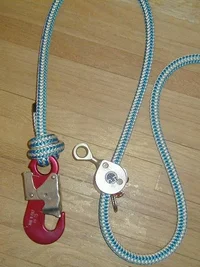
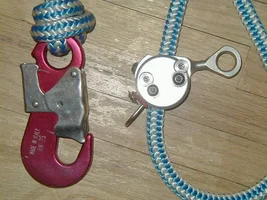
The King of Cams, er, Kams

Tom Dunlap

Here from the beginning
Administrator
Since Denny Moorehouse is already the "Wizard of Iron" I would like to nomitate Hubert Kowalewski to be the King of Kams. Since coming up with the original Lock Jack weveral years ago he continues to find more applications for the mechanism.

Last week I got a package with the plastic teather and the alternate clutch cam that fits the Fly rope. Also included in the package was a new tool. The Positioner is a new configuration of the cam that is used as a lanyard adjuster. I've mounted it on my lanyard but I haven't climbed with it yet. Just setting it up in my garage and "climbing" around on the workbench and the atv makes be believe that it will be another fine tool. Next week I'm heading up to the Canadian border for a week of camping so I'll have to wait for the actual field test. When I do, I'll post my thoughts.

Here is what Hubert sent me:

The adjuster is called "The Positioner" and it is made for 12 to 13 mm double-braid-rope [see footnote TD]. The breaking load of the Positioner is good for more than 24Kn. The weakest part of the system is the rope. The Positioner depends on the rope but the standing load of 15 Kn for 3 Minutes (That is our rate for a lenyard with adjuster in the European-standard, EN-Certification )is no problem.

Footnote: I'm not sure if what Hubert refers to as "double braid" ropes is the same rope as Americans think of. I'll get a clarification.

All Hail the King!

Tom
 
</font><blockquote><font class="small">In reply to:</font><hr />
Next week I'm heading up to the Canadian border

[/ QUOTE ]

Thanks for the warning, I'll inform the mounties.
grin.gif


Where at Tom?
 
I have no clue what they will cost, if they're for sale in the US or when they might be for sale.

My guess is that Greg Good and Sherrill will be the vendors.

Since I'm heading out of town I figured that John could demo the Positioner and make a report.

Every winter some friends and I make a trip to the Boundary Waters Canoe Area Wilderness for a week. http://www.quietjourney.com/photo-contest/thumbs1.html Camp in the snow. Drink water out of the lake. See the Northern Lights. Drink cowboy coffee. Life is good!

A few years ago there was a terrible wind storm that flattened thousands of acres in the BWCAW. One of the goals of this trip is to burn up as much firewood as I can in order to reduce the fuel load. I bought a Silky Ibuki especially for this trip.

Tom
 
Tom;
I don't know if you have any lucky stars in the skies over Minneapolis but if you do, start thanking them you aren't up there camping out this week!
 
Yoav;

As Tom said, the Positioner is a lanyard adjuster. In the close-up picture that John provided the 'ring' on the right is for a carabiner (the Positioner is moved 180* in the other pic, so it's important that you look at the pic that John called 'a closer look'). The carabiner is then attached to your saddle.

The small orange line on the left side of the Positioner is what amounts to a very small rubber band. This is simply to provide a little bit of pressure to ensure that the cam contacts the rope. This is similar to the small wire on the Petzl Micrograb (previously sold as the Rock Exotica Microjuster).

To shorten the lanyard the climber simply leans forward and pulls on the rope. With the Micrograb and the Grillion the rope has to be at just the right angle or it rubs against the body of the device and makes it difficult to pull. If the device is attached to the saddle using a single krab then you have to pull almost straight down. Adding a screwlink, shackle or clevis improves the angle of pull, but also adds bulk and moves the the rope farther from the climber. So far I haven't felt the need to add an extra link for the Positioner. It allows smooth adjustment while pulling the rope from various angles. Since the Positioner itself has a very clean profile the whole setup is light and compact (compare it to the size of the rope snap in John's pic).

To lengthen the lanyard the climber simply pulls on the Positioner itself on the side with the 'rubber band'. This can be done without having to lean forward to take weight off of the cam. The first time that I used the Positioner was for a rainy crane removal. The rope was wet and I wasn't used to the Positioner so sometimes lengthening the lanyard was a bit jerky. Now I have developed a feel for the amount of pressure to apply and find that it is much smoother.

Mahk
 
Mahk, I took my RG cam and am know using it ad a positioner. I added a small peice of spectra where the quikdraw was and gerth hitched it to my d- ring.It works very,very well.I Know that it not the intended use for this cam. Do you see any problems with this set up.To lengethen the lanyard I just give it a twist. I tried to make that twisting motion On accident to make it slip but could not.
 
I have been using both for a while now, I do perfer a rope tool RG. They each have their advantages and disadvantages. The cam is very easy to adjust the length. With a RT RG it is more difficult to adjust. I do feel a RT RG sticks to stems better, more friction. While using a Camming RG I find it to not stick to smaller stems, It tends to wiggle down. The caming RG is easy to handle and very smooth.
 
Tod;

I compared the Positioner cam to the RG cam. They are similar, but not exactly the same.
The Pos. has some features that make it easier to use as a lanyard adjuster, but I can't see that there is any safety problem with using the RG cam for the same purpose. The motion used to lengthen the lanyard would be the same for both of them.

Mark B. might have some insight to offer on this.

Mahk
 
Mahk,
there's a slightly higher amount of friction on the positioner cam, precisely to avoid the unit sliding back down the lanyard due to it's own weight if it's positioned above the climber. It's more about giving you a positive fix on the lanyard, rather than a safety issue.
 
A comment from The King of Kams

Hubert sent me a note today. Here is a part that applies to this discussion. I took the liberty to tidy up his letter. I can only wish for the day that my German is as good as Hubert's English :)

Many climbers combine this and that to have a special device. This can really be dangerous because nobody knows
about the breaking point for the self- made device. In the European standards the way is clear: For example, in case of the
Positioner lanyard adjuster the demand is to have a certified "system" in which every part is defined. I can say that each
device from ART is certified as a System. There are some parts in the German catalogs which are available as a single devices.
Maybe there is a rope diameter from 9 to 13 mm on it. Believe it or not; this is not allowed for working devices.
I do not fight against the self-made systems or against the single devices with the potential to create a self-made system. What I
want to show is that the devices from ART are specially created for this job because I'm one of you and I try to invent what
many good climbers want to have. The devices are certified as systems and they are really safe.

5000# or 22KN...both of these rates are right and both of them sound good. Let's have respect to the rules on both sides of
the Atlantic Ocean !

HK

Hubert's concern is that the Rope Guide might be used as a Positioner or vice versa. Always follow the manufacturers recommendation and realize that when you don't you put your self at a self-assumed risk.

Tom
 
Not to get off the subject, but as tophopper can verify--
those are not the northern lights you see, but the
reflection off all the new shiny alum hanging off Toms
belt!! Up close it's blinding
 

New threads New posts

Back
Top Bottom