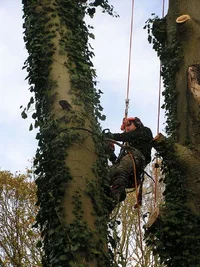
The Advent of Single line work

5. Tourists outnumber residents by:

  • 1:1

    Votes: 0 0.0%
  • 2:1

    Votes: 0 0.0%
  • 4:1

    Votes: 0 0.0%
  • 6:1

    Votes: 0 0.0%

  • Total voters
    0

SoftBankHawks

Branched out member
Location
Japan
In my opinion it is so much safer and more flexible to work off a single line. It incorporates access, work positioning and rescue.
I wonder how many of you are turning to working with a single line and if you think that there will be a change to the training programmes to incorporate it?
 

Attachments

  • 149456-beechcutting333.webp
    149456-beechcutting333.webp
    157 KB · Views: 140
I believe that SRT is something that will become more widely used. I do not believe that it is any more or less safe than the double rope system. It is it's own system and has it's own set of do's and don'ts, there are things a climber has to be careful of regardless of the system he uses.
 
Yes and no.

I believe it is a valuable tool, but I dont think it will ever replace Ddrt.

For access, it is already being taught. So yes.

For SOME position, Id say yes.

For full on working 100% of the time Id say no way.

So how do I vote?
 
I work position SRT quite often. My lanyard almost every climb, and my main line if I only have one or two work stations and don't need to move too far laterally. I use the Frog Walker for access almost exclusively.
 
Isn't there a big chance of you or your groundie cutting through the anchored end of your SRT line? for that reason, i'm out.

149456-beechcutting333.jpg
 
Using a trunk belay gives my groundsman the ability to rescue me, theoretically, very quickly.
I choked the line 70/30 when I first started to work position on a single line. It's 30/70 now.
You are right though, it is A BIG DRAWBACK, but with skill and use, like anything, the climber and groundsman become accustomed to the dangers.

As yet I havn't rigged a tree while working from a trunk belay.

As far as I am aware our training systems do not teach ANY single line climbing.
 
[ QUOTE ]

As yet I havn't rigged a tree while working from a trunk belay.


[/ QUOTE ]

I wouldn't try that if I were you, to even think of it gives me shivers. By the way, I like SRT for access to tall trees and use it regularly, but using it for work positioning is flawed and a step too far in trying to 'progress' climbing techniques IMO.

Great pic of you in that tree though, good luck with your venture into the world of SRT work positioning. Have you heard of Paolo Baveresco? he might have some empathy for your ideas, he runs a company called treemettlenexus, based in Wales, they have a website, he likes SRT and 'frogging', which should in no way be confused with 'dogging'.
 
I use it for access then switch over. I dont like a rope running down the trunk while working, to many hazards for it getting chopped. If it was fixed at the top then maybe
 
[ QUOTE ]
I use it for access then switch over. I dont like a rope running down the trunk while working, to many hazards for it getting chopped. If it was fixed at the top then maybe

[/ QUOTE ]

+1
 
In the picture shown above a ground man could not rescue you ffrom the ground soley. Another person might be better able to assist a rescuer with that set up though.
I think it is important for a rescuer to get in the tree to assess the victim in many situations. Obviously if the climber has cut their arm and is using the free hand to apply pressure this system would work great. Every situation is different.
 
being the only climber for the company i work for i often find myself working srt for rescue and saftey reasons, i will also work drt off of srt for the same reason, im not quite as comfortable working off of just a single line srt but im sure i will be once i get more comfortable with the equipment. im currently looking into a unicender, which i feel will make me much more comfortable climbing srt than my very bouncy but very effective petzl grigri
 
AxeKnot, working off a single line is not flawed. There are ergonomic benefits, work positioning benefits, simplification of equipment, no twizzeled lines....I can go on.
Allmark, the picture wasn't meant to show anything more than it being a cool picture of me working with my Unicender on a single line. Every cut in every tree throws a different dynamic to rescue situations and so I place a rescue line in along with my trunk belay.
TLHamel, what friction device do you use on your lanyard, you use a treemotion I think so where do you clip your lanyard and how long is it?
 
Paul, FWIW I voted yes on the poll....

But, RE: No_Bivs response

[ QUOTE ]
I dont like a rope running down the trunk while working, to many hazards for it getting chopped. If it was fixed at the top then maybe

[/ QUOTE ]

Perhaps not for a concientious worker like youself but for someone, having that line running down the trunk, some or all of it being out of your view and under tension during a tree removal is a dangerous and unecessary liability.

While the rescue convenience is a +, preventitive measures in the first place should always take precenence....and IMO that would start by eliminating that base anchor asap. All things considered there's just too much to lose and not enough to gain by its retention.

I like the picture, but would like to see some video also i.e. limb walking, working shots you know, if you have the means that is? Thanks
 
I have just checked the poll results thus far....57 - 43 is encouraging. SRT for access is so easy and safe there should be no qualms for a 100% response. I do understand how strange working a single line seems so......lets give it a few years!
Reg, I will see what Mr Gairn can do about some video footage.
 
I would like to jump in with a few comments of my own. I always try to stay abreast of current advancements in our industry. Many of these need to be examined and tried out to determine if they will fit into an individual's climbing style or not. Many of the things we do appear to be ridiculously dangerous to the uninformed. I use SRT for access only. And even at that, not always. Perhaps, using my own thought pattern, I should be experimenting more with SRT for work positioning but I am extremely comfortable on doubled rope and enjoy the mechanical advantage when coming back in from a low hanging limb.

[ QUOTE ]
...having that line running down the trunk, some or all of it being out of your view and under tension during a tree removal is a dangerous and unecessary liability.

[/ QUOTE ]

There is a danger present here already in the technique of butt-hitching logs that fit all of the criteria you are concerned about yet are accomplished successfully and safely on a regular basis.


[ QUOTE ]
While the rescue convenience is a +, preventitive measures in the first place should always take precenence....and IMO that would start by eliminating that base anchor asap. All things considered there's just too much to lose and not enough to gain by its retention.

[/ QUOTE ]

I see the rescue ability from the ground as more than just a convenience but, instead, a key component. Preventative measures prevent most accidents, in that you are very correct. But stuff will still happen. Even if the rescue requires aerial assistance, having a ground-based lowering system will reduce the danger and complexity for the rescuers by quite a bit.

But because of all of the fears people have mentioned, I feel this system has a world of potential for improvement. I am patiently looking forward to the day when a specific rope designed for this use could be manufactured. Something that would incorporate the new fibers geared toward cut resistance. The anchor itself should be a designated component, easily operated but also not easily accidently released. Maybe with lots of colorful stickers explaining its use.
grin.gif


Dave
 
REMEMBER, SRT work positioning does not have to incorporate the trunk belay. Choke the line with an alpine butterfly and leave the dead end to dangle for collection when you finish. This also means that your working end can be tailored for the height of the tree! Or other wise bundle the dead end at the top of the tree while you are rigging.
I was not rigging this beech.
I put my pantin over my spike. It worked OK.
 
[ QUOTE ]
TLHamel, what friction device do you use on your lanyard, you use a treemotion I think so where do you clip your lanyard and how long is it?

[/ QUOTE ]

I use a Trango Cinch; always in the front dees. I attach to my bridge ring or hitchclimber when used SRT. Length is 16' (5m)
 
Thank you.
I use a Silver Bull bag for the tail of my lanyard. Have you seen those? No more trippin 'n' slippin!
Do you use a krab on the running end?
 
Reg:[ QUOTE ]
...having that line running down the trunk, some or all of it being out of your view and under tension during a tree removal is a dangerous and unecessary liability

[/ QUOTE ]

Dave:[ QUOTE ]
There is a danger present here already in the technique of butt-hitching logs that fit all of the criteria you are concerned about yet are accomplished successfully and safely on a regular basis.

[/ QUOTE ]

Dave, I used the word unnecessary because that ground anchor just doesn't need to be there to work the tree using SRT. Re: butt-hitching, in most cases having the ground anchor is necessary to carry out the operation.

And I wasn't only referring to the risk of the climb getting hit by a log either i.e. I was working with a crew once in New Zealand, devoted Christians they were....I had to be extra careful so not to use bad language or anything like that as it didn't go down well at all.

Anyway, I came down from the tree one day to find that the tail of my climb line had been badly cut, must have happened while they were all cutting and shifting brush from around the base the tree....yet nobody seemed to know anything about it when I asked!

I wasn't happy but it wasn't the end of the world either as I didn't feel like I'd had a close call or anything i.e.
When descending using DRT a climbers tail end is always visible before the friction hitch runs over it (in theory) which obviously works in his favour should it unknowingly get damaged....but with SRT, well its not just the visible tail end you need to worry about!

Hey, its cool and I wouldn't want to discredit the technique or anyone who uses it, but as well as not being able to maintain a constant view of the line with everything that goes on, there's just know way I'd trust anyone sawing and working around that ground anchor with my life depending on it....why on earth would I want to do that when there’s an option of anchoring it way up high in the tree?

Incidentally, we've had a couple of mishaps over the last week.... first I nearly got hit by a swinging log and then on Thursday my spike came out of a dead cedar and I got slammed face first into the trunk
grin.gif
....just bracing myself for no.3 now! Although you can be sure it won’t be SRT related!

 

New threads New posts

Back
Top Bottom