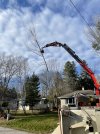
Standing Pieces Up

chris_girard

Branched out member
Location
Gilmanton, N.H.
So I have a question for you guys. When rigging pieces out and you have a chance to stand the piece up, do you do it, or try to rig it horizontal and balanced?

I have down it both ways and really don't have a preference. Some people think that it can be tricky to stand a piece up, but I have honestly never had a problem with doing it.

I have one crane operator who would rather have me stand the pieces of horizontal than take the time to balance them. He is a phenomenal operator, so I usually will rig it the way he prefers.

Thoughts?
 
So I have a question for you guys. When rigging pieces out and you have a chance to stand the piece up, do you do it, or try to rig it horizontal and balanced?

I have down it both ways and really don't have a preference. Some people think that it can be tricky to stand a piece up, but I have honestly never had a problem with doing it.

I have one crane operator who would rather have me stand the pieces of horizontal than take the time to balance them. He is a phenomenal operator, so I usually will rig it the way he prefers.

Thoughts?
Different situations call for different actions
We generally butt tie
If we need to suck up the lead as we cut most of the time we tip tie
If we’re really short handed we will tip tie and then winch the butt right into the chipper
So I guess long story long we mix it up
 
If I am understanding correctly, you are referring to rigging with a crane? If so, we rarely balance picks, we usually stand them up as it is much faster and easier. Our operator is excellent, likely the best tree crane operator in the area, which helps though. There’s a reason he calls himself the “Lift Magician”, he’s not joking about that with some of what he can get out of/into with a crane.
 
If I am understanding correctly, you are referring to rigging with a crane? If so, we rarely balance picks, we usually stand them up as it is much faster and easier. Our operator is excellent, likely the best tree crane operator in the area, which helps though. There’s a reason he calls himself the “Lift Magician”, he’s not joking about that with some of what he can get out of/into with a crane.
I agree, easier to rig and less guess work. Down side if you dont control the butt it can drop and do damage if close to targets. A flat shelf for a back cut with a notch and 2 point rigging to keep it from rolling. Down side to balancing is if you miss your ball position or balance point the butt can battering ram the climber. Standing picks up feels way more controlled and predictable. Cant think of the last time I balanced a pick and I deal with alot of big Plains Cottonwoods with large horizontal sections. This is crane work. In a manual removal tip tying and pulling the tip to the lowering point with the mini or Grcs is smooth and less shock load, down side you have to climb out and make the tip tie. In tight areas it allows better control and usaully a bigger cut. This is in general. Knowiing when to use each technique is the real skill and dont get boxed into doing 1 technique.
 
Last edited:
I prefer to stand pieces up. If I'm climbing, I want anything that has the possibility to swing around to be up above me so it can't swing into me. It also depends on how well the tree hinges. If near a target, nothing wrong with throwing a rope and pulley on the tree to control the butt in case it goes early. We normally hook that part up to our mini skid so we can take the slack out as the piece comes up by backing up.

As the crane operator, a lot of times its easier to put a piece down vertical and have the ground crew grab the butt with a mini to lay it out in the direction you want it.
 
It is a very practical technique, but it depends on an unrated attachment point (and thus the climbers skill/knowledge + tree integrity) to avoid shock loading the crane. It is similar to showing up to crane day with unrated slings and telling the crane op "they're good". I'm not taking a stand one way or the other for other people. For myself, I avoid it. But, if there was a circumstance where I felt it was the safest way to perform the pick, I would do it. It is worth noting that I frequently do it to some small degree when I take a balanced pick, so there is that element of "why not have your cake and eat it too?"...
 
We never stand pieces up. If you understand rigging and have the proper equipment, there’s no need to. Every pick we take is balanced, and when you make the proper cut, the piece will just stay in place until the crane operator lifts it. When standing pieces up there is a lot of room to make errors and dynamic load the crane. If you’re staying well below 50% of the cranes capacity you can get away with it and I’ve seen it done well. I just figure why take the risk? I have 5 kids at home I want to see at the end of the day.
 
We have done/ still do it both ways. But it is always far smoother and less stressful to balance picks or as Steve said “rig it as it grew” In my experience you have to have the crane set up just right in relation to the branch you are standing up to avoid side loading the boom.
 
We never stand pieces up. If you understand rigging and have the proper equipment, there’s no need to. Every pick we take is balanced, and when you make the proper cut, the piece will just stay in place until the crane operator lifts it. When standing pieces up there is a lot of room to make errors and dynamic load the crane. If you’re staying well below 50% of the cranes capacity you can get away with it and I’ve seen it done well. I just figure why take the risk? I have 5 kids at home I want to see at the end of the day.

We never stand pieces up. If you understand rigging and have the proper equipment, there’s no need to. Every pick we take is balanced, and when you make the proper cut, the piece will just stay in place until the crane operator lifts it. When standing pieces up there is a lot of room to make errors and dynamic load the crane. If you’re staying well below 50% of the cranes capacity you can get away with it and I’ve seen it done well. I just figure why take the risk? I have 5 kids at home I want to see at the end of the day.
Be careful when you say "never" as you will limit your thinking in many rigging situations. When you understand rigging, you will realize that there are times when you do need to either stand a piece (or sometimes even lower it down so that its tip-heavy), in order to get it to fit into an LZ, or when you have to strip off brush to lighten a load, or even to fit the boom down into the canopy.
 
Be careful when you say "never" as you will limit your thinking in many rigging situations. When you understand rigging, you will realize that there are times when you do need to either stand a piece (or sometimes even lower it down so that its tip-heavy), in order to get it to fit into an LZ, or when you have to strip off brush to lighten a load, or even to fit the boom down into the canopy.

True, “never” was not appropriate. We all know that every tree is different and presents new challenges. There could come a time when standing a piece up is actually the safest or only option. That is what I love about tree work. No tree is ever the same, no job is routine.


Sent from my iPhone using Tapatalk
 
I still prefer to balance my picks just because I love making the cut with little or no movement and telling the op “It’s all your mate”. But I have been in a lot of situations were the landing zone can’t handle the length that way or the many limbed trees would just take to long. When doing this we are usually working at 25-40% of the chart. Also have to be aware of how offset the tip of the crane has to be to eliminate swing out or in. Honestly with careful observation you can almost take them off as smooth as a balanced pick.
 
Did this today. Multi slings for torsion but stood them up. With careful cutting I still get to say “it’s all yours mate”. Damn English ivy covered cotton weed. Got a power kill to 31 homes for this. Only one phone call from someone bitching about it. Office just told them that 30 other homes were affected and they understand that the tree is a hazard. I’m still trying to figure out how 36” diameter within 2 feet of the primary was let go for years?

 
I think it is a vlid technique in the right situation. Used to do it all the time years ago but prefer to balance most of the time now. I still stand some up though when it seems the best option at the time.
 
I'm new to crane work, so im asking to understand the process. That said, dont worry, im notngoing to just try this out on the newly shared knowledge on my next job.
Im imagining you notch, tension, back cut and leave hinge, and then allow crane to work hinge to close, then you cut free?
I cant imagine the climber is cutting wjole the OP is lifting
 
Yes and no. Depends on the climber and operator. If you’re new to crane work stick to static picks. You really don’t want the piece to move at all till you tell the op it’s all his.
As I said before, we stay well with in the load chart. Think about a pin oak with a hundred limbs that need to come off one at a time to fit the drop zone.
 
Yes and no. Depends on the climber and operator. If you’re new to crane work stick to static picks. You really don’t want the piece to move at all till you tell the op it’s
all his.
As I said before, we stay well with in the load chart. Think about a pin oak with a hundred limbs that need to come off one at a time to fit the drop zone.
Rich I just stand em up like this now way easier :baaa:;)
B1FD2EC2-30DC-4524-A858-F256EBE4296C.jpeg
 
I'm new to crane work, so im asking to understand the process. That said, dont worry, im notngoing to just try this out on the newly shared knowledge on my next job.
Im imagining you notch, tension, back cut and leave hinge, and then allow crane to work hinge to close, then you cut free?
I cant imagine the climber is cutting wjole the OP is lifting
Pretty new to crane work myself, even took my first brush picks yesterday. Before that its always been ground work and some trunk picks. We've stood a few up, some like you described and some of them we tension, cut 80% through from bottom to top, then the crane lifts and tears the wood fibers. Then finish the cut if needed once its vertical.

I'm not sure yet how to decide if you should notch or tear a lifted piece, I just give the crane op what he wants. He has 28 years experience so I trust him to make the right call.

Here's one from today that was stood up using a notch. 4100lbs.

Edit: thats not me in the video, @kiteflyingeek made that cut, that was the last piece I was on the ground for, then I took out the trunk.
 
Last edited:

New threads New posts

Kask Stihl NORTHEASTERN Arborists Wesspur TreeStuff.com Teufelberger Westminster X-Rigging Teufelberger
Back
Top Bottom