SRT/Lanyard Canopy Tie-In/Cinch Options?

Regarding 'bridging' the non-steel biner - I guess the real question might be shock loading; no-one ever wants to shock load - but if even you only did it once in your life, and that one time your bridged biner failed you - maybe that one time would be enough to do the damage?

These 'bridged' biner videos were cool - thanks.

Anyone got any 'shock loaded bridged biner' vids? ;)

I would believe that both the splice and the alloy biner would be stronger than the 3" piece of green wood...

Reed Wortley
CTSP #01739
ISA CA #SO-6953A

Good point. I've no problem with 'bridging' the splice once or twice. It's just I do worry about it weakening with constant bending/flexing on a regular basis.
 
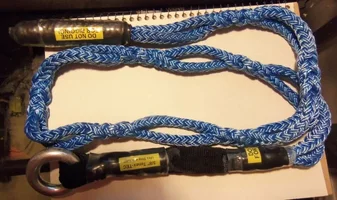
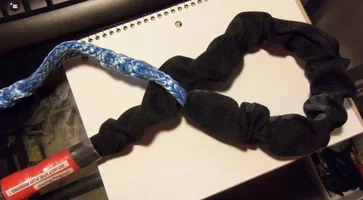
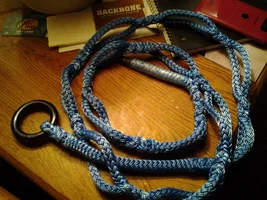
Thank you, Reed... I was about to mention Tenex-TEC for the obvious reason that it solves a lot of the problems mentioned. I think it is easy to forget how strong it is for its diameter. There's a reason it makes great slings. And, a brummel doesn't care about side loading. I carry a short, Tenex-TEC ultrasling on my belt. If I want to choke off to a stem, I add it to the end of the lanyard or climb line. If I'm tired of carrying it on my belt, I just leave it on there. Small steel ring on one end... big, rigging steel ring on the other end (small ring will pass through big one). Cordura chafe sleeve (2" wide stuff) covering it, sewn to brummel at one end. To stick one end through the loops, I just bunch up the chafe sleeve toward the other end until the right loop is exposed. No brainer. Useful for dozens of things.

Do you have a picture of this setup ? I'm curious as to how that looks :)
 
Some are in my equipment trailer, at the shop in a nearby town... but I have some stuff here.

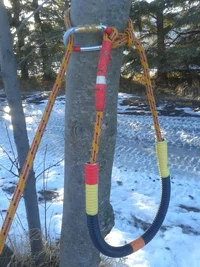
Small Tenex-TEC with a small aluminum ring on one end. It is 5' long, and I have a 4' length of ProTec chafe sleeve (removed to take pic) that feeds over it:

Sm-Alum-Ring.webp

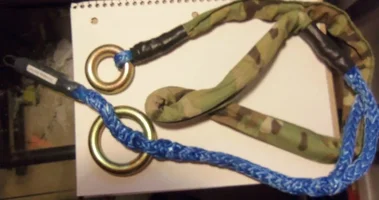
This one is 3/8" Amsteel Blue... small steel ring in one end... chafe sleeve is stitched to the sling near the ring end, shrink tubing over stitches. I've pulled back the chafe guard to expose one of the loops and stuck the ring through, putting it in choker mode:

Amsteel-Small-Anchor.webp

This one is an experimental ring-and-ring friction saver with chafe guard, using steel rings. It can be used like a regular R-R FS or choked to limb, etc. and so far works very well. I have not gotten it caught up in a crotch, yet. It is also made from Amsteel Blue:

Amsteel-Ring-Ring.webp
 
Using the high-modulus rope means de-rating the sling a bit more than what the Tenex-TEC would be in the same size, but it starts out higher... So far, they've held up, but I'm using the Tenex-TEC more, lately. I've been pleasantly surprised at how quick and easy the ultraslings are to use. I'm embarrassed to admit to how many I've made this winter... :rolleyes:
 
Regarding 'bridging' the non-steel biner - I guess the real question might be shock loading; no-one ever wants to shock load - but if even you only did it once in your life, and that one time your bridged biner failed you - maybe that one time would be enough to do the damage?

These 'bridged' biner videos were cool - thanks.

Anyone got any 'shock loaded bridged biner' vids? ;).

I advocate using a choked alloy carabiner only for a positioning lanyard SRT attachment. The possibilities for shockloading are next to nothing. If a climber is setting up their lanyard for positioning and creating shock loading potential they're doing some thing wrong.

That's why I don't use a choke with an alloy carabiner for a "remote" (out of reach) canopy anchor, there is obviously the danger of shock loading and other bad things happening in that scenario.
-AJ
 
I just finished the last loop with 5 locking brummels, buried about 6 inches after that, crossed stitched with about last 3 inches. Shrink wrap is just so I always know where the end is without looking.
 
I will add that the likelihood of my using the last loop are slim, the last loop choked would be about a 34" diameter trunk. Not really my realm of work size on a daily basis.
 
I will add that the likelihood of my using the last loop are slim, the last loop choked would be about a 34" diameter trunk. Not really my realm of work size on a daily basis.
Base anchor! (y) I've made a bunch of these. They're great for alot of things from climbing redirects to heavy rigging points (on larger diameter cordage of course). I love them. On my climbing ultraslings,I just leave a tight eye on the end and use a revolver makes for a nice redirect
 
...with 5 locking brummels, buried about 6 inches after that, crossed stitched with about last 3 inches. Shrink wrap...

That's what I do, too... I use last loop, often, and it's no weaker than any other one.

They're great for alot of things...

Yesterday, I had to move my 35-ton log splitter back to this house, from the shop 7 miles away. I don't like to tow it that far because it has no suspension and bounces around too much, so I trailer it. I used two of the 3/8" Amsteel ultraslings around the wheel end of the splitter to the front of the trailer, and a 1/2" Tenex-TEC one at the hitch end of the splitter to the back of the trailer. Held that 660 lb. splitter just fine for the ride home. I never seem to run out of things to use these things for.
 
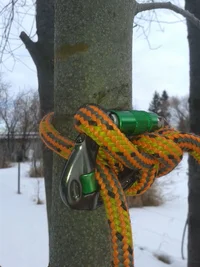
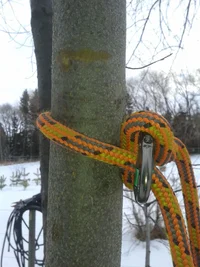
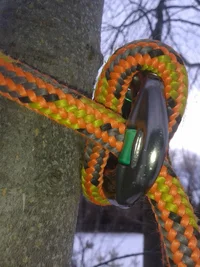
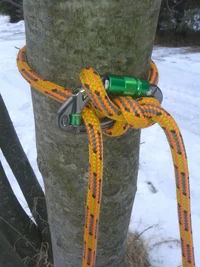
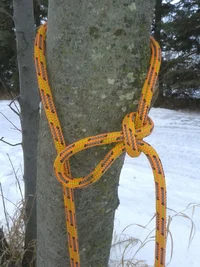
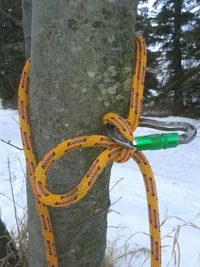
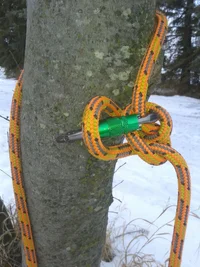
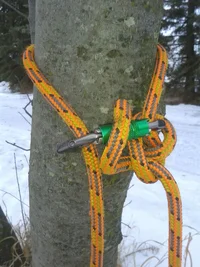
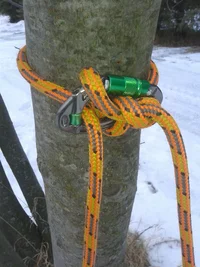
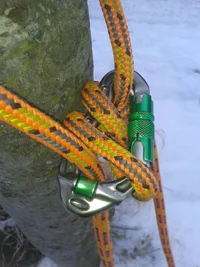
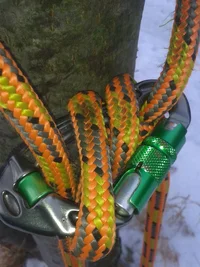
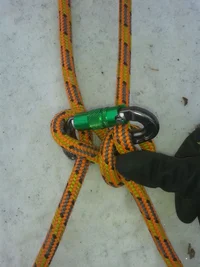
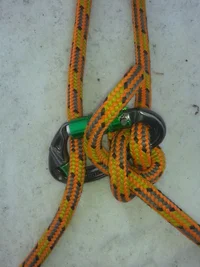
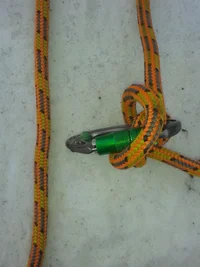
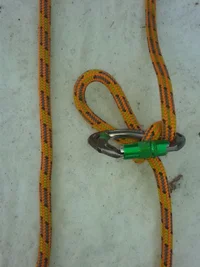
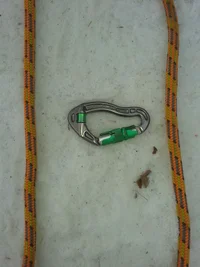
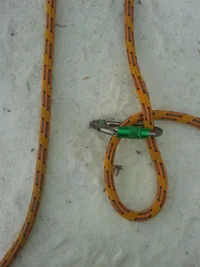
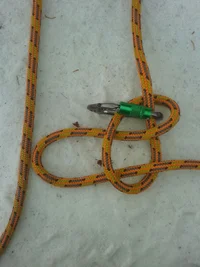
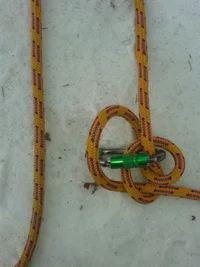
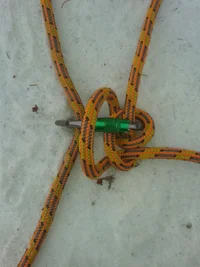
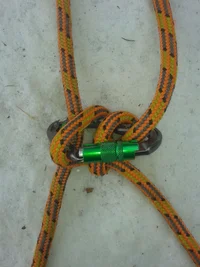
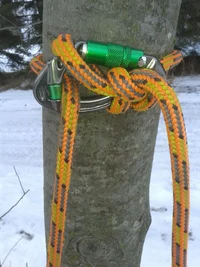
Has anyone used this knot before? It could be called the 'Looped Slipknot Midline Biner Cinch' or 'Magic Midline Slipknot' - the first one is more accurate, the second one sounds cooler ; )

20160202_092727.webp

Step by step (then comments):

Slipknot in working end.
20160202_092516.webp

Clip Revolver onto working end above knot, AND immediately onto middle part (cinch) of rope on slipknot.
20160202_092551.webp

Pull the biner down through the front of the slipknot bight.
20160202_092610.webp

Clip the biner onto the standing part.
20160202_092638.webp

Dress, Set + Cinch.
20160202_092727.webp

What it should look like from the back.
20160202_092757.webp

Slight abrasion on rope to be considered (more in comments below).
20160202_094548.webp
 
Last edited:
To Untie:

Pull down on knot where thumb is, use left hand to pull more slack into slipknot bight.
20160202_093017.webp

Pull bight round front of biner.
20160202_093103.webp

Unclip biner from standing part.
20160202_093126.webp

Pull bight round back of biner.
20160202_093152.webp

Pull lower side of working end - slipknot comes completely free from biner (this is the cool part).
20160202_093221.webp

Can be tied this way too (same knot):

Put this loop down through the biner (lower part of working end crossing behind upper part).
20160202_095015.webp

Pull a bight from the lower working end through the loop.
20160202_095059.webp

Again - pull biner down through bight of slipknot.
20160202_095154.webp

Again - clip biner onto standing part.
20160202_095301.webp

Again - Dress + Set.
20160202_095357.webp

 
Last edited:
Cinch.
20160202_094232.webp

On Smaller Diameter Trunk:

20160202_100153.webp

20160202_100200.webp

20160202_100215.webp

Slight squeeze to clip/unclip standing part (more in notes):
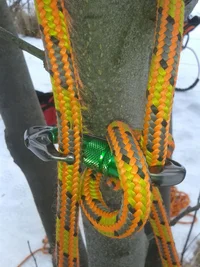
20160202_100502.webp

Ddrt Mode:
After unclipping from standing part - roll bight of slipknot up around FRONT (- very important) of biner - cinch bight at top of knot.
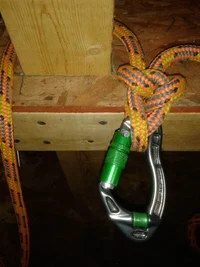
20160202_104739.webp

Back of knot in Ddrt Mode.
20160202_104817.webp


Notes:

1. This knot may help prevent the biner from directly 'Bridging' on the cambium of the trunk so much - it slightly 'cushions' the biner.

2. Possibly eliminating need for steel biner.

3. Maybe replaces need for pinto pulley.

4. Minimal gear (just biner).

5. A 'true' midline attachable solution (no need to pull any tail ends of ropes through).

6. Relatively easy choke/release.

7. Unclip from standing part - straight to bridge for Ddrt (and vice versa) - all without unclipping biner.

8. Revolver may be ideal - pulley, size + shape of biner, smaller (less biner to bridge), curve in spine, angle of biner beneath nose at gate, just enough space to 'capture' standing part of rope.

Points of concern to be considered:
9. Although you may think that the bight of the slipknot has the potential to orient itself onto the gate (and then possibly release the gate) - in reality, the way the lower part of the working end of the rope exits the slipknot - it means that that bight does not naturally want to orient itself above the middle of the biner gate (rather - off to the side). Also - the bight does not see the majority of the tension of the slipknot (mostly just when you are setting the knot). Also - if the bight were to orient itself over the gate and also be tensioned from the upper part of the working end of the rope - the way the bight would want to pull on the gate is opposite the way you would want to rotate the biner gate in order to open it.

10. The biner is still sideloaded/bridged - I know; with this type of knot - I am just trying to reduce these forces upon it. I am also aware that I have also introduced a slight (albeit minimal) tension on the biner to 'compress' it on it's minor axis, ie - by having the bight of the slipknot around the nose of the biner.

11. As in the first of these 3 posts - you can see the effect of slight abrasion on the rope from the cambium - this is something I will be monitoring closely to see if it develops into a greater concern.

12. As in the second of these 3 posts - it can be a little bit of a squeeze to clip/unclip the standing part of the rope on/off between the nose & gate of biner. If you orient the knot captured in the biner better - this can be minimised. If you have thinner diameter rope it may also be easier.

Biggest Points Of Concern (Common Sense - Tie Your Knots Right):
13. DO NOT LET BIGHT OF SLIPKNOT GO ROUND BACK OF BINER UNLESS UNTYING - IF YOU THEN PULL ON LOWER PART OF WORKING END - KNOT AND BINER WILL UNTIE AND YOU'LL BE IN FREEFALL.

14. DO NOT CAPTURE BIGHT OF SLIPKNOT IN BINER - the knot can collapse into a type of munter - and then you could be heading to the ground pretty fast.


I'm still to use this for real as part of my working day. I know it isn't a perfect solution to everything - though as much as I know just now, it may be as perfect a minimal solution as can be achieved right now. I can tie/untie most of these configurations between 15-30 secs (even with gloves). Practice it a bit on the ground - see what you think. The more critique/opinions the better.

Thanks

 
Last edited:
Decided not to use the above configuration - I don't know enough about how side 'bridging' carabiners would react in case of shock load - I guess I just don't want to take the risk. Revolver in side 'loading' (I assume pulling sides apart) is rated at 8kn - I worked out that that is 10x my climbing weight. The trees I generally climb are mostly not big and challenging enough that I will need redirects - maybe that will change in the future.


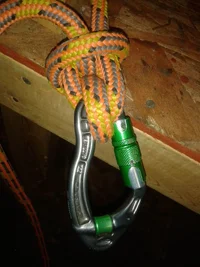
After consideration - I'm settling on this: Slipknot Steel Biner Cinch - working end tail eye left on biner for back up (in mid-line - I'll replace the slipknot with farmers loop).

It's simple, quick, easy. No working end rope on standing end friction (un-cinches easy). Standing part is clear all the way to the cinch (multicender right to the trunk). To ddrt - un-clip biner from standing part + slipknot, pull out slipknot - rope sleeve into crotch, clip biner to bridge.

20160206_153903.webp

Good to explore options though - maybe in the future I won't need the steel biner.
 
Last edited:
In your picture, the carabiner is still side-loaded (essentially trying to bend the carabiner around the tree, putting pressure on the side on the spine and gate). A better solution might be to girth a webbing sling around the branch and hook your carabiner to that. (y)
 
Last edited:
Way over complicated... Running bowline. Running bowline on a bight for midline attachment. Dependable. Easily inspectable, same knot you already use. Safe. Done. Stick with tried and true. $0.02.

FYI the cambium is under the bark. Cambium savers keep from burning through the bark to the cambium, ergo the name. Not trying to be snotty, btw.

Climb safe!
 

New threads New posts

Back
Top Bottom