spreader bars

Courierguy

New member
Location
Idaho
For general crane use:

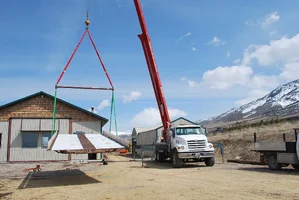
The first pic is a telescoping one, made out of sch. 40 pipe. It shrinks down to a bit less then 8', so I stow mine
on the back of my boom support. It goes up to 12'+ wide, can't remember for sure. The adjustment made it handy for picking my 4200 lb. ramp I use in the winter to get the plane, when it's on skis, straightout out of the hangar. I built it so I could pick it come spring and stash it behind an outbuilding. It too two setups but I got it 150' away, next fall it'll go back in.
 

Attachments

  • 278231-DSC_0786.webp
    278231-DSC_0786.webp
    320.7 KB · Views: 230
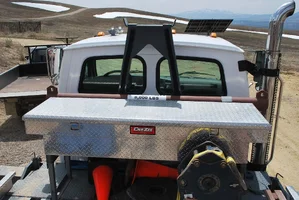
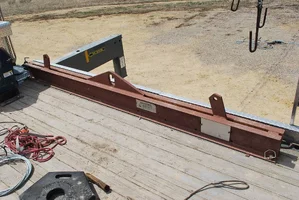
Another one, my heavy duty unit, that is stowed in the bed on tabs welded to the truck bed, the two pins that hold the rigging also serve to secure the bar when on the road. I like it's many pin holes in the bottom, you can rig stuff off balance or in many combinations. I usually use this single point, as it is designed for it. But I have the option of using a dual pick point, like the first bar.

At the lower left you can just barely see my 15 ton quick reeve single sheave load block (with the two sheaves in the boom tip, and a snatch block, this gives the ability to go up to a 4 part line). It is also secured to the truck bed with welded flat bar as the attach points. I have a port of entry/weigh station I have to go through all the time, so after a few close calls (not with my load, but with a trooper wanting to ticket me, I pointed out I have side boards on the bed and he backed off, but he got me thinking)so now all the heavy stuff is solidly secured. Doing this without making it a huge pain took some work, but I like knowing it's all tied down tight.
 

Attachments

  • 278234-DSC_0792.webp
    278234-DSC_0792.webp
    490.5 KB · Views: 159
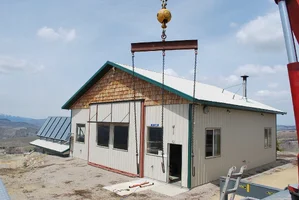
My third spreader I carry on board, for setting the right type of truss, three at a time, (symetrical, or balanced, and with a peak so the hooks are not sliding) on the right day, with the right crew. The j-hooks allow me to self unhook. Many of my builder customers love this setup. I like it because it cuts down the crane cycles, one pick and I get to relax for a few minutes while they deal with all three trusses, it really speeds up the job. I've set thousands of trusses this way, and it does take the right crew to deal with three at once, but once they get the hang of it they really like it.

It's a smaller version of my largest one: just 2 pieces of 6" channel, with 5/8" flat bar through bolted in such a way that the welds arn't critical.

Overhead lifting rated hardware was used on all three bars, they were designed by a certified rigger, load tested, and are tagged with the last inspection date, the next inspection date, their tare weight, date of manufacture and permissable load. A separate log book is kept of the inspections.
 

Attachments

  • 278236-DSC_0789.webp
    278236-DSC_0789.webp
    257.1 KB · Views: 157
I had someone contact me asking about spreader bars, so I thought I'd post what I use. Yeah, I can't see needing one for tree work.

I do have a wind turbine to take down in a week or so, and we will be cutting the tower (mono-pole 12" pipe) after we rig the turbine, that should be a fun one!
 
I was waiting for someone to ask this.....two were built by me, one was commercially built, but modified by me. Here is the way I (and my OSHA instructer/crane certifier a few weeks ago)interpeted the regs: they have to be engineered OR designed by a qualified person, and as a certified rigger I AM a qualified person.

I also told him I've load tested them. He is a retired iron worker who now instructs OSHA compliancy classes and crane operator certifications, as such he has a practical background and some common sense! He gave me some very good points, one being if you are making a serious effort to "be compliant", and have most of the regs clearly complied with, and you don't be a wise with the "compliance officer" (kind of like dealing with a traffic cop, suck up), you have some wiggle room as to how some of the regs are enforced.

Obviously, if a spreader bar failed, I'd be in deep doo doo no matter what (factory built, professionaly engineered or no) so the way I deal with that is simply make them stout enough, times 4, to not fail. This is the same way I made my first man basket after pricing store bought ones. $2,000.00 for a one person basket, made out of 1" sq. tube, I used 2" for mine, welded AND bolted together, and then placarded (the placards are the thing) it for a max weight of 250 Lbs., where it would easily hold 10 times that.

So, in building my own spreader bars I am taking into consideration:
1. The odds of being checked by OSHA.
2. If I am checked, and have all my ducks in a row, a good attitude, and am using the placarded, inspected, bar properly (within it's load range) all rated rigging with all their inspection records, we can then quibble as to whether or not, as a certified rigger, I meet the definition of a qualified person as per spreader design.
3. Any spreader built by me will never fail in normal use time 3 or 4.
I'm comfortable with the above considerations, I'll let ya all know if I ever go through a compliancy check and how it goes. BTW, my iron worker buddy also moonlights as a compliance officer himself, so when he said it looked like I had my butt covered (and agreeded the bars were way strong)I figured I was good to go. I had been using my own spreaders for years, but just recently got them "certified" (by me, after I got the rigger cert.), tagged etc.

 
I'm guilty of using the two terms interchangably, and frankly don't know the difference..... to me they both mean a device that fastens to the load hook, by rigging or directly, and then provides 2 or more riggings points to the load. Close enough?
 
speader bars have two lines from the hook to the bar (and require more overhead space) the bottom of the bar has the load attachment hooks and a lifting beam has a center attachment for the hook and the bottom has the load hooks, good for less overhead space.
 

New threads New posts

Back
Top Bottom