
Split Elm Crane Removal

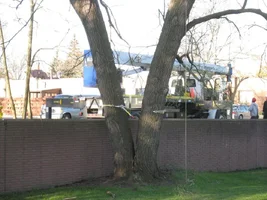
Homeowner called and said he noticed the split while mowing his lawn. The split didn't look that fresh to me, my guess would be it happened sometime over the winter and he just noticed it now. The homeowner put a come-along at the base, I put a hank of stable braid up in the tree and came back the next morning to remove it. As soon as we took the first couple branches off it started to draw back in.

We got to work off the driveway of a nursing home right next door, which worked out really well. This was my first experience using a joker hook, and crane bag. Loved the joker hook. Crane bag im still unsure on. I only needed 1 choker and 1 spider leg so the bag wasn't really necessary. I could see it being useful managing 3 spider legs though like TCI uses.

Wish I spent more time editing as I could have done more transitions between cameras.

http://youtu.be/3Er02CE0EE8
 

Attachments

  • 319500-buzz.webp
    319500-buzz.webp
    126.2 KB · Views: 104
The two cameras was a nice touch. Well done.
jamminz.gif
 
Looks good. Why stay tied into that tree though? I would have stayed tied into the crane and burned to the ground after each cut. It would have been less work for the crane too since it had to come back and pick you up every time anyway.
 
[ QUOTE ]
Looks good. Why stay tied into that tree though? I would have stayed tied into the crane and burned to the ground after each cut. It would have been less work for the crane too since it had to come back and pick you up every time anyway.

[/ QUOTE ]

Care to give a more detailed explanation of that particular method Banjo?

Jomoco
 
I don't really see it being any faster to go to the ground after every cut. If any thing it might be slower. I was not very concerned about the entire tree failing as we were taking weight off it with each pick and it was drawing in more and more.
 
I think you did a good job too. I would have done it differently though. I just don't like tying into trees like that if I don't need to.

Jomoco, I'm talking about staying tied into the crane while you make your cut, usually a snap cut, shelf cut, step cut or whatever its called. After you make the cut burn to the ground then the crane op takes the piece away. It's not for every situation but its a good technique. It's also one less move for the crane because it doesn't need to pick you up at the last cut.
 
[ QUOTE ]
It's not for every situation but its a good technique.

[/ QUOTE ]

It's also defensible as the 'safest possible method' when dealing with damaged or defective trees like the elm in the vid.

-Tom
 
[ QUOTE ]
I think you did a good job too. I would have done it differently though. I just don't like tying into trees like that if I don't need to.

Jomoco, I'm talking about staying tied into the crane while you make your cut, usually a snap cut, shelf cut, step cut or whatever its called. After you make the cut burn to the ground then the crane op takes the piece away. It's not for every situation but its a good technique. It's also one less move for the crane because it doesn't need to pick you up at the last cut.

[/ QUOTE ]

Sounds very sketchy to me in that the dynamics of you burning to the ground while tied into the crane could easily dislodge the snap cut pick and tangle your lifeline before you reach the ground.

On the rare occasions when a tree is so sketchy that I stay with the pick and crane, I stay with the pick because burning down would usually land me on a roof, a power line, into another tree, river or even off a cliff depending on varying circumstances dictated by the tree's locale.

Your method may be ANSI-Z allowable, though I kinda sorta doubt it. Don't get me wrong cuz I've been wrong before. If your method works well and safely for you? Then more power to yu Banjo.

jomoco
 
[ QUOTE ]


Sounds very sketchy to me in that the dynamics of you burning to the ground while tied into the crane could easily dislodge the snap cut pick and tangle your lifeline before you reach the ground.

On the rare occasions when a tree is so sketchy that I stay with the pick and crane, I stay with the pick because burning down would usually land me on a roof, a power line, into another tree, river or even off a cliff depending on varying circumstances dictated by the tree's locale.

Your method may be ANSI-Z allowable, though I kinda sorta doubt it. Don't get me wrong cuz I've been wrong before. If your method works well and safely for you? Then more power to yu Banjo.

jomoco

[/ QUOTE ]


I agree.. if staying tied to the pick is the safer option riding the piece to the landing area is the best decision in most circumstances ...plus it is the quicker way. I drop out when the piece is 10 ft off the ground...step aside...stuff the 20-30 ft of rope back in my rope bag (not 100+ ft) while the groundies are landing and unslinging the piece...step forward...clip into the crane ball while the slings are being clipped...and off to the next pick.

A climber on a crane crew has two main objectives
1)Safely complete the task (remove/prune tree(s))
2)Maximize the efficiency of the crane

To the OP: Great video...nice job
 
I think this is a great discussion. I think all three techniques have their place in crane assisted removal. Staying tied into the hook while the piece is being lifted to my knowledge is a violation of the z133 standard. I have done it once in my career when i was taking down a 135' lightning struck pine and could not make the rappel to the ground after the cut. I did not want to stay tied into the tree because I questioned if it was sound.
Staying tied into the crane, making a snap cut then rappelling to the ground is a great way to deal with uncomfortable positions and hazardous trees. trees you don't want to tie into. Im using this technique more and more to make crane work easier for me the climber.
Staying tied into the tree and making the cut is what i tend to do the most.

I guess up until the end of last season when I took down the pine I did not realize that i could use a combination of techniques to safety do my job.

I think understanding all three techniques and using them in the appropriate situation can make crane assisted tree removal faster, safer and more fun.
 

New threads New posts

Back
Top Bottom