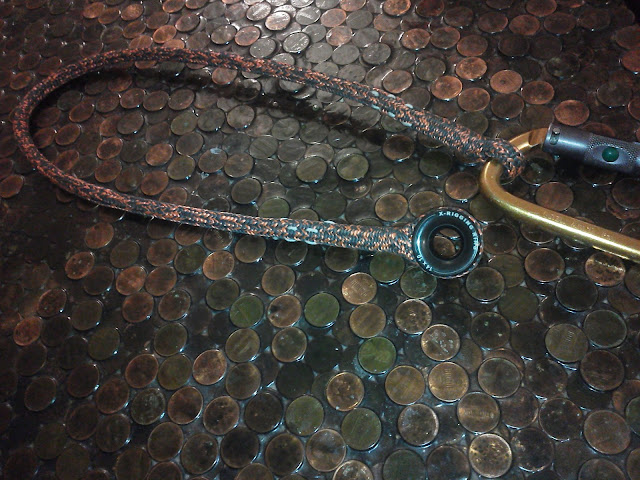
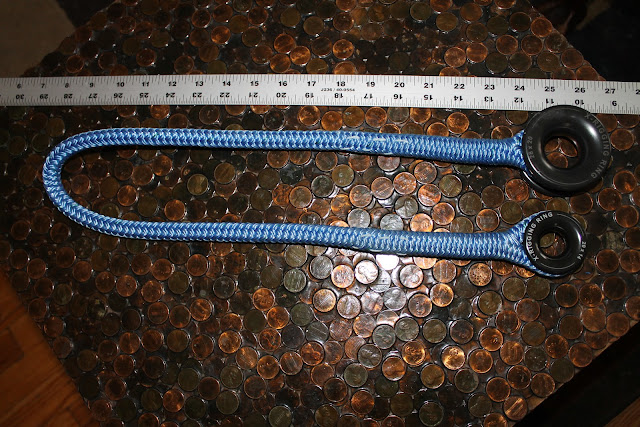
Splicing with X-Rigging Rings

bonner1040

Branched out member
Location
Boston
54" End to end
9/16's Husky Double Braid (14,000lb MBS)
28/20 XRR
20/14 XRR

Sets with throw line, retrieves with ART ball or a quarter with a whole in it (tied to a loop of throwline).

1390648_10202304669564226_1834488429_n.jpg


1378684_10202304669484224_1804523392_n.jpg


1240015_10202304669924235_1679404764_n.jpg


1392081_10202304673284319_1439657261_n.jpg
 
I use NERopes C1DB instructions. There is only about 3 fids between where I temporarily lockstitch the first splice and my mark D (core bury exit point) for the second splice. After bothe splices are cpmoplete but before the 2nd is run home I remove the temp lock stitch to free everything and then run the 2nd home.

I dont understand what you mean, too much going on, reduce numbers, best effect?
 
Because its a short length, the fid numbers are only (IMO) for a full length of rope.

A short eye2eye, can be done differently with a calculation of fibres, length, core bulk, eye size etc..

What I do is test the rope itself in stages, I found the online instructions un-informative on these points.
 
Re

So you are saying it's no good or it is good? I have done quite a few with this method, and they have all been tested in field
 
Re: Re

no, its a great splice, but what i'm trying to say is your work with all the bulk, there are easier ways and still works according to plan.

The bulk may inhibit its used as a prusik setup, unless thats not required.
 
Re: Re

It about the rope itself.

Decide the length of the first mark, then calculate the other marks, only pick threads that are needed, to make sure its not to fat or too skinny.

I use cardboard templates for my splices, although it took months to get them spot on.
 
Re: Re

[ QUOTE ]
It about the rope itself.

Decide the length of the first mark, then calculate the other marks, only pick threads that are needed, to make sure its not to fat or too skinny.

I use cardboard templates for my splices, although it took months to get them spot on.

[/ QUOTE ]

Let me get this straight, you are hocking splices that you made up the directions for? Have you received manufacturers approval for your methods? If you haven't and someone gets hurt as a result of your work you are so insanely screwed. Tuttle, I think you're playing with fire.
 
Re: Re

Before we jump to that conclusion banjo we have to remember he is based out of the UK. They do have different standards over there. I was talking with a splicing friend of mine from the other side of the pond and he was telling me some tricks they use on used ropes that I personally wouldn't use. He then went on to say that with the difference in standards what's acceptable there might not be here. We also could have easily misunderstood his last comment. With all that being said I would be careful selling overseas where the side might not cut the mustard.
 
Re: Re

[ QUOTE ]
Before we jump to that conclusion banjo we have to remember he is based out of the UK. They do have different standards over there. I was talking with a splicing friend of mine from the other side of the pond and he was telling me some tricks they use on used ropes that I personally wouldn't use. He then went on to say that with the difference in standards what's acceptable there might not be here. We also could have easily misunderstood his last comment. With all that being said I would be careful selling overseas where the side might not cut the mustard.

[/ QUOTE ]

There is a reason why he's trying so hard to sell stuff here.

PS nice work Bonner.
 
Re: Re

Yeah you may really want to break test your splices, especially if they're experimental. What holds a person up in ideal conditions may still break far under requirements, let alone safe numbers.
 
Re: Re

[ QUOTE ]
[ QUOTE ]


Do you think it's a good idea to cram the rope in the smaller ring?

[/ QUOTE ]

I dont see why not. Its not really crammed so much as its held in its natural shape. All the examples I show use rope equal to or less than the max diameter of the groove. For Example the orange sling is 3/4" or 19.05 millimeter, the smaller of the two rings has a 28 mm hole and a 20mm grove. The blue slings (smallest ring has a 20 millimeter hole and a 14mm groove) use 1/2" (13mm) rope. The OP/Armorprus slings use either 20/14 or 14/10 rings. The yellow slings are 14mm (9/16) rope and use mostly 28/20 rings and some 20/14 (technically 9/16 is 14.28 millimeters...whatever)

Other than that, since they are sold with similar sized cordage from the supplier and retailers, I figure it cant be that bad.

https://www.treestuff.com/store/catalog.asp?category_id=455&item=2165
X6159S.jpg


*********
*********


[ QUOTE ]
Are these all being used as Friction Savers for your climbing rope ?

[/ QUOTE ]

They can all be used for whatever suits you I guess. I climb SRT and dont really use friction savers. I gave most of them away so I can't say what people use them for.

The bigger ones I use as ring and ring friction savers for rigging.
 
Re: Re

mishmah on comments.

I know everything from threads to wire, dyneema to stainless steel.

My life has been in 20 different industries, my health and saftey has been on the front line for 25yrs.

So my skills, methods, testing, products ... outperforms, so in my view, I have the industry standard that they should be looking at.
 

New threads New posts

Back
Top Bottom