Spar split on me even though notched properly?

I do not understand the diagonal back cut. To me, from a purely engineering standpoint, it reduces the physical zone of holding wood, and therefore the predictability of the hold/release, which is why we don't use it with face cuts. I'd love to hear an explanation as to why it is better than a perpendicular cut.

Tom
 
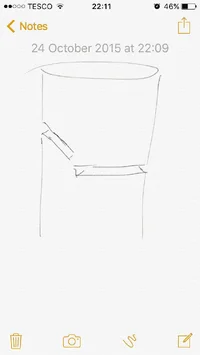
I sometimes go all the way back a leave a small strap at the back, the angle cut keeps the block safe from the climber because the angle, I do this cut because it's only 2 cuts, as doing gobs and back cuts its 3 cuts, time saving for me.

I know people have their own way to do things, but I like my tricks :)
 
View attachment 33961 Tried to draw this on my iPhone, need more practice I think, first cut is the face.

Thanks for taking the time and effort to draw this up and post it, tuttle. I greatly appreciate it. The idea that it saves you time because of fewer cuts needed is interesting. I'm assuming that you have never had a cut like this do something badly unexpected and possibly injury causing, or else you would not be using it so much.

More traditional timber fallers might have reasons that they do not like this idea, and I'd like to hear from them if that is the case. Sometimes though it is just a matter of not liking the sound of something that one is unfamiliar with. I'm still learning about all of this stuff, and so appreciate any and all comments on the issues involved. Thanks again.

Tim
 
I sometimes go all the way back a leave a small strap at the back, the angle cut keeps the block safe from the climber because the angle, I do this cut because it's only 2 cuts, as doing gobs and back cuts its 3 cuts, time saving for me.

I know people have their own way to do things, but I like my tricks :)
The cut you illustrated takes more time than a conventional snap cut and is more difficult to line up the hinge. I see home owners using that back cut all the time with ill results. There was a thread a wile back that discussed this and I learned even more reasons why it is bad. For instance if you intend to use a wedge the force generated is not vertical so it can actually cause a barberchair.
 
  • Like
Reactions: evo
It's only a blocking down cut, NOT A FELLING CUT, please people reading this check the wording.

To prevent a barber chair, there are so many techniques, too much to illustrate here.

Step cuts on longer stems are the main reason I put a thought in, obviously those cuts are perpendicular, with thoughts to how much distance between the cuts to prevent failure of fibres.
 
I was doing a locust removal today and had a spar split on me even though it was notched and back cut properly. This was a first for me. It was maybe 8" in diameter, it did have a bit of a lean to,it over the house. Nothing I haven't dealt with before. The pulley was set up on a spar next to it so it would swing away from the house. My TIP was in yet another spar. It was a very safe set up it seemed. The only problem was that I had my lanyard around this spar for work positioning. So as it fell, instead of closing the hinge and breaking free, it closed the hinge and split the spar. It sucked me into the tree by my lanyard but luckily broke over my lanyard before squishing me. I am just throwing this out there to tell others and to see if anybody has had this experience before?

The wood was very solid throughout the tree so I am just wondering if it something to watch out for with this species or if it is something else. Thanks in advance for your input. I am always trying to learn as much as I can and use safe practices, so I was surprised by this today.

Thanks in advance for your input.
This is a MOST EXCELLENT post... thanks for sharing and thank God it wasn't much bigger... Lot to learn for all from hearing such experiences.. that's why there is nothing that can replace experience int his business.. if you do it long enough, you see there strange sorts of things and put them in the remember next time files...

more later.. thanks!!!!!
 
I often take a short piece of rope and tie around the piece as someone already mentioned, to hold it together from splitting out and then really flying through the back cut. Did it a lot in my hazard tree cutting days with chain or ratchet straps. Also if its possible and the concern is great enough taking the time to get up higher and piecing out all the brush can really take off the tip weight, pole saw if you have to, a little extra time spent is always better then getting smashed. In my opinion barber chairs are the scariest things out there especially on brittle wood such as these. First post for me but felt strong enough to chime in since I've seen this happen many time it really sticks with you when it does.
 
I often take a short piece of rope and tie around the piece as someone already mentioned, to hold it together from splitting out and then really flying through the back cut. Did it a lot in my hazard tree cutting days with chain or ratchet straps. Also if its possible and the concern is great enough taking the time to get up higher and piecing out all the brush can really take off the tip weight, pole saw if you have to, a little extra time spent is always better then getting smashed. In my opinion barber chairs are the scariest things out there especially on brittle wood such as these. First post for me but felt strong enough to chime in since I've seen this happen many time it really sticks with you when it does.

Great first post. Welcome to the TreeBuzz forum!

Don't be shy about sharing your experiences, it all helps.

Tim
 
the width of the notch is a major factor in taking out tops.... often there is a lot more side loading, properly called bending moment, when a 45 degree notch is used.... notch closes with all that weight so far out and some momentum behind it... takes a good long second to break the hinge in which time the side load gets put on the stem. can be quite a ride and potentially cause failure below the climber... If you can race through the hinge as the top begins to go, it will lessen the amount of hinge wood. It takes a lot less force to break the hinge, which will result in less side loading. Depth of notch can also effect the amount of hinge wood.. generally on smaller diameter tops its easy to cut a deep notch, very deep, almost all the way through, leaving just a small strap to nick on the back cut. at that point you can definitely race through the hinge. That has the additional advantage of "cutting a lean" into it, or throwing the center of gravity forward relative to the notch.
You can also cut a narrow notch so the hinge closed fairly early in the fall, maybe 15-20 degrees. this is often enough to ensure the top will go to the intended direction of fall. It will be far less momentum when the face closes, as the speed of the fall starts slow and builds rapidly at 30+ degrees, and the center of gravity will be much closer to the tree, resulting in far less side loading when the hinge closes and eventually fails.... that's generally my "go to" cut on straight tops, deep notch, 3/4+ through the diameter, and fairly narrow, maybe 15-20 degrees wide. That however will cause the top to throw forward, often landing 10' or more in front of the stump. If there is no room for forward movement, then a narrow notch is not a good option.

In which case you can go to an extremely wide notch, 70+ degrees. That will give you a lot more time to race through the hinge, such that the hinge can often be completely cut before the face closes, so the top isn't pulling on the stem with a side load. Even if there is some hinge to break, with a wide notch, the momentum of the top will be more downward than forward when the face closes. this will result in far less side loading than a conventional notch. Here again its important to keep in mind the way the top will fall will be much different than a narrow notch. With a wide notch the top will rotate far more than narrow, often times resulting in the tips landing closer to the base of the tree and then springing the but back past the stump... this can also be use to "shorten the fall", however, if the tree is right next to a house the butt can end up in the living room... so there are a lot of factors to consider.

one thing particularly important to keep in mind is: In the circle of death, it doesn't take that big of a top to pin and kill the climber... it's all about the leverage. That top may not look that big to you, standing straight up, but when it's leaning out 45+ degrees, like a giant lever pulling on your lanyard, it will suck the life right out of you. If you have any doubts about it, take a short line up and tie off a few wraps below the notch...

Note: actually if you are paying attention to what happens when taking out a big top. you can feel the top start to push back on the stem as it starts to go, when the hinge closes it pulls the stem forward, then when the top releases, the stem snaps backwards, that springboard effect can rattle the climber right off his spikes.. it gets even worse if the piece is getting lowered out and the groundie doesn't let it run. as the piece gaines all that momentum in the fall then comes to an abrupt stop, the stem gets pulled forward with even more force, escalating oscillation to the point of throwing the climber around like a rag doll.. Not fun!!!

Stay safe brothers!
 
Last edited:
What!? Is your saw sharp? Did you stay with your cut?
It has been a while since this happened so my memory of it is a bit fuzzy, but I might have just done the back cut until it started to go and then put the saw down to hold on as I knew I was in for a bit of a ride. I am not sure, but it may be that I neede to stay with the cut to lessen the amount of holding wood in the hinge.
 
Looks like maybe a lot of pretension, and no hinge. There is a quick show of a jagged end to the top, indicating it tearing rather than hinging.
 
Glad you are safe. I'm trying to picture the exact situation. Here are a few questions and ideas to consider.
- how long was it?
- how much lean was there?
- above or below your rigging point?
- how much house/roof clearance?
- can the piece safely do "with" the lean?
- do you have to pull it another direction?
- tip tie or butt hitch?
- how much tension on the rigging line?
- trying to lift or swing the piece?
- butt line or tag line for control?
- was the locked or lowered during the cut?

When I'm cutting, particularly in a curitical situation, all of these questions remain n through my head and help determine the appropriate cut that will make the piece Do what I want (i.e. keep my safe, make it easy to land, minimize shock load and prevent property damage).

If I'm picturing the scenario correctly, my preference would be to take that piece with a high rigging point and a tip tie with lots of rope tension and perhaps a butt line for control. Also might consider "standing up" the piece toward my rigging point with a double-whip tackle rigging and a top-side notch.

However, if you're stuck with a lower rigging point and a butt hitching, here are a few ideas that might help:
- consider taking it in two smaller pieces if not 100% certain You can control one bigger piece
- use an open-face notch to guide the piece for as long as possible before it releases
- aim the notch carefully and double-check before your back cut
- be certain to make the back cut parallel to the notch or leave a little extra holding wood on the "top" side
- ask myself "what happens if I'm wrong?" and consider the downside risk before making my back cut

I hope these are helpful. Be safe out there.

Craig
 
I was doing a locust removal today and had a spar split on me even though it was notched and back cut properly. This was a first for me. It was maybe 8" in diameter, it did have a bit of a lean to,it over the house. Nothing I haven't dealt with before. The pulley was set up on a spar next to it so it would swing away from the house. My TIP was in yet another spar. It was a very safe set up it seemed. The only problem was that I had my lanyard around this spar for work positioning. So as it fell, instead of closing the hinge and breaking free, it closed the hinge and split the spar. It sucked me into the tree by my lanyard but luckily broke over my lanyard before squishing me. I am just throwing this out there to tell others and to see if anybody has had this experience before?

The wood was very solid throughout the tree so I am just wondering if it something to watch out for with this species or if it is something else. Thanks in advance for your input. I am always trying to learn as much as I can and use safe practices, so I was surprised by this today.

Thanks in advance for your input.

I've learned some good stuff from.this thread you started, thanks for sharing this.
Doesnt sound like it would have played much a role in the you situation, but if I plan on trying to leave a lot of hinge, ill cut tabs on the sides, and sometimes aim to leave more hinge in the center of the cut, less towards the outside.
The hinge wood looks kinda like a triangle. Does doing this do anything good for me or is it basically the same as cutting right straight?
 

New threads New posts

Kask Stihl NORTHEASTERN Arborists Wesspur TreeStuff.com Teufelberger Westminster X-Rigging Teufelberger
Back
Top Bottom