Soft shackles

dmonn

Branched out member
I love my Big Dans for rigging. They're easy to put on and remove. The mbs is over 21,000 pounds. They're also heavy.

I make and use soft shackles for sailing. Lots of advantages. The dyneema they're made from is super strong. A 3/8 inch strand has an mbs of over 19,000 pounds, and weighs practically nothing by comparison. One (big) drawback is that it takes two hands to put on and take off.

Anybody use these for rigging?
 
I do not, but there is a trade off to that strength and that is lack of shock absorption. It static loading dyneema is amazing but dynamic loading situations, not so much.
 
I was considering making a few to open up connection options on our equipment, i.e. Bobcat, Chipper, Truck, etc., rather tying the ropes directly on things. Still feels like I'm trying to solve a problem that's not really a problem.
 
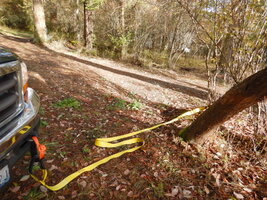
I am a big fan of soft shackles, but as mentioned I also never use them in dynamic situations. Mostly for connecting slings to rings or hitches in straight pulls. Today I used one to attach a sling to my truck, so I could rip some bushes out by the roots.

00 soft shackle 01.jpg
 
Honestly for me it's just a mental thing, the 'knot tucking into the loop' connection of soft shackles just doesn't seem ideal for something in the air that does a lot of moving around. People use them a lot pulling vehicles, but that is on the ground and worse case it just disconnects, nothing falls through a house. Slackline people use them and that is a life-support item, but they usually tape up the shackles to ensure they can't open when the line is moving around in the wind or whatever.
 
Good point, and I think I buy into your concern about opening up "on its own". I've not seen it happen on a sailboat and I've not seen it happen in any of my applications, but that's a pretty small sample of observations. When I make a soft shackle I try to size the knot to match the size of the opening of the loop. That way even if the loop opens up when it's not under load, the chance of the knot pulling through is minimized. However, it COULD happen, so I try to keep that in mind when choosing to use them vs other connectors.
 
Just to clarify, I'm not even saying my concern is rational, they are tried and true in many situations, I'm just personally not 100% comfortable with them for some uses.
 
Many things are mixed chains of rigid and flexible dampening parts, or different ranges of flexibility mixed.
Car frame to shocks, pogo stick, rope vs chain truck pull, pillow on bed etc.


Honestly for me it's just a mental thing, the 'knot tucking into the loop' connection of soft shackles just doesn't seem ideal for something in the air that does a lot of moving around. People use them a lot pulling vehicles, but that is on the ground and worse case it just disconnects, nothing falls through a house. Slackline people use them and that is a life-support item, but they usually tape up the shackles to ensure they can't open when the line is moving around in the wind or whatever.

Very thin line of great improvement to me of from normal to pro lacing status in ALL ropework by the very architecture:
upgrade the 1x arc180 single/simple turn to a 3x arc180 of RT Round Turn around the button i'd try.
Upgrade each half of Girth simple turns to RT's, have more pro level Prussic etc.
Sometimes counter-intuitively might want the quicker , less rope, more forgiveness of nonRT where simple turn is greatest
>>but mostly in real working rope, RT is the greatest geometry
Can try girth capture of button, but seems would be more of an angled pull, at high loading.
.
Here this brings us from just depending on the button, to primarily gripping self, and button now less stressed as a secondary stop? Which would be even be more help if not using the 'teflon-ic' friction co-efficiency of dyneema.
.
i think 1x arc180 gives a 1D pull across only, never count the 'legs' to the arcs as commanding like an arc does
>>this is a much more 'open' side of not full arc power
2x arc180 gives a 1D grip, as now gives the most evolved rope element of arc180 from either side
>>but can show as a line 1D still, WE(Working End ) does not return to the same position as odd number arcs like 1
3x arc180 as an RT structure is odd number so WE returns to same side as 1x
>>and now a more 2D grip shape like V(connecting dots of the most powerful arc apexes), more arcs just extend the 2D structure not go 3D i think
>> rope is flexible class/does not resist on the cross axis, so hard to get 3D force from it
>> also, in round rope, there is no axial differentiations / all axises match to then not show 3D ,effects by that quantity.
.
i always heard that direction was most important,
this seems most true of rope, that only natively resists in the tension direction,
and along it's length w/o the cross axis resistance of rigids.
Round rope maintains this as undifferentiated cross Axises vs. Flat/linear/non round shape of webbing of differentiated cross axises.
.
i have above extended rope understandings pared down to 1 theory, that can't break with examples;
and has consistently yielded many answers: only 3 raw rope elements in loaded/working rope.
They are differentiated per their directional geometry of input, output and center apex positions. arc0(simplest linear) and arc180(most evolved) maintain the same power axis, arc90 overcomes reigning power axis to cross axis, making new reigning power axis to subsequent rope parts. All 100% USDA Prime directions of geometry.
From here, views become simple logic i think, this is how i tie, groom, inspect, forensically decipher etc. really anything have ever shown.


A very true pareto/ power law of distribution/ 80:20 rule/law of the vital few/principle of factor sparsity(wiki); (i think of as 'pare to' the essentials)
of "Leveraged L-earning" the fewest pivotal points to leverage out furthest to cover the most ground;
thereby most equitable investment return on input efforts to L-earn.
Then in turn, the principles are universal, far beyond the rope examples.
This raw work we do, is gateway to much greater understandings, like few other get the chance.
Just as Doc Shigo invited to touch trees to know better, we can touch these lessons too, as few other.
Each generation buffers the next from these raw lessons as evolution, but not w/o loss(that they then shake at the buffered generation).
>>us throwbacks go back to raw wood weight, length and rope that was the beginning of all mechanical understandings outside self, as brain developed. rope was first technology outside of self of a series of ordered steps or fail, and could make connections to compound too.
Wife spends whatever was made , truest ongoing gift of treework to me are these things; they are what take forward after money gone, and much further than trees to boot, a way of understanding all around.

 
Last edited:
Flexible supports(rope etc.) have no side/cross axis resistance so as to give what i picture as an 'amplitude wave' of suddenly leveraged (sine)force, that rigids can't deliver(rigid sine can give lever that whip can't in trade tho). The initial force is the recoil like on wrong/breach end of some shoulder rocket launcher, an equal/opposite reaction of projectile fired in 1 direction; that completes the loaded axis to the opposing direction.
.
i like having 1 steel carabiner with me as a throw weight option over aluminum carabiner or soft shackle.
But, it will crack your coconut if it can!
On some high stress mostly horizontal systems have placed tarp or light branch over system/parts with seam to 'confound' such whip/wave action if it where to appear. i like heavier snap on lanyard, rather than light carabiner for same reason, got pretty good and throwing it over spar, or around spar or even under me and getting end back right to saddle_D quite predictably and cleanly as if 'boomerang'.
.
As far as the whole chain being able to have shock absorption, shock absorber etc. in car shows that 1 point of elasticity can be as a peak steam pressure relief valve, dropping pressure to whole system, a limiter, but not a fuse blow out(i picture weakest point of any chain, as 'the fuse'). But, then also, different rigging materials in chain can each have a different range of dampening to lend; especially when not a specialized part or enough size of that part to fully cover this purpose fully across the powerband.
 
Last edited:
I agree that every part of a rigging system exposed to dynamic loads does not need to elongate to absorb energy. It goes without saying that a soft shackle shouldn't. I dont think I would want a sling on a tree or other anchor to stretch much, it would move on the bark more than a low stretch material like the polyester ropes commonly used.

Has anyone made a tenex soft shackle? I'm sure it would work, but am unsure how big the puckered eye could get under extreme load. Also, I might not trust other people in the future to notice which soft shackle is dyneema and which is polyester. Melted ends would indicate polyester, but not all soft shackle knots have exposed ends.
 
I've made soft shackles out of 1/8" (and larger) polypropylene for very light loads where it's not a disaster if it fails. You can make them out of any kind of hollow braid, so I agree that tenex would be fine for making soft shackles. You just need to make sure they're not accidentally used for super high load applications. That should be easy to do with a short section of specially colored whipping.

I'm sure there are soft shackle break test videos out there that would give you an indication of stretch in dyneema, but tenex test vids might be tough to come by. Please post a link if you find one.
 

New threads New posts

Back
Top Bottom