six block rigging

We had some fun one rainy early spring morning. (see attachment) The driveway had about 4" of packed snow on it, which the rain was softening up as we did the rigging. We put chains on all four wheels of my 4x4 pickup, and spread a lot of sand in front of the wheels. We coaxed the pretty young lady out of her house and into the rain before we pulled the tree up and over - no problems.
 

Attachments

Sorry olman60, I havent a clue whats goin on in that diagram, no photos?
 
Cool idea, but all you did really was reduce the distance of pull. MDA, right? That's a really great idea when room is limited and you have enough power. You are brave to do this in the snow!
grin.gif
 
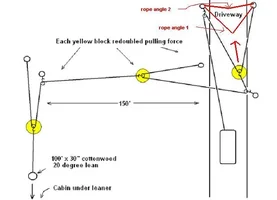
I had my digital camera with me but it was raining. Anyway, a photo of all that rope and tackle would've been no less confusing. Grover, if you start at my pickup, the rectangle on the driveway, and follow the rope, study the dynamics, I think you'll figure it out. See the attachment.

The distance of pull is increased by each yellow block. Fortunately I had the long straight driveway. (what's MDA?) Doing this in the snow was a little scary. That's why I added all the extra blocks, to make sure the pull was easy.
 

Attachments

I always thought that was a 3:1 pulling system?

The truck has 3 times the pulling power in your diagram.

Wonder why I always thought that?
Like a classic 3:1 Z Rig
Or 3:1 block and tackle system
which you can turn into a 5:1 pulling system with 2 double pulleys.

I'm confused now, going to look at my rigging notes.

thanks Olman60.
 
That rigging set up would give an 8 to 1 increase in pulling force but that advantage is decreased considerably by the friction in the blocks and the angles formed in the pull ropes by the anchor points.

Off the top of my head I would guess a 3 to 1 pull advantage is about the most that is gained.
 
[ QUOTE ]
That rigging set up would give an 8 to 1 increase in pulling force

[/ QUOTE ]

TreeCo, I was talking about Olman60's 2nd attachment. Is it a 3:1 pulling mechanical advantage?
 
[ QUOTE ]


TreeCo, I was talking about Olman60's 2nd attachment. Is it a 3:1 pulling mechanical advantage?

[/ QUOTE ]

It is a two to one.
 
i think that with that many blocks; choces for which block/efficiency should be placed where must be maid to reach maximum efficiency and lowest anchor loading.

i think that working in dynamic/statci pulley pairs; we should place most efficiency towards the truck; this sets the limiting less efficient sheaves to only limit efficiency in the tail of the system/ near load. If less efficient pairs are first; then they would limit efficiency of whole system and not just tail end. Keep as much raw input force going as long as possible.

i think that within the pair of dynamic power and static redirect pulleys; the effeciency differance wouldn't matter total power to load wise(?); but would matter anchor load wise between the 2 of them to have the more efficient pulley 1st/ closest to input effort.

This would be for pulling or lifting. It would seem that for lowering we would re-verse; but for a controlled lowering, and less anchor loading i think we'd leave the less efficiency near the load. We would reverse pulley strategy if we were using the 'load' as an input(so would now be considered effort/input in model i think) to lift something else (that would now be output end/load in my imageries); but not for controlled lowering IMLHO.

Nice work, Dan is write about friction; and i think closing the angles more when ya could (not all anchors positions or diagrams lend themselves to this) would give more efficiency too.
 
Sorry TreeSpyder, I dont have the faintest idea what your going on about.

I have read your last post 4 times and I still dont get it!

I've been working with blocks/pulleys/ropes for over 10 years and I still cant understand what you just said.

I do want to know though.

Make it easier for a dumbass like myself, please.
 
[ QUOTE ]
...if you start at my pickup, the rectangle on the driveway, and follow the rope, study the dynamics, I think you'll figure it out. See the attachment.

[/ QUOTE ]


In your second attachment it says "Block attached to tree" and points to the yellow circle. Does 'attached to tree' mean that the yellow circle represents a tree to which the block is attached? Or does 'attached to tree' mean that that block is attached to the tree that is being pulled over?

Seems it must be the latter...
 
What I saw I thought was an 8:1. It is similiar to what I have seen with the fiddle block where you attach a pulley to the tail of it and run anither rope through it where the end is anchored down. When putting multiple MA's into one system I thought you mutliplied as you go. First is 2:1 then another 2:1, now a 4:1, then another 2:1, and now you end with an 8:1.

Just think of what treespyder just said. Now the lower the friction on the first pulley and more force and sent to the second pulley and then the same to the 3rd. So the more force you can have on the first pulley would be best to transfer on down the line.

Ex: If one pulley has 5% friction reduction and the other 2 have 8% friction reduction you want to use the 5% one first.

Think I interpreted this right,.... treespyder???
 
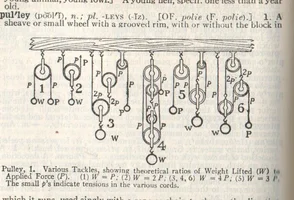
I think the mechanical advantage shown in my second diagram is 2:1 (see third attachment), which, IN THEORY, makes the advantage in my first diagram 8:1, right?

The diagram in first attachment is not to scale, but certainly there was some loss of advantage because of wide angles off the yellow blocks, more so in the one on the driveway, as I remember. And, of course, some loss due to friction.

Spyder, I put my heaviest block nearest the cottonwood. Minimal friction, greaseable bearings. I wouldn't change that. I used every block I had for this little project, and most of my rope.

Mahk, yes, "attached to tree" means attached to the tree to be pulled over. I phrased it that way because that block can be attached to the tree on any length of rope, or short chain or choker.

The (third) attachment comes from a 50-year-old Webster dictionary - an irreplaceable reference book.

 

Attachments

  • 63541-pulley.webp
    63541-pulley.webp
    95.6 KB · Views: 142
TreeCo is correct! The first is ideally an 8:1, the second is a 2:1 and both are reduced from the ideal because of the nonparallel nature of the ropes and the friction in the pulleys. Though, I think he is a bit off on the 3:1 effective pull on the 8:1 system. My guess is it is higher. It all depends on how “to scale” the drawing is.

Grover,

Don't feel bad! Half the time even I don't understand exactly what Ken is trying to say, but then again, I also don't really consider that a problem. I guess if it all works out in his head that's what is most important.

Mark,

You need to multiply the increases not add them (2*2*2 not 2+2+2).

Cary
 
[ QUOTE ]
Though, I think he is a bit off on the 3:1 effective pull on the 8:1 system. My guess is it is higher. It all depends on how “to scale” the drawing is.

[/ QUOTE ]

I probably am off on my 3/1 guess. I've added to the original drawing in red the rope angles 1 and 2. As the pulley moves towards rope angle 2 the truck aproaches zero pull on the tree.

Like Cary said it all depends on the scale of the drawing.

All of the yellow pulleys in the drawing are moving pulleys.


63552-Ropeangleoneandtwo.jpg
 

Attachments

  • 63552-Ropeangleoneandtwo.webp
    63552-Ropeangleoneandtwo.webp
    18.2 KB · Views: 75
That problem can easily be over come by connecting the upper right 1x rope to the same tree/anchor as the 1x redirect pulley (move it across the driveway). The load on the anchor goes up to about 3x, but there are other places that are supporting around that load.

Cary
 

New threads New posts

Back
Top Bottom