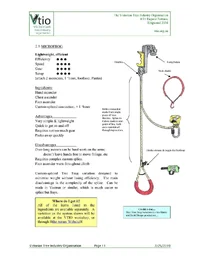
Simple SRT set up?

Thanks for all the replies. Very interesting reading, I'm starting to work on getting my new system together now.

I'm only looking for a system for ascending into the tree, but I suppose I need to think about rescue as well.

.
 
I disagree emphatically with treestyler on this one, but I respect your opinion. I do believe there is a place for mechanical devices in SRT, but for me they are simply for ascent, once aloft, its hitch and wrench all the way. I will go so far as to say I have no need to ever climb DdRT again. I have worked a hitch on SRT in the rain, the snow, and every condition in between, and I have yet to see, experience or hear of something that in any way makes me doubtful or skeptical of a hitches value in SRT.

Quote from treestyler,"I'm not saying that working SRT with knots is impossible I saying it is more likely that this can cause failure to the climber and it's system especially when he doesn't understand what he is doing out there and wich gear is suited for the job."

I believe knot and hitches in SRT are in fact SAFER than mechanical devices, which MUST BE BACKED UP WITH HITCHES ANYWAYS. I do agree with the last part of your paragraph quoted above, it is absolutely the climber's job to understand the components, limits, and capabilities of the climbing system, and lack of that knowledge can most definitely lead to injury or death.

Regardless of differences, I respect your position and opinion, and am simply arguing mine, no hard feelings.

 
[ QUOTE ]
A knot on single rope will slide down when raining or freezing. If you walk one straight way up the knot has to be wide open to let the rope run free and will have to be handled before putting weight in it.


[/ QUOTE ]

This may well be a personal experience with a hitch that you tie. Tied correctly, a hitch should act like a cam. A hitch is a cam, it uses the same principles as the mechanical devices. The main difference is the person doing the tieng. There are a thougsand diffferent ways to make a hitch, not all of them work the same. Tied incorrectly, a hitch will kill you. actually an incorrectly tied hitch probably wont kill you, youll just slide.

One of the biggest reasons to use a hitch or a UNI is that you do not have to disconnect from the line to descend. If you wish to switch to ddrt, your hitch is already tied to the line. There is no disconnecting or connecting. I think the transistion from ascent to descent is the most dangerous aspect of most SRT systems.
 
Thats oke Shawn, I think as long as we talk about gear and climbing techniques you can allways learn from the other because we all have a different way of climbing and working.

I really like you guys explaining why working with a knot in SRT is good for you.
In the netherlands my friend (treeclimber as well) has broken his back during ascending with a knot on double rope. Prussik hitch on footlock rope. The freezing cold in combination with a climbing line made the knot not work and after burning the skinn off his fingers he came down faster as planned. Since we don't ever use knots on ascents in cold or rainy circumstances.

I've done a lot off SRT climbing in trees and IRATA industrial climbing and I'm very strict about working with the proper tools to get the job done safely and efficient.
I've tested out different setups with rope and apparently did something wrong or didn't get the whole picture....

Anyway I'm now using hardware for SRT purpose and I do a lot off instruction and training and never tell climbers to go on knots in SRT. This because if you don't do it right the risc is bigger doing something wrong.

I wonder why there are some people on the treebuzz forum who only look at the extra costs and don't invest in their own safety and efficienty. On the dutch forum you will never hear anything about costs, only for some real bling bling and unnessacary equipment.

I'm happy using my own setup en I know that you all will be happy using yours setup. As long as we all know what we are doiing and why we are using this specific equipment we can really learn a lot from each other. And that's what these forums are about ;-)

climb safe
wouter
 
The dutch forum? whats the web site name? Hey whats the chance we can have someone ask to see what peoples climbing technique is without having it derailed? Lets just see the pics people or explanation! Start a diffrent topic about why or why not to use them.
 
This is something that I have discovered and it may very well be what happened to your friend who fell ascending on a knot while footlocking. It is also the reason that putting your hand above a hitch is banned in competition. For good reason. I have watched a person whip down a rope and I have done it myself when I was using an anchor bridge set up on dDRT. If you are ascending with a knot above your head as one does with a footlock prussic, or in extended mode dDRT your arms are fully extended.

If you reach up with your arms fully extended and grab on to your hitch, you will begin to slide. The bodies natural reaction at that instant is to grab on harder. It is hardwired, full on instinct. Imagine hanging on at the edge of a cliff, or a branch above a river full of crocodiles. Your body is hard wired to tighten your grip. If you are hanging on to your prussic or above your prussic, you will slide all the way down the rope burning your hands and possibly breaking your back. It is a very dangerous situation and it can happen in dDRT and in SRT if you have to extend your arms fully in order to reach your hitch.

With your hitch at your saddle, there is not a danger of clutching on to your hitch for dear life. If you start to slide you will reach well above and clear of your hitch and grab the rope which will hold you. If you tie your hitch well, you do not have to engage it before sitting back.

It is not about money for me. If i pieced together all the money I have spent on random descenders and cords and various other devices that havent worked, I could have bought several Unicenders by now. I climb with hitches because there doesnt exist any mechanicals that boast the built in safety features of hitches. The biggest safety feature of all to to me is simplicity. Thats is worth way more than money.
 
[ QUOTE ]
I do believe there is a place for mechanical devices in SRT, but for me they are simply for ascent,... I will go so far as to say I have no need to ever climb DdRT again.... in fact SAFER than mechanical devices, which MUST BE BACKED UP WITH HITCHES ANYWAYS.

[/ QUOTE ]

Not trying to be nitpicky here, but to try to maintain accuracy you can't just leave out the Unicender on discussions like this. It is an option, which is the exception to the above statements.

I wholeheartedly agree that I find very few situations to where I will revert to doubled rope technique for working the tree when the option and efficiency of working the tree in SRT is available.

Dave
 
[ QUOTE ]

...
One of the biggest reasons to use a hitch or a UNI is that you do not have to disconnect from the line to descend. If you wish to switch to ddrt, your hitch is already tied to the line. There is no disconnecting or connecting. I think the transistion from ascent to descent is the most dangerous aspect of most SRT systems.

[/ QUOTE ]
x2

Well said, Kevin - wholeheartedly agree. An excellent goal for developing any SRT system is as you state: "There is no disconnecting or connecting." It stays on for the entire climb and works for all ascent, work, & descent - as does your system. Not only are transitions "dangerous", they're a waste of valuable time.

Specifically to answer the OP, "Simple SRT set up?" means much more than 'simple components' but it also means 'simple to use' (safe) - that is, no transitions. Good point, good post!!!
 
"Not trying to be nitpicky here, but to try to maintain accuracy you can't just leave out the Unicender on discussions like this. It is an option, which is the exception to the above statements."

Absolutely correct Dave, my apologies. i didnt mean to leave out the Uni, definitely a viable method for SRT climbing.

And I agree with styler, the more we discuss, the more we can learn from each other. I know I have gotten some of my best ideas from discussions on the buzz.
 
I think if I lived were the big trees are then i might want a croll or chest ascender. Here, I almost never have to climb more than 75 feet.
 
More simple yet- I just use a 3 wrap prusik tied to my bridge (about 36 or 40 inches- not too long) and a pantin foot ascender.

I just use it to get into the canopy- usually no more than 40 or 50 feet. It just makes up for the fact that I can't do a DRT static footlock worth a darn. Once up I go DRT. I don't really enjoy the transition though. I always feel like I'm going to drop something.
 
Not to say I disagree with it being nice to go from ascent to descent without having to take anything off the line, but that doesnt mean that if you have to switch over it makes it dangerous. If you use my setup for an example, I am tied into both asending and descending systems before I come off of the ascending system. When looking at my pic, I place my weight onto the hand ascender, give myself some slack between the hand ascender and the hitch, place the descender onto the line (locking it off) and then slowly sit down onto the descender. The ascending setup is all tied together at all times so there is no chance of droping any of it as I take it off. Like I stated before yes it is nice to go from ascending to descending without removing and adding but as for the safety of it there are ways to be safe with no problem. I am tied into three points prior to taking anything off and have all my weight on a locked off descender.
 
Treebing's on fire in this thread!
owned.gif
 
[ QUOTE ]


Not trying to be nitpicky here, but to try to maintain accuracy you can't just leave out the Unicender on discussions like this. It is an option, which is the exception to the above statements.


[/ QUOTE ]

The Unicender and art were specifically not invited to this discussion by the poster.

I definitly agree that it is an excellent option for going SRT, it seems to ascend very well. It seems to work very fluidly and I havent heard any bad reviews of it. Its not for everyone though and Grover is one of those who is specifically not interested. Im not sure why. Everything is always worth trying out.
 
My apologies to Grover For using the U word. But my purpose for doing so was not to promote its use but to correct statements on what "all" mechanicals can or must do.

Dave
 
Does Mark Chisholm use a Simple SRT set up?

Probably not, he knows how to get stuff done rather than mucking about with equipment.

...at The Geezers International, Invitational, Open, World Championship!
 
[ QUOTE ]

The Unicender and art were specifically not invited to this discussion by the poster.

Its not for everyone though and Grover is one of those who is specifically not interested. Im not sure why.

[/ QUOTE ]

I believe the Unicender is a great tool, as the Art products (Lockjack Sport etc) are as well in the right circumstances, but 90% of my work is takedowns and I just dont think these tools are going to be at their best when full of sawdust, treedirt(?), moss, lichen and sap.

Having attempted to use the Lockjack Sport for a few months in place of my usual Swabisch I found the cam would become clogged and unpredictable with Spruce/pine/sawdust and sap on the cam. The Unicender has even more cams so to speak so this is why they are not part of my climbing system. I also dont see how the Lockjack Sport was ever supposed to be used when working on a pole during the last part of a tree takedown.

I have always used rope hitches and have only ever used mechancical ascenders for long climbs into the tree to find a suitable TIP.

My ascending technique using SRT is about 10 years old now and having seen Frog system in action over the last few years on the forums I thought it was about time I found a more ergonomic way to ascend a single rope.

Thanks for all the replies and advice.
 
I found this pic somewhere and have been meaning to try it out. It looks to be an excellent setup, I would implement it with a regular handled ascender and a knotted piece of rope.
 

Attachments

  • 257624-MIcrofrogSRTsystem.webp
    257624-MIcrofrogSRTsystem.webp
    100.1 KB · Views: 144

New threads New posts

Kask Stihl NORTHEASTERN Arborists Wesspur TreeStuff.com Teufelberger Westminster X-Rigging Teufelberger
Back
Top Bottom