Show off them splices

Here are just a few suggestions based on your splicing video. I suggest you get a cleat or wall mounted eye bolt and carabiner rather than a steel vice for working on rope. When you start jerking on a climbing rope against a sharp metal edge there is a good chance you are going to damage fibers. Also, I can't tell what you are beating on the rope with. If it is a rubber padded tool, that is ok, but it is hard to see in the video. The best tool is a rubber mallet. In general I avoid beating on a rope unless I absolutely have to, which is rare in the case of loosely braided rigging ropes.
 
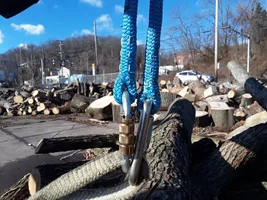
I thought I would try my hand at the soft shackle. I did some research and found the improved soft shackle. It claims 230% of single line strength. I made one with a 12 inch opening. I started with an 84 inch long piece of 3/8 Amsteel. That means this shackle should be good for 40,000lbs. Would @yoyoman care to break test it for me. Maybe I shouldn't test the limits of his machine. I plan to make the same thing with 5/8 tenex. It has about the same break strength.

 
I thought I would try my hand at the soft shackle. I did some research and found the improved soft shackle. It claims 230% of single line strength. I made one with a 12 inch opening. I started with an 84 inch long piece of 3/8 Amsteel. That means this shackle should be good for 40,000lbs. Would @yoyoman care to break test it for me. Maybe I shouldn't test the limits of his machine. I plan to make the same thing with 5/8 tenex. It has about the same break strength.

]

I thought I would try my hand at the soft shackle. I did some research and found the improved soft shackle. It claims 230%.

I plan to make the same thing with 5/8 tenex. It has about the same break strength.

I think we read the same article. 230% seems very precise. I wonder how they came about those numbers, hand calc or machine. 230% to the eye/mind, looks like a crazy increase in strength. What would that be if multiplied, you know, like, 1.5 times the regular strength.. 2.5 times the regular strength..?

Regardless, strong little buggers to say the least, especially with Dyneema.

Hey.. question...
What do y'all think is the most commonly used rigging sling?
Ultra/Pocket
Whoopie
Loopie
Deadeye
Eye to Eye
Eye to Ring
 

I personally have gone back to using dead eye slings with my rigging rings. I don't mind using ultra's and whoopie's for re-directs that I don't/rarely move, but having the ability to keep the rope through the ring and tie a cow or timber hitch is for me far superior...they are also easier and faster to splice
 
The dead eye sling is a very useful tool. I te
Hmmm. Whipped at the standing end of the splice rather than the throat of the loop? I'm new to splicing and I usually stitch and whip at the throat. Why the standing end?

The throat is too tight to lock stitch. Trying to force a needle through that part of the rope will damage to many fibers. It is also only needed until the rope is loaded. After that it is just decoration. A proper double braid eye splice should not slip once it has been loaded. If it slips at all the dimensions of the splice were wrong.
 
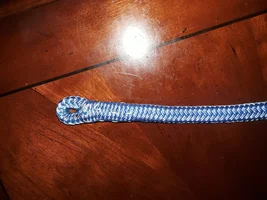
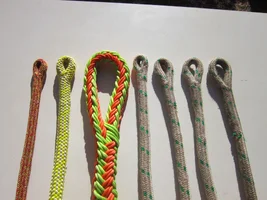
Here is a db eye splice from rope logic on yale Aztec. It is at the base of the core taper. The lock stitch is for locking the core to the cover. It is not necessary to capture the taper in the lock stitch on a double braid. That being said; if you can do it and not damage fibers, it can't hurt.
 

Attachments

  • P_20190310_085912_vHDR_Auto.webp
    P_20190310_085912_vHDR_Auto.webp
    165.4 KB · Views: 27
Here is a db eye splice from rope logic on yale Aztec. It is at the base of the core taper. The lock stitch is for locking the core to the cover. It is not necessary to capture the taper in the lock stitch on a double braid. That being said; if you can do it and not damage fibers, it can't hurt.
Thanks for the info. Good to know. It does seem like sometimes I have to work the speedy stitcher pretty hard to get it through the throat of the eye. I might be damaging fibers when it's that tough to do. If it's tough to do, I'll back off the throat area. I do like the look of the whipping at the throat, but then I would only have to bury the whipping cord ends.

Speaking of lock stitch, when using a Speedy Stitcher (a.k.a. a painfully slow stitcher), I bury the lock of each stitch per the directions for the SS. Is this OK or should I run the stitching twine all the way through back and forth like the Samson directions call for?
 
Thanks for the info. Good to know. It does seem like sometimes I have to work the speedy stitcher pretty hard to get it through the throat of the eye. I might be damaging fibers when it's that tough to do. If it's tough to do, I'll back off the throat area. I do like the look of the whipping at the throat, but then I would only have to bury the whipping cord ends.

Speaking of lock stitch, when using a Speedy Stitcher (a.k.a. a painfully slow stitcher), I bury the lock of each stitch per the directions for the SS. Is this OK or should I run the stitching twine all the way through back and forth like the Samson directions call for?

I don't think it matters that much. I use the speedy stitched method, knot the ends, bury the loose ends, and then use a separate thread for whipping over the lock stitch.
 
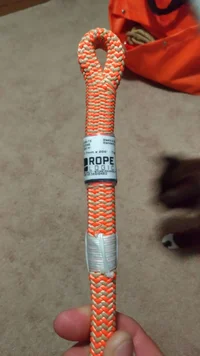
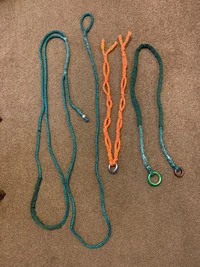
How do you use the orange sling? I don't think I've seen a double ultra sling before, if I'm looking at it correctly.
I actually designed that double one with a rap ring on it more for a rock climbing anchor. Sometimes they’ll have bolts or chains drilled into the side of the rock and it makes it so that you can put anchors up there with for your top rope setup. Basically this makes it so that you can throw a carabiner on each sling, attach them to the two different anchor points (sometimes they’re offset) and then you slap another carabiner in the first pocket of both so it overlaps the ring and the rope runs through both the ring and the carabiner. (Redundancy is stressed much more in rock climbing than tree climbing, I.e. you always have two points of anchor, you would never use a bowline on its own type thing)

However, you could easily use something with a similar concept as a speed line rig (maybe beef it up to a steel ring and some amsteel blue) make it so that you can put multiple branches on the legs, snap the ring to a pulley, maybe add a third leg?

I mean basically you could use it as a soft rigging plate type deal.
 

New threads New posts

Kask Stihl NORTHEASTERN Arborists Wesspur TreeStuff.com Teufelberger Westminster X-Rigging Teufelberger
Back
Top Bottom