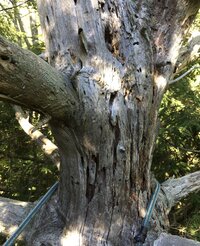
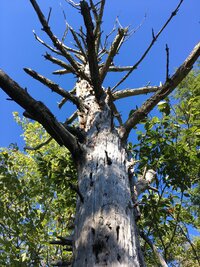
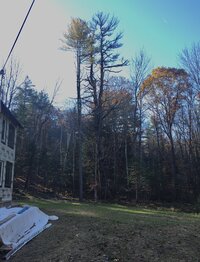
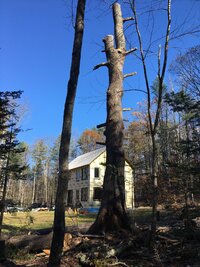
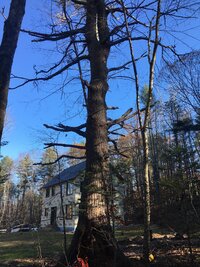
Show me your SNAGS

Pretty good description of the "bat kerf" in Brian's text. There are a bunch of different bat species with different roosting preferences. For example Big Brown Bat in the northeast likes to roost between the partially separated bark and the trunk on dead standing white ash. I think any bat is going to like getting behind the bark in any species of dead standing tree. Bat's can squeeze into just about any wood crevice or slightly separated bark. Abandoned woodpecker cavities are favored by some bat species. I think you can read Brian's bat recommendations, add some imagination and you're there ;-) The brown creeper (cool bird) builds its nest in the same small space between separating bark and the trunk.
-AJ

Thanks! That makes sense. It is a great article.
 
I've been reading about forest recovery after wildfire, turns out bats are important. Woodpeckers dig out nesting cavities in standing snags, when they're done bats are one of many possible creatures that will move in, as well as use whatever cracks and existing hollows they can find on snags. Their droppings aka guano are an important source of nitrogen for the successional phase of forest regrowth.
-AJ
 
I’ve never bothered trying to target any specific species, but I’ve done some cutesy shit. I made a few cuts to slide out a section of the trunk and bored in a cavity behind it, basically making a gnome style mailbox. I even carved in the letters mail on the sliding door.
We are pretty lucky here, the only animal we are lacking is apex predators. I just make a snag and let nature do the work. The bark will flake, the wood peckers will nest. They know what they want and like specie wise and size/location better than I.
The only hard rule I have with snags is just to make them short enough for WHEN they break it won’t hit anything. Or so they can be felled later
 
I couldn’t find any photos, but I also like the birdhouses and cavities we can create with careful boring/cutting
 

New threads New posts

Back
Top Bottom