Matias
Been here much more than a while
- Location
- Silicon Valley
Follow along with the video below to see how to install our site as a web app on your home screen.
Note: This feature may not be available in some browsers.
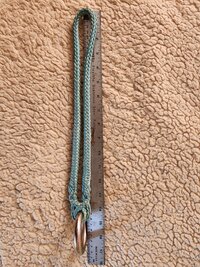
The end of the taper went about 6" past the last brummel.What are the bury lengths?
Thanks Brock, I like having some numbers to wrap my head around. I'm pretty new to this, and still learning a lot every splice I do. If you lost even 2/3 of the Icetails 8500# strength, you'd still have ~3000# left to catch you. Nonetheless, an idea I'll ruminate on while that bit of cordage lives on as a little e2e.New England Rope’s Lock Stitch Splice, that’s what they call it, now has a 3 fid length bury after three passes through the rope. Their earlier instructions were only 2 fids. But unlike Samson’s instructions, NER doesn’t make a distinction between class I and Class II materials. Their straight bury splice only has a 2 fid bury, seems you need more length to overcome the lose of strength of the brummel, that’s what I call it.
I’ve found a locked brummel with a fid and a half of bury looses around 25% of the rope, or cord’s break strength. If you do a rebraided tail to do a second eye for a hitch cord, another 15% of strength is lost.
I appreciate the thorough response, and your thought process mirrors my own. I was trying to come up with ways to minimize the thickening of the rest of the cordage as much as possible, but I think I need to try this out with thinner cordage to be able to bury it all the way through and end up with a closer working diameter to what I wanted. Don't worry guys, it's been dismantled and lives on as a standard e2e for not anyway.I would redo! If I could not I would thoroughly inspect and likely use it if I had nothing else.
The things I don't like about it is the crossed or woven eyes, it looks like one eye is passing through the other.
The other thing I don't like about it is when doing a short eye to eye in this configuration, why not follow the manufactures recommendation? Having both tails go past center and overlap creating a even diameter throughout the entire cord.
Now the reason I would likely temporally use it as is (AND IM NOT ADVOCATING FOR YOU TO DO SO!) is in this configuration it is in a basket doubling the theoretical strength, or halving the load on each splice depending on how you look at it. This assumes you are using it as an adjustable friction saver (Ring and ring)? This would also theoretically be half your weight on each ring, thus 50% load on that one ring, and that load is again shared by each leg (or each eye) seeing 25% of the load applied to an adjustable ring and ring FS. I would guess if you had it broken it would break at acceptable life support numbers but WELL BELOW what you can get out of it.
Now my question is: if used in low load cyclic loading, would that make it more likely to pull a splice? More so in a slippery line?
So please dont use this, and redo using the instructions linked... DO NOT cut any corners, and follow the manufactures instructions until you become experienced then you can play around a little.