southsoundtree
Been here much more than a while
- Location
- Olympia, WA
Any good info sources and/ or anecdotes?

Follow along with the video below to see how to install our site as a web app on your home screen.
Note: This feature may not be available in some browsers.

It takes ALOT of copper nails to kill a tree. Makes for some pretty stained wood though.
I have heard the premise that copper nails hammered into a tree would kill it but have never done it or spoken to a person who has. I guess if copper just killed the cells of the roots it comes in contact with and doesn't travel systemically it could work well as foundation protection.
Totally depends on the foundation. I can’t recall where I found it, but a tree is only able to exert a limited psi with diameter growth. Houses are heavy, a solid stem wall foundation with a good footing is pretty bulletproof unless it’s a sequoia uniformly lifting with many roots close to the foundation.Any good info sources and/ or anecdotes?

That wouldn't be the case in my area of California. Cracks in T wall type foundation around the exterior. Not sure about condition of interior lines of foundation but it was lifting those enough to warp hardwood floors and crack a couple of walls.This is a frequently cited reason we're given by clients who want to remove giant healthy perfect trees. We usually just say no or tell them they can repair a good amount of damage to a foundation for the same price or less than a huge removal, plus it doesn't damage the ecosystem. They usually just find another company

A lot of houses here are built on stem walls only, and we're only required to dig down a foot for the footings. The crawl space under the house is moist and aerated for far longer than the surrounding area. The roots won't damage a well built wall as they grow, but as we also don't have freezing temps, and a lot of houses were built next to existing trees that are now large. I have seen some enourmous rootplates come up with big pines. I haven't been paying attention for more than a few years, so I am still inclined to err on the side of caution, though I will also always try to sell people on doing whatever it takes to save a big old tree.Much damage to hardscape (including foundation) is more about failure of the material BEFORE the tree exacerbates the damage.
There is a Zelkova at a client's house that he pointed to and said "that tree really tore up the sidewalk.". I pointed to the driveway "It's the same difference to the drive...look at that giant root right along the concrete, but it hasn't moved. What's the difference?"
The answer is the sidewalk was poorly built. Likely not enough of a base, minimal compaction, and 2.5" of concrete. The driveway slab was built better and thicker so the roots had no interest in getting under it.
What do roots want to do with a foundation? If there is water and air, they'll find it. So if the foundation cracks, roots will exploit that crack and worsen the damage...but it's pretty rare that they initiate damage.
Another example I look at periodically: there is a giant Silver maple about 6' from the foundation of a +/- 100 year old house. No damage. But people are worried about the tree 30' away. Sure...if your foundation wasn't built well. But is that the tree's fault? Will removing the tree fix a poorly built foundation? It might delay problems. Maybe long enough to sell the house and move on.
Timeline is likely more important than species. What came first the foundation or the tree? Cutting some surface roots for a 12” stem wall really close to the tree will probably be worse if it uprooted than the inverse, a tree planted too close to the foundation… still those tension roots play one fuck off role in stability.A lot of houses here are built on stem walls only, and we're only required to dig down a foot for the footings. The crawl space under the house is moist and aerated for far longer than the surrounding area. The roots won't damage a well built wall as they grow, but as we also don't have freezing temps, and a lot of houses were built next to existing trees that are now large. I have seen some enourmous rootplates come up with big pines. I haven't been paying attention for more than a few years, so I am still inclined to err on the side of caution, though I will also always try to sell people on doing whatever it takes to save a big old tree.
Have you seen an uprooted tree move a foundation with it? Not saying that's impossible or unheard of...but does it happen? And if so, with what frequency?A lot of houses here are built on stem walls only, and we're only required to dig down a foot for the footings. The crawl space under the house is moist and aerated for far longer than the surrounding area. The roots won't damage a well built wall as they grow, but as we also don't have freezing temps, and a lot of houses were built next to existing trees that are now large. I have seen some enourmous rootplates come up with big pines. I haven't been paying attention for more than a few years, so I am still inclined to err on the side of caution, though I will also always try to sell people on doing whatever it takes to save a big old tree.
I’m sure your stats are reflective, unfortunately I’m not sure they are representative.Have you seen an uprooted tree move a foundation with it? Not saying that's impossible or unheard of...but does it happen? And if so, with what frequency?
I try to help people reframe tree risk.
For example... about 300 people per year due from tree related failure (removing industrial accidents).
*It takes 2 days to kill that many in car accidents. And you want me to to.get in my car and drive home? No way. I'm staying here. Set an extra place for dinner. Hope the spare bed is comfortable!
*Estimates of the mortality rate of autoerotic asphyxia range from 250 to 1000 deaths per year in the United States. So a lot.ore frequently than tree deaths. You know many who die that way?
*According to the Centers for Disease Control and Prevention (CDC), an estimated 178,000 deaths in the United States each year are attributable to excessive alcohol consumption. Gonna quit drinking too?
*Another way to think about risk and perception...3 most deadly animals in Australia - the land where everything wants to kill you, right?: dog, cow, horse.
Trees striking houses cost about $1 billion per year. It would be interesting to look at storm damage to houses that would have been damaged even if not by a tree...IOW, a tornado is taking the roof. Whether it rips it off or a throws a tree into it, your roof is gone...is that really the tree's fault? Would also be interesting to know the stat minus Florida. Compare:
*In the United States, fire departments respond to an estimated 170,000 to 185,000 home fires caused by cooking each year. Causing $1.1 - $1.2 billion per year. Are you having your stove removed as well as the tree to prevent damage?
All that to say...yes, trees present a risk. But so do a lot of things. Make a reasonable assessment of the risk then decide if it is in line with risk tolerance you have everywhere else in life.
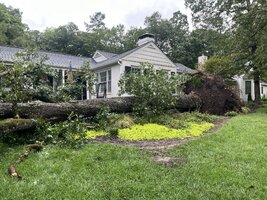
I tried to be clear that I have never seen a foundation ripped apart in this way. I was curious about it because almost everyone I know has either suffered some amount of loss directly from falling trees/stems, or knows someone who has.Have you seen an uprooted tree move a foundation with it? Not saying that's impossible or unheard of...but does it happen? And if so, with what frequency?
I try to help people reframe tree risk.
For example... about 300 people per year due from tree related failure (removing industrial accidents).
*It takes 2 days to kill that many in car accidents. And you want me to to.get in my car and drive home? No way. I'm staying here. Set an extra place for dinner. Hope the spare bed is comfortable!
*Estimates of the mortality rate of autoerotic asphyxia range from 250 to 1000 deaths per year in the United States. So a lot.ore frequently than tree deaths. You know many who die that way?
*According to the Centers for Disease Control and Prevention (CDC), an estimated 178,000 deaths in the United States each year are attributable to excessive alcohol consumption. Gonna quit drinking too?
*Another way to think about risk and perception...3 most deadly animals in Australia - the land where everything wants to kill you, right?: dog, cow, horse.
Trees striking houses cost about $1 billion per year. It would be interesting to look at storm damage to houses that would have been damaged even if not by a tree...IOW, a tornado is taking the roof. Whether it rips it off or a throws a tree into it, your roof is gone...is that really the tree's fault? Would also be interesting to know the stat minus Florida. Compare:
*In the United States, fire departments respond to an estimated 170,000 to 185,000 home fires caused by cooking each year. Causing $1.1 - $1.2 billion per year. Are you having your stove removed as well as the tree to prevent damage?
All that to say...yes, trees present a risk. But so do a lot of things. Make a reasonable assessment of the risk then decide if it is in line with risk tolerance you have everywhere else in life.