Daniel
Carpal tunnel level member
- Location
- Suburban Philadelphia (Wayne)
tough to say.... not sure what you;re talking about... the first two links are not my work...Butt, what do I know…
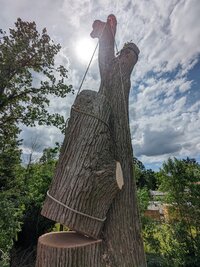
On overhead rig of the long , some skinnier near horizontals would favor tighten hard by hand(including climber 2/1 and climber sweat/swig), hitchpoint a bit hinge side of CoG; and use the length as a lever stretch rope hard(from the distance of drift on hinge) as lay load into rope, pre-tightening rope even more until line tension to equal or about the load itself. The longer the lever between hitchpoint and hinge pivot, the greater tightening per degree of drift down.
.
Make it handle very lightly on hinge and less tear off shock because most of the weight already transferred to rope by then. At tearoff want rope angle pulling away from climber.
.
Use beast's own length and weight against it, and the positive tip weight to make it steer itself into hole to ground. Line up the pool shot correctly and kinda like a martial art, the limb can beat itself; configure it's own graceful demise.
exactly.. you were the first person I ever heard trying to explain the concept online way back at AS circa 2002 or 2003. I think you called it ball in socket or something like that. I had accidentally achieved the result once so thought of that moment, and saw Mark C explain the balance point concept at a riggign workshop in 2002. Then I started working with my climbing mentor who was a true master of the art... he would tie off 40' oak limbs that were so well balanced you could push them with your thumb. He wsa using notches at the time as was Mark C. I discovered that using a rip cut right in the shoulder achieved better results. MUCH BETTER
To my knowlede I AM the first person to publish the technique of using rip cuts to swing limbs with the near COG tie off as you describe above. Also I AM the first and possibly only person to publish the use of a "remote trip" for the described rigging. That is making the cut to cripple the hinge, but only after the groundie allows a little slack in the system. That allows the climber or bucket operator to leave the work area before any movement in the limb is initiated.