- Location
- Va

Navigation
Install the app
How to install the app on iOS
Follow along with the video below to see how to install our site as a web app on your home screen.
Note: This feature may not be available in some browsers.
More options
You are using an out of date browser. It may not display this or other websites correctly.
You should upgrade or use an alternative browser.
You should upgrade or use an alternative browser.
Rigging failure
- Thread starter Chino Blanco
- Start date
- Location
- Va
Bear with me. New guy here

treehumper
Carpal tunnel level member
- Location
- Ridgefield, NJ
How about typing a description of what we are looking at and how the failure occurred?

NE Tree
Branched out member
- Location
- fremont, Ne
Yes, a little more info on what's going on here please. It's hard to tell from the pic what was trying to be done and what actually happened
- Location
- Va
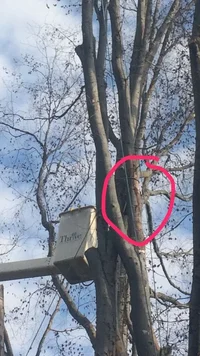
Sorry. Hypoxylon canker on American beech may have comprised the structural integrity of the lead in question. Two arborist blocks were placed in adjacent leads to dissipate the load.
- Location
- Va
The piece being lowered wasn't very heavy either. Just wanted to remind everyone.
- Location
- Va
He had two blocks in the tree, in adjacent leads, to dissipate the load. The failure occurred next to the bucket in a patch of hypoxolyn canker. Piece wasn't large although a small amount of dynamic loading took placeYes, a little more info on what's going on here please. It's hard to tell from the pic what was trying to be done and what actually happened
- Location
- Va
He placed two blocks on a codominate stem and the lead with the hypoxolyn canker failed at the canker. Not a large piece, but a trivial amount of dynamic loadHow about typing a description of what we are looking at and how the failure occurred?
treehumper
Carpal tunnel level member
- Location
- Ridgefield, NJ
Did the groundperson let the rope run or tried to catch the piece? Any sense of how far the piece dropped? Size of piece to get an idea of the weight would be helpful too! Thanks!
Good that nobody was injured!
Good that nobody was injured!
- Location
- Va
- Location
- Va
Did the groundperson let the rope run or tried to catch the piece? Any sense of how far the piece dropped? Size of piece to get an idea of the weight would be helpful too! Thanks!
Good that nobody was injured!
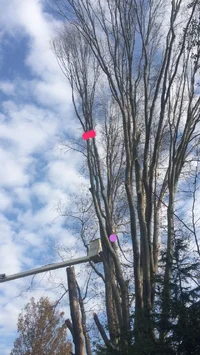
10 in beech maybe 6 feet long. Traveled enough to clear the bucket and was slowly stopped 20-25 below.Did the groundperson let the rope run or tried to catch the piece? Any sense of how far the piece dropped? Size of piece to get an idea of the weight would be helpful too! Thanks!
Good that nobody was injured!

CutHighnLetFly
Been here a while
- Location
- Cape Cod, MA
Your boy wasn't really "spreading the load", more like sharing it between two stems at the same side of the crown.
So when the rigging is set up at posted in that picture, the load is going to pull the stems out, towards the left, no matter the size of the load.
If the second block was set on an upright, central lead in the center/closer to right side and at the same height of the block out the left side, it would have caused much less pullijg of that last rigging point where the piece hangs. The set up would cause a more downwards force on the stem with the block.
To illustrate this more, imagine it was set off to the right in the canopy center BELOW the the last block where the piece hangs. The rope angle coming out of that block would have legs heading down towards the ground, pushing down on the stem from the rigging point.
The take away : The wider the rope angles are between at the rigging points, the less force the points see. The more wide angled rigging points you create, the less each point sees as the force is widely distributed.
That's why brothas call me dr dre
So when the rigging is set up at posted in that picture, the load is going to pull the stems out, towards the left, no matter the size of the load.
If the second block was set on an upright, central lead in the center/closer to right side and at the same height of the block out the left side, it would have caused much less pullijg of that last rigging point where the piece hangs. The set up would cause a more downwards force on the stem with the block.
To illustrate this more, imagine it was set off to the right in the canopy center BELOW the the last block where the piece hangs. The rope angle coming out of that block would have legs heading down towards the ground, pushing down on the stem from the rigging point.
The take away : The wider the rope angles are between at the rigging points, the less force the points see. The more wide angled rigging points you create, the less each point sees as the force is widely distributed.
That's why brothas call me dr dre
- Location
- Va
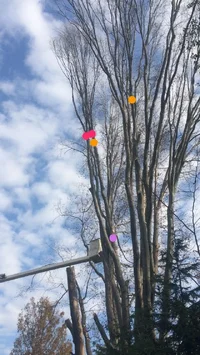
I think I follow. What if the blocks were installed where the orange dots wereYour boy wasn't really "spreading the load", more like sharing it between two stems at the same side of the crown.
So when the rigging is set up at posted in that picture, the load is going to pull the stems out, towards the left, no matter the size of the load.
If the second block was set on an upright, central lead in the center/closer to right side and at the same height of the block out the left side, it would have caused much less pullijg of that last rigging point where the piece hangs. The set up would cause a more downwards force on the stem with the block.
To illustrate this more, imagine it was set off to the right in the canopy center BELOW the the last block where the piece hangs. The rope angle coming out of that block would have legs heading down towards the ground, pushing down on the stem from the rigging point.
The take away : The wider the rope angles are between at the rigging points, the less force the points see. The more wide angled rigging points you create, the less each point sees as the force is widely distributed.
That's why brothas call me dr dre
Attachments
- Location
- Va
I was taught the highest block set absorbs more of the load. Is this accurate?

- Location
- Va
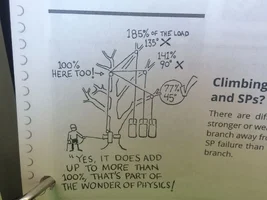
Is this legit?I think it would depend more on the angles of the rope at the anchors than the height.
Attachments
treehumper
Carpal tunnel level member
- Location
- Ridgefield, NJ
This is applied physics. YOu'd be well served to learn about vector analysis. Simply put a vector is force with a direction. When you learn this you'll understand the effect of angles in a system.
- Location
- Va
I consider myself a student of the game that is still teachable. The challenge will be relaying this info to my LatinosThis is applied physics. YOu'd be well served to learn about vector analysis. Simply put a vector is force with a direction. When you learn this you'll understand the effect of angles in a system.
treehumper
Carpal tunnel level member
- Location
- Ridgefield, NJ
When you've got it then it'll be easier to convey it to them.
New threads New posts
-
test
-
 Apr 09 (Free CEUs) & May 07 - 'Urban Forestry Today' Webcasts @ Noon (Eastern)
- Started by UFT
- Replies: 0
-

-
-

-
KBNest -Midline Attachable SRS Canopy Anchor.
- Started by TreeSteward
- Replies: 6
-

