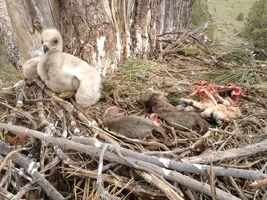
Renesting a fallen Great Horned Owl

moss

Been here much more than a while
I was contacted by a federally licensed wildlife rehabilitator yesterday morning, she was looking for assistance returning a fallen GHO owlet to its nest. Great horned owls are infamous for using lousy/rickety nets. They do not build their own and re-use whatever old crow or hawk nest they can find. As a result, early every spring owlets are falling out their nests all over North America ;-) I climbed up using alternating trunk cinches (no available upper anchor without disturbing the nest). I attached a bundle of sticks to the tail of my rope and pulled that up to build out the incredibly skimpy nest to something that would safely contain the total of three owl young. Once I completed that I pulled the owlet up in a bag on the tail of my rope and placed it in the nest.

Short vid at the nest:

Getting started on the alt/cinch climbing
49706722291_22ee9303ce_b.jpg


Rabbit parts hung on the way up
49706718671_70aed9beda_c.jpg


Just below the nest
49706718576_935956e145_c.jpg


Hello! Most of a cottontail rabbit carcass in the nest in front.
49707037757_d718da1783_c.jpg


Looking through as I built up the nest
49707276033_c42423a4c0_c.jpg


All the photos here: https://www.flickr.com/photos/naturejournal/albums/72157713653991732
-AJ
 
Last edited:
I can imagine those siblings looking at each other and thinking, who was that guy?
Very neat job, well done. Did you see the parents around?
 
Most excellent! Did you make a tiny Moss lanyard for the little guy, so he can climb back up on his own, the next time he falls out of the nest? He wouldn't need tiny little spurs... I think he's got those built in.
 
Hey Moss, I think you did the right thing in this case, but as an owl biologist I gotta do my spiel about rescuing owlets that are found on the ground. Although they do occasionally fall from the nest, the majority of owlets leave the nest before they are capable of flight. They just bail out and come flopping down until they get lucky and grab a limb or they fall to the ground. Once on the ground they are excellent climbers and can usually climb up a rough or sloping tree trunk until they reach a secure perch. They sometimes spend several days on the ground before they reach a good perch. Even very young owlets that jump early usually make it because the adults continue to feed and protect them.

So, it is often a difficult decision regarding whether or not to stick them back in the nest. If the nest has collapsed or the owlet is in a really exposed spot where it is likely to get killed by dogs, cats, or humans, then it is a no-brainer to at least put them up on an elevated perch. But if the owlet is on the ground in the forest and appears healthy, I often just leave them alone or set them up on a log or low limb. Arborists need to understand that most owlets that are temporarily on the ground do not need rescuing.
 
PS -glad to see you have your eye protection on. Great-horns can be really nasty.
 
I can imagine those siblings looking at each other and thinking, who was that guy?
Very neat job, well done. Did you see the parents around?

Both the mother and father were there. He left when I started climbing, she stayed on the nest watching until I was about 20' below her then she flew. I heard from the rehabber that the parents returned to the nest.
-AJ
 
Hey Moss, I think you did the right thing in this case, but as an owl biologist I gotta do my spiel about rescuing owlets that are found on the ground. Although they do occasionally fall from the nest, the majority of owlets leave the nest before they are capable of flight. They just bail out and come flopping down until they get lucky and grab a limb or they fall to the ground. Once on the ground they are excellent climbers and can usually climb up a rough or sloping tree trunk until they reach a secure perch. They sometimes spend several days on the ground before they reach a good perch. Even very young owlets that jump early usually make it because the adults continue to feed and protect them.

So, it is often a difficult decision regarding whether or not to stick them back in the nest. If the nest has collapsed or the owlet is in a really exposed spot where it is likely to get killed by dogs, cats, or humans, then it is a no-brainer to at least put them up on an elevated perch. But if the owlet is on the ground in the forest and appears healthy, I often just leave them alone or set them up on a log or low limb. Arborists need to understand that most owlets that are temporarily on the ground do not need rescuing.

That's great info, I didn't know GHO young are such strong climbers. Just about all species of perching/nesting birds in North America end up on the ground for a bit before they figure out the basics of flying. There are exceptions. Parents feed their young that end up on the ground, and often young birds of any species find their way to safer locations getting into shubbery or thickets. Or as Arlo points out, climb back up.

This owl landed between two heavily landscaped suburban properties, very little cover. 50/50 it would get taken out by a cat, dog, fox, etc. The decision to renest was not mine, I was brought in by an animal control officer and a wildlife rehabber to do the job. I was happy to help, it was a great experience, a good use of my skills.
-AJ
 
PS -glad to see you have your eye protection on. Great-horns can be really nasty.

Yeah I've handled adult barred and great horned. Probably like some of you I grew up grabbing snakes, snapping turtles etc and have handled a variety of small and large birds, mammals and fish with large pointy teeth. I'm always impressed at the size of adult GHO talons, massive for the size of the animal.
-AJ
 
I should've elaborated, arborists shouldn't be the ones making decisions on how to handle raptor distress situations, that's for wildlife professionals. You need a federal license to handle a raptor. I wouldn't have been involved except that I working at the request of a federally licensed wildlife rehabber who determined that renesting was what needed to happen. The nest was the worst I've seen for a GHO. With the reinforcements I added the fledglings likely won't leave the nest until they intend to.
-AJ
 
I should've elaborated, arborists shouldn't be the ones making decisions on how to handle raptor distress situations, that's for wildlife professionals. You need a federal license to handle a raptor. I wouldn't have been involved except that I working at the request of a federally licensed wildlife rehabber who determined that renesting was what needed to happen. The nest was the worst I've seen for a GHO. With the reinforcements I added the fledglings likely won't leave the nest until they intend to.
-AJ
Actually, if you find a bird that is obviously injured or sick you can stick it in a box and take it to a rehab facility. Nobody is going to give you a ticket for that. But if the bird looks healthy and is in a place where it is not likely to get run over or killed by the neighborhood cat, you are better off calling a rehab facility to get advice before you do anything. Otherwise you may create an orphan that would have been better off if left where it was.
 
Awesome stuff and good information all around. Thanks Arlo.

Way to go Moss!

I imagine the recommendations for owl on the ground rescue might change a little if every rescue center had a climber like Moss on call. Maybe not, but I imagine so.
 
Awesome stuff and good information all around. Thanks Arlo.

Way to go Moss!

I imagine the recommendations for owl on the ground rescue might change a little if every rescue center had a climber like Moss on call. Maybe not, but I imagine so.

Thank you!

Yes, without a climber available the responder has to weigh leaving things as is or raising the young as an orphan which is labor intensive and expensive to do it right.

At some point a few years back the local Boston birding community raised an alarm online that a one-eyed great horned owl was hanging around a cemetery that’s a popular place to observe birds. People were talking about how to capture the owl and get it to a rehabber and “save it”. I had a feeling that there wasn’t actually a problem. I contacted a local owl expert and described the owl and location. He replied something to the effect of: “She is my best foster parent, i’ve been stuffing orphaned owls into her nests for 15 years. She is an impressive hunter and has no problem providing no matter how many young are in her nest”. I let the birding community know everything is fine. My owl expert friend receives many orphaned great horned owls every spring. Since the people who bring these owls in have no idea where the nests are it’s easier and most effective to climb and simply put them in a foster nest.

That same year I visited at her nest in a white pine in the cemetery. The quantity of rabbit parts at the base of the tree was astounding ;-)
-AJ
 
Last edited:
@ARLO, since you are an owl biologist, maybe you can answer a question for me. I have heard of cases where a Great Horned Owl has taken a healthy, adult cat as prey, but I am wondering if that is a rare, occasional or frequent occurrence for urban owls. Do you have any idea?
 
@ARLO, since you are an owl biologist, maybe you can answer a question for me. I have heard of cases where a Great Horned Owl has taken a healthy, adult cat as prey, but I am wondering if that is a rare, occasional or frequent occurrence for urban owls. Do you have any idea?

I'm guessing Arlo has many stories on this, if so looking forward to hearing them. My owl expert friend has taped great horned owl nests with infrared cameras. He reports a variety of prey captured by the parent owls. In addition to the usual suspects: skunks, rabbits, various nocturnal rodents etc., he's documented domestic cats and small dogs, like toy poddles etc. brought to the nest. He has found pet collars at nest sites.
-AJ
 
I've had excellent assistance given freely to me by our Raptor Bird Society on many occasions, particularly injured young Falcons that waited too late to fly....

They'd come out to the job, pick up the youngsters, then send me reports once they'd been rehabilitated n reintroduced to the wilds.

Can't say enuff good things about them.

I do my best to scope out removals for predatory birds before droppin em, but have failed on several occasions.

Jomo
 
Back
Top Bottom