













Redtree, you say a lot man. Most of your posts you say something that I don't agree with. Don't get me wrong, I'm not mad or dislike you. I'm just saying, it's like you are jacked up on caffeine or something and just ramble and state things without even having strong beliefs, but act like they are strong beliefs. Kinda odd.
Navigation
Install the app
How to install the app on iOS
Follow along with the video below to see how to install our site as a web app on your home screen.
Note: This feature may not be available in some browsers.
More options
You are using an out of date browser. It may not display this or other websites correctly.
You should upgrade or use an alternative browser.
You should upgrade or use an alternative browser.
Removal technique suggestions?
- Thread starter AW4130
- Start date

guymayor
Branched out member
- Location
- East US, Earth
To pursue the derail:
"I use seat belt in trees $100 instead of cable and through hardware at $300-$400. "
Have you looked at terminal fasteners? Through hardware is more invasive and expensive than through-cabling.
" U might also be thinking that supports shouldn't be used at all. I think we need to use them carefully and realize we've created a tree that now requires regular monitoring"
With all due respect to everyone who has been taught this rule of thumb, and has repeated it 1000x like I did, it's complete bullspit. Cabling creates no such need. Every urban tree that is pruned needs regular monitoring too. What's the dif? The attached did not get inspected for 38+ years and it's fine.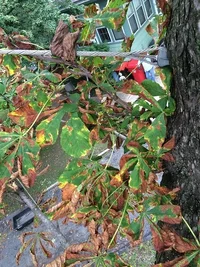
"I use seat belt in trees $100 instead of cable and through hardware at $300-$400. "
Have you looked at terminal fasteners? Through hardware is more invasive and expensive than through-cabling.
" U might also be thinking that supports shouldn't be used at all. I think we need to use them carefully and realize we've created a tree that now requires regular monitoring"
With all due respect to everyone who has been taught this rule of thumb, and has repeated it 1000x like I did, it's complete bullspit. Cabling creates no such need. Every urban tree that is pruned needs regular monitoring too. What's the dif? The attached did not get inspected for 38+ years and it's fine.

Redtree
Participating member
- Location
- Mt. Albert
Thanks xman I needed that.
I hear what you are saying about rambling. I'll try keep posts shorter or at least more thought out. I do have strong beliefs. I also question them often and change them. Does any one else recognize something their believing might be somewhat wrong? In my posts I'm trying to talk about the huge grey area in between black and white and it takes a lot of words. Ok yes I'm odd.
For instance, cabling grey areas.
First of all thanks guy for that terminal fastener cable info I'm ordering some asap. What's the brand? What can I expect to charge?
It takes balls to say I install seatbelt. So let me defend myself because I would expect you all think I'm crazy. I still install steel and have done around 1200 feet and 400 feet cobra.
The seat belt is a different tool. If there isn't a target or if the tree is still small then often a cable is too expensive and no support goes in, then the tree might fail. I believe this is incredibly relavent in targetless multi stem trees where a cable system would be over $1000 and likely won't be sellable without a target. I can still do the strap for $120 as long as I'm pruning as well.
So to relate it to the thread, you could use seatbelt instead of old climbing line for the leash. Compliment with reduction.
The drug caffeine was not used for this post, I'm trying to quit. Seriously. Thanks xman for the support and I edited out some rambling
I hear what you are saying about rambling. I'll try keep posts shorter or at least more thought out. I do have strong beliefs. I also question them often and change them. Does any one else recognize something their believing might be somewhat wrong? In my posts I'm trying to talk about the huge grey area in between black and white and it takes a lot of words. Ok yes I'm odd.
For instance, cabling grey areas.
First of all thanks guy for that terminal fastener cable info I'm ordering some asap. What's the brand? What can I expect to charge?
It takes balls to say I install seatbelt. So let me defend myself because I would expect you all think I'm crazy. I still install steel and have done around 1200 feet and 400 feet cobra.
The seat belt is a different tool. If there isn't a target or if the tree is still small then often a cable is too expensive and no support goes in, then the tree might fail. I believe this is incredibly relavent in targetless multi stem trees where a cable system would be over $1000 and likely won't be sellable without a target. I can still do the strap for $120 as long as I'm pruning as well.
So to relate it to the thread, you could use seatbelt instead of old climbing line for the leash. Compliment with reduction.
The drug caffeine was not used for this post, I'm trying to quit. Seriously. Thanks xman for the support and I edited out some rambling
Redtree
Participating member
- Location
- Mt. Albert
Sorry Guy for not putting a capital G. I hate it when people do that. I'll change. And thanks for your constructive criticism.

treehumper
Carpal tunnel level member
- Location
- Ridgefield, NJ
Redtree there is a huge grey area when it comes to addressing trees based not on their condition but on the fear of the client. People want guarantees that nothing bad will ever befall them. With every report of something failing, be it trees, cars, planes, trains, houses, computers, etc…, they rush out and want to buy a solution. The market ponies up all sorts in an effort to cash in on the fear. In our business it's easy to pander to a client's fear of a tree near there house that looks big and ominous. Doesn't mean that it is.
I'm trying to get away from removing trees simply to allay unfounded fear. If there's a good reason to take it down then great have at it. But, their may be many more reasons to keep the tree that the client isn't considering. Once it's down its not coming back any time soon. So, to consider non-tree related alternatives is a mental exercise worth taking.
I'm trying to get away from removing trees simply to allay unfounded fear. If there's a good reason to take it down then great have at it. But, their may be many more reasons to keep the tree that the client isn't considering. Once it's down its not coming back any time soon. So, to consider non-tree related alternatives is a mental exercise worth taking.
Redtree
Participating member
- Location
- Mt. Albert
It's a good point. You must have learned a lot through Sandy. On that day I guesss almost any tree was high risk. I once heard a guy say that his client had a low risk tree but she couldn't sleep at night. So he removed it and now she can sleep at night. I don't know if enough time was taken to educate her but it is likely there was. She holds the cards. Was it wrong to remove it? People come before trees and should. But the funny part is probably three of her neighbours cried when it came down. But they weren't up at night.
I often steer people away from fear especially when the tree is too small to go through the roof . I often try to sell reduction if the fear is justified. But I always do my best to educate the client on the benefits.
Selling pruning trees to clients wanting to remove a good tree near the house (less commonly mentioned)
1 Raking is really good for your body and mind.
2 If you remove it, all you'll see is your neighbours brick wall. Or storage area.
3 If you remove it, that tree behind it which has a medium risk has no pillow to hit if it falls toward your house.
4 If you remove it you'll get a lot more wind through here.
5 Where is that squirrel going to live? In your roof?
6 The shingles actually do better shaded. Just need clearance
7 your lucky to have such a great species in great shape.
8 you can get light to the windows with some annual pruning
9. Your wife wants to keep the tree. Don't piss her off. I'll prune it nicely
10. Yes there's risk but it's very low and we can reduce the risk via thinning or reduction.
I often steer people away from fear especially when the tree is too small to go through the roof . I often try to sell reduction if the fear is justified. But I always do my best to educate the client on the benefits.
Selling pruning trees to clients wanting to remove a good tree near the house (less commonly mentioned)
1 Raking is really good for your body and mind.
2 If you remove it, all you'll see is your neighbours brick wall. Or storage area.
3 If you remove it, that tree behind it which has a medium risk has no pillow to hit if it falls toward your house.
4 If you remove it you'll get a lot more wind through here.
5 Where is that squirrel going to live? In your roof?
6 The shingles actually do better shaded. Just need clearance
7 your lucky to have such a great species in great shape.
8 you can get light to the windows with some annual pruning
9. Your wife wants to keep the tree. Don't piss her off. I'll prune it nicely
10. Yes there's risk but it's very low and we can reduce the risk via thinning or reduction.
treehumper
Carpal tunnel level member
- Location
- Ridgefield, NJ
To add to your list, reduced utility bill along with less wear and tear for A/C. We had a client remove a tree for a pool and his neighbour's A/C ran all day afterwards. Not a happy camper, I hope he was invited to use the pool to cool off.
We have run into the can't sleep at night argument and thus removed trees that otherwise would've remained. This was a big one after Sandy and even some of the storms that had hit NJ in previous years.
One thing I did notice was that older homes tended to fair better. Trussed roofs didn't stand up as well as conventional cut roofs specially where a strike was perpendicular to the ridge. Consider that the ridge is made up of blocks instead of a continuous piece.
We have run into the can't sleep at night argument and thus removed trees that otherwise would've remained. This was a big one after Sandy and even some of the storms that had hit NJ in previous years.
One thing I did notice was that older homes tended to fair better. Trussed roofs didn't stand up as well as conventional cut roofs specially where a strike was perpendicular to the ridge. Consider that the ridge is made up of blocks instead of a continuous piece.
Thanks xman I needed that.
I hear what you are saying about rambling. I'll try keep posts shorter or at least more thought out. I do have strong beliefs. I also question them often and change them. Does any one else recognize something their believing might be somewhat wrong? In my posts I'm trying to talk about the huge grey area in between black and white and it takes a lot of words. Ok yes I'm odd.
For instance, cabling grey areas.
First of all thanks guy for that terminal fastener cable info I'm ordering some asap. What's the brand? What can I expect to charge?
It takes balls to say I install seatbelt. So let me defend myself because I would expect you all think I'm crazy. I still install steel and have done around 1200 feet and 400 feet cobra.
The seat belt is a different tool. If there isn't a target or if the tree is still small then often a cable is too expensive and no support goes in, then the tree might fail. I believe this is incredibly relavent in targetless multi stem trees where a cable system would be over $1000 and likely won't be sellable without a target. I can still do the strap for $120 as long as I'm pruning as well.
So to relate it to the thread, you could use seatbelt instead of old climbing line for the leash. Compliment with reduction.
The drug caffeine was not used for this post, I'm trying to quit. Seriously. Thanks xman for the support and I edited out some rambling
Hi Red, that was funny.
It's a really positive attribute to consider other's information and consider changing your opinion. Many people can't do that because they are stubborn and consider it "giving up", but it's not that, it's progression.
Yes, it was big of you to put up some practices that are created by yourself or only used by a few.
Those things can start great conversations.
It just seemed like you had a lot of self made up ideas.
Have you seen how much lag bolts hold in strong wood deciduous trees? It's incredible. That's why they are allowed in the ANSI standard for certain diameters.
Seat belts are static. Tying them around leaders, means lots of slack. lots of slack seems to mean to mean a lot of movement then a static jolt. Seems bad, but then again, I haven't done a seat beat material.
Also tying doesn't seem to like a person could get height placement very exact. Seems like you would need crotches. Would be fine on a numerous limb conifer maybe.
At least the climbing line would give stretch when it got tight and maybe not cause the top above it to snap off.
Lots of smart people help develop the standards through proved systems.
Anyway, carry on. I didnt' read the posts below this. will another day, gotta go.

Mangoes
Participating member
- Location
- Greater Toronto Area
Seatbelt tree support? No thanks.
Being the first missionary might be noble, but historically, often fatal.
Red = (m)visionary
Lawyers = Cannibals
$120 isn't going to feel very profitable on the bench under litigious circumstances.
Shepherds sells Amsteel/Dyneema very competitively. Could use that with standardized splices and have a more defensible position in lieu of failure.
Profit Red ..... Charge for some!
Being the first missionary might be noble, but historically, often fatal.
Red = (m)visionary
Lawyers = Cannibals
$120 isn't going to feel very profitable on the bench under litigious circumstances.
Shepherds sells Amsteel/Dyneema very competitively. Could use that with standardized splices and have a more defensible position in lieu of failure.
Profit Red ..... Charge for some!
Redtree
Participating member
- Location
- Mt. Albert
Good point about the j lags. So now i guess I've been a bit stubborn on the no hooks thing. Again a species and tree specific issue. Less invasive. But if you load the system to failure what happens first?Either the hook bends open or the lag pulls, especially in softwood. Why not a welded eye on a lag? And I really don't believe the through hardware is invasive to the point of any significant issue? Just because it's the most invasive. The only reason I think steel gets a bad rep with respect to failure is due to improper cable hardware. I once saw 6 strand aluminum with centre strand of steel. Broken of course. The 2nd replacement cable was undersized. I put in through hardware. Should still be there in 50 years.Hi Red, that was funny.
It's a really positive attribute to consider other's information and consider changing your opinion. Many people can't do that because they are stubborn and consider it "giving up", but it's not that, it's progression.
Yes, it was big of you to put up some practices that are created by yourself or only used by a few.
Those things can start great conversations.
It just seemed like you had a lot of self made up ideas.
Have you seen how much lag bolts hold in strong wood deciduous trees? It's incredible. That's why they are allowed in the ANSI standard for certain diameters.
Seat belts are static. Tying them around leaders, means lots of slack. lots of slack seems to mean to mean a lot of movement then a static jolt. Seems bad, but then again, I haven't done a seat beat material.
Also tying doesn't seem to like a person could get height placement very exact. Seems like you would need crotches. Would be fine on a numerous limb conifer maybe.
At least the climbing line would give stretch when it got tight and maybe not cause the top above it to snap off.
Lots of smart people help develop the standards through proved systems.
Anyway, carry on. I didnt' read the posts below this. will another day, gotta go.
Redtree
Participating member
- Location
- Mt. Albert
Thanks mangoes. And I'll check out that product too.Seatbelt tree support? No thanks.
Being the first missionary might be noble, but historically, often fatal.
Red = (m)visionary
Lawyers = Cannibals
$120 isn't going to feel very profitable on the bench under litigious circumstances.
Shepherds sells Amsteel/Dyneema very competitively. Could use that with standardized splices and have a more defensible position in lieu of failure.
Profit Red ..... Charge for some!
But
Like I said its for smaller trees and ones that have no target.
I also said its $120 if there's other pruning in the tree (maybe not the first time I said it here though). But I usually crown reduce to compliment.
I just did a three stem basswood. Cable would not have sold easily on top of the other pruning and removal. We would have gone with just reduction instead. The tree was reduced two years ago and likely again in two years. Or four if the strap and previous reduction is still looking good in two. So the strap is temporary remember. Not really comparable to steel. It is likely unnecessary in this basswood but cheap insurance during the retrench/reduce process. On top of this I gave informed the client thoroughly of what I'm installing. I did two sugars with steel recently. With one, strap was not presented as an option. With the other (no target), strap was an option but lucky for the tree they paid for steel. The other option was no strap and just wait for it to drop some nice firewood.
Selling one cable is easier than selling three but if mangoes is who I think it is then you probably sell really well. Did I see u at the gas station beside AT Tire a while back?
TCtreeswinger
Branched out member
If you are using seatbelt what is the advantage to climbing line besides element degradation? Is it that much stronger and easier? Do you just tie a bowline or something? Just looking for other options...
Redtree
Participating member
- Location
- Mt. Albert
First of all remember it is not a permanent fix or even an alternative to steel cable. The only reason I use seatbelt is because I found rolls for a low price. The real point here is that any kind of strap is wide and gentler on the bark. Should be a strong strap. 2000 to 15000 lbs. depending. If you have old climbing line then you could use a loop of strap around each stem at a crotch. Then tie these together. Just leave a lot of room for growth.If you are using seatbelt what is the advantage to climbing line besides element degradation? Is it that much stronger and easier? Do you just tie a bowline or something? Just looking for other options...
Again the strap doesn't replace the job of cable it is simply better than nothing. As for monitoring, I agree with Guy. Not a whole lot of need in the average tree with cable. Unless however decay is significant more than structure. As for strap the tree and strap should be monitored. The trees I strap are ongoing projects. The trees I cable are often not. Or at least longer term.
Who checks their cables or Cobras 40 years later? Up to the new homeowner at that point? We need an iCloud app so we arborists can input any cable installed. Good business for the next generation too. Just another rambling brainstorm

- Location
- Asheville N.C.
Right on, I m pretty sure I understand what you're getting at.Ya I was thinking out loud.
stand with your back against the building at any spot and draw an imaginary line through the air at 45 degrees . then shuffle your way around the building taking note of all trees that are in falling range and reduce them. This does not mean to create a void of trees in this area, it just means to reduce anything in that area. Or at least the trees that are showing a higher than acceptable risk. The worst tree is not necessarily the closest. But the closest is more capable of worse damage should it fail.
It's really just a round about way at saying: walk around the place and check for failure potential and decide what to reduce.
The tricky part is deciding what is risky, then deciding where reduction cuts will be made. Basically the dose is hard to nail. You might reduce it lightly, leaving a tree that will hold up to average storms and then only get average storms while you own the place. On the other hand you may reduce heavily and get a tornado that knocks it down anyway.
So you have to coordinate dose with how bad the next bad storm is. Good luck.
I think it comes down to being practical. Several cuts 1-2.5 inches which reduces the overall shape will reduce the likelihood of failure. But apply it to the whole tree or trees in question, not just on the building side.
Once dose is figured out there is one more tricky part, the execution. Pole pruners hand saws and a high but safe tie in.
I did a similar group of oaks. 70-80 feet tall. I was able to work in five trees without coming down. Was a good day. More deadwooding than reduction. But at least the retrenchment (growing inwards) was started, as the trees react to sun coming to the inner canopy and dare I say leading tips are divided and slowed with the removal of lead buds (heading back). Years down the road, after several reduce/thin jobs the tree may be the same height or shorter while still bigger in diameter, instead of taller and more vulnerable.
Sometimes a branch can be headed instead of removed. This feels unnatural but look at what Mother Nature does with ice-sometimes a near perfect dose of reduction. Seriously though, there are a few trees better off after the ice. The lucky ones that broke at 3 inches and under. Not pretty but safer once hangers are out.
Now I'm thinking out loud again
Goodnight

Mangoes
Participating member
- Location
- Greater Toronto Area
Cobra cable is expensive and doesn't move off the shelf very quickly. Holding inventory (of anything) ties up capital. As a result we do less cobra/dynamic cabling.
I can hold 10x the steel cabling supplies in inventory as dynamic; per cable sold.
Lags are only used on small ornamentals i.e. Magnolia or Crabapple. ALL others are through bolt and installed to ANSI standards. If the tree fails - we adhered to standard.
Adhering to standard turned a Red Oak into a pig of a job last fall. 8' 3/4 threaded rod braces x3. 4x EHS cables aloft. Plus canopy reduction in a ravine. Team worked hard on that one. (But they always do, couldn't ask for harder working guys/gals)
All addresses (not clients) get a letter each year suggesting a cable inspection ought to occur. No inspection? - we're not liable for failure.
I can hold 10x the steel cabling supplies in inventory as dynamic; per cable sold.
Lags are only used on small ornamentals i.e. Magnolia or Crabapple. ALL others are through bolt and installed to ANSI standards. If the tree fails - we adhered to standard.
Adhering to standard turned a Red Oak into a pig of a job last fall. 8' 3/4 threaded rod braces x3. 4x EHS cables aloft. Plus canopy reduction in a ravine. Team worked hard on that one. (But they always do, couldn't ask for harder working guys/gals)
All addresses (not clients) get a letter each year suggesting a cable inspection ought to occur. No inspection? - we're not liable for failure.
guymayor
Branched out member
- Location
- East US, Earth
Mangoes if that approach is working, great! The inspection needs ime can often be in a longer timeframe (3-5 years typically), and owners emailing pictures can be useful. But there's nothing wrong with annual reminders.
"ALL others are through bolt and installed to ANSI standards. If the tree fails - we adhered to standard.
Adhering to standard turned a Red Oak into a pig of a job last fall. 8' 3/4 threaded rod braces x3. 4x EHS cables aloft."
The A300 Part 3 has huge overkill built in, because the people writing it work for a big corporation with extremely low risk tolerance, and individual users (including many of YOU readers of this post) do not bother to comment in the few opportunities allowed. It's a pay-to-play deal; unlike the Z, observers are not allowed to participate at the meetings.
That chart in the back has little scientific basis. But through-cabling with terminal fasteners is A300-compliant. The big company still has a lot of through bolts on the shelf, so terminal fasteners do not get talked about in the standard. Innovation is suppressed. You have to look hard to see they comply, but they do.
O and it's nice to see Canadians paying attention to the US standard! I was impressed by the interest in ANSI's Root Care standard in Ontario in 2013: in a 2.5 hour talk, only 1 or 2 out of 100+ people nodded off!
"ALL others are through bolt and installed to ANSI standards. If the tree fails - we adhered to standard.
Adhering to standard turned a Red Oak into a pig of a job last fall. 8' 3/4 threaded rod braces x3. 4x EHS cables aloft."
The A300 Part 3 has huge overkill built in, because the people writing it work for a big corporation with extremely low risk tolerance, and individual users (including many of YOU readers of this post) do not bother to comment in the few opportunities allowed. It's a pay-to-play deal; unlike the Z, observers are not allowed to participate at the meetings.
That chart in the back has little scientific basis. But through-cabling with terminal fasteners is A300-compliant. The big company still has a lot of through bolts on the shelf, so terminal fasteners do not get talked about in the standard. Innovation is suppressed. You have to look hard to see they comply, but they do.
O and it's nice to see Canadians paying attention to the US standard! I was impressed by the interest in ANSI's Root Care standard in Ontario in 2013: in a 2.5 hour talk, only 1 or 2 out of 100+ people nodded off!

Daniel
Carpal tunnel level member
- Location
- Suburban Philadelphia (Wayne)
most of the cable failures that prompted the change from J lags to thru bolts are due to cables being placed in low. It's rare for me to put a thru bolt in.. I just keep going up til the wood is under 8" and put the cable there... I think ANSI calls j lags acceptable in 10" diameter and under... of the hundreds or maybe 1000+ cables I've put in, two have failed due to lightning strikes, and one failed to keep the the branch union in tact, as there was a bad angle between the co-doms (though it did protect the piece from falling)... other failures certainly may have happened, but I haven't seen them. That said, Guy's preference for wire stops sounds like an innovative, easy and effective alternative to lags or thru bolts
Redtree
Participating member
- Location
- Mt. Albert
Yes I like the look of the through cable. I suspect it may be the best long term that is easily installed. Even better than any synthetic (cobra or Amsteel), for that 50 year plus kind of plan. I've seen j lags fail in softwood three times (pulled out). I've seen them bent too. But bent and one pull out failure were due to undersized j lags.
How did that union fail? Was the cable installed slightly off perpendicular or did it peel off sideways? Not that I'm implying it's your fault, anyway you did save any targets which is good. I'm just curious. That must've been quite a storm or a real bad union or both.
How did that union fail? Was the cable installed slightly off perpendicular or did it peel off sideways? Not that I'm implying it's your fault, anyway you did save any targets which is good. I'm just curious. That must've been quite a storm or a real bad union or both.
Daniel
Carpal tunnel level member
- Location
- Suburban Philadelphia (Wayne)
due to the angle of the codom, the cable wasn't pulling straight back against the crotch... the crotch ripped out and the lead swung out away from the house and just hung there, cable in tact. So in a way the cable did its job of protecting property.
I don;t buy anything but 5/8" j lags. I do not understand why anyone would . did a video awhile back about cable failure due to small lags and low placement...
I use a smaller bit for silver maple... if you lube the threads up with some soap, they turn in much easier, even when they are tight like that. I'd guess that the cables you saw pulled out were also set too low. I don't stop at 2/3 up from the crotch, that's a minimum. Usually go higher..
I don;t buy anything but 5/8" j lags. I do not understand why anyone would . did a video awhile back about cable failure due to small lags and low placement...
I use a smaller bit for silver maple... if you lube the threads up with some soap, they turn in much easier, even when they are tight like that. I'd guess that the cables you saw pulled out were also set too low. I don't stop at 2/3 up from the crotch, that's a minimum. Usually go higher..
Redtree
Participating member
- Location
- Mt. Albert
due to the angle of the codom, the cable wasn't pulling straight back against the crotch... the crotch ripped out and the lead swung out away from the house and just hung there, cable in tact. So in a way the cable did its job of protecting property.
I don;t buy anything but 5/8" j lags. I do not understand why anyone would . did a video awhile back about cable failure due to small lags and low placement...
I use a smaller bit for silver maple... if you lube the threads up with some soap, they turn in much easier, even when they are tight like that. I'd guess that the cables you saw pulled out were also set too low. I don't stop at 2/3 up from the crotch, that's a minimum. Usually go higher..
Yes they were set too low in two cases and in one of those cases also undersized. In the under sized low lag case, the tree loaded up to a very high wind force. Now picture this. The tree at the exact moment of failure was not even in the extended flex position. So when the lag pulled the 100km plus shoreline gust took the stem past its extension at a high velocity then failed the stem and sent it some good distance impailing a cedar hedge. Another reminder that a fifty foot failed tree can hit a target 70 feet away. Infrequent I assume though.
I use a 36 volt electric drill Fort ship auger so I don't find it harder. If anything easier than a j lag. But I have changed my view slightly with j lags after hearing your experience. Do you figure j lags are less invasive? I would use them in hard hardwoods now, but the third case of pull out failure was in a white pine. The only cable of mine that has failed that I know. It was installed very high but tree to tree. I've not done tree to tree since with a tight static cable in a tree not reduced first.












New threads New posts
-
test
-
-

-
-
 Free CEUs: February 05 & March 05 - 'Urban Forestry Today' Webcasts @ Noon (Eastern)
- Started by UFT
- Replies: 0
-

-








