Thank you for raising that point, and referring that article. My first thought is appreciation for the work with swages, which I did not think of using before. Kudos to Patrick Brewer, a true Tree Expert, for developing this technology, and to other Bartlett staff for doing this study and sharing it on their own dime. Other thoughts:
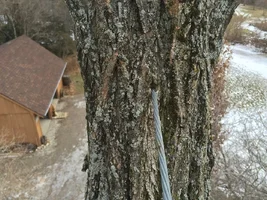
1. Figure 5. on the top of page 70 clearly shows the cable is not in the middle of the hole, but rubbing one side. This indicates that the system is cross-loaded, not in alignment, due to substandard installation. The reason for choosing this image is unclear.
2. Figure 5 also illustrates that, like any hardware the cable stimulates the growth of callus and woundwood. This reinforcement far outweighs any strength loss from holes getting larger due to improper installation. Since that research, the author has learned a lot about the strength of woundwood, having witnessed a very scary hollow rotten red maple with an open cavity ~1/3 circumference at 2013's Biomechanics Week. The tree with this 'obvious defect' withstood 4.5 kN (~1000 pounds) of pull before failing--but only above and below the cavity--THE WOUNDWOOD DID NOT FAIL! This also calls into question previous guesses in publications about strength loss from decay. Those guesses were based on engineering formulas for pipes. But trees are not pipes.
3. The hollowness evident in that image is deep enough to indicate it existed before the support system was installed. Decay is not as fearsome as we have been taught and re-re-re...taught since 1986. But without thinking, many people have an instinctive loathing for tree hollows, like old Arthur Radley in To Kill a Mockingbird. Between that hollow and the cross-loading, this may be the worst possible image to illustrate through-cabling.
4. The caption for Figure 5., "Galvanized EHS steel cable that has widened the hole in the bark and terminated with a Wire Stop fastener." is ungrammatical, which does not befit the ISA journal. The sentence would logically end with 'bark'--that's the end of the relevant information. The substandard cross-loading, and the apparent preexisting hollow, would certainly have been relevant to mention. But they were not.
No matter what kind of terminal fastener is used--swages, WireStop, WedgeGrip, Endz--hole enlargement will occur in a cross-loaded system--as it will with j-lags and bolts or any other fastener!!. The reason for adding "and terminated with a Wire Stop fastener", and rendering a complete sentence incoherent, is befuddling. Maybe that's the purpose; smoke and mirrors marketing. This study seems to go out of its way to cast doubt on this technology.
5. If the mean size of enlargement is 6mm, the total hole size is still less that a throughbolt, so that helps prove the benefits of through-cabling!
6. Swages held up under 7 kN (~1500#) of pull, making them an obvious choice for small trees. The small group that revised the A300 cabling standard was handpicked and wielded by a Bartlett employee, so they should have been well aware of this research. Yet swages were not mentioned at all in the A300 revision, and through-cabling is barely mentioned. Even though ~17,000 WireStops are sold every year, anyone using terminal fasteners has to read between the lines in the standard to figure out if they are A300-compliant (they are). Tens of thousands of terminal-fastened support systems are holding trees together today. Why does this standard resist proven technology?