Redwood Issues

Matias

Been here much more than a while
Location
Butte County
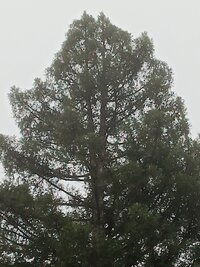
I know most of you guys don't actually deal with these a lot, if ever, but a broader discussion of theory is welcome. I will be climbing this one and just taking of a couple of the lowest branches, broken ones and dead mostly, and then figuring out what to do about the top(s)1000002572.jpg1000002573.jpg
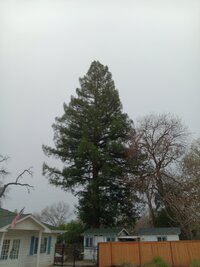
It's almost certainly the Aptos Blue cultivar, known for tops breaking out and developing codoms. The guy I'm working under on this one would usually take one of the leaders out, but I worry that it won't necessarily leave the union any better off, and will promote suckering in the hole it leaves, creating a higher maintenence situation. I was thinking about cabling it, but it seems like it will be so slim at the appropriate location, that I'm not sure it will accomplish the desired result in the event of a strong storm.

Is there a minimum stem diameter for cabling to be useful? I worry about smashing a lot of branches trying to rig down the top, especially since they don't want any end weight reduction. The pistache over the shed is scheduled to come out first, but it could be done after if it might be useful to protect that shed, especially since there will be a little crane helping with the pistache removal. I am sure I could take it apart in tiny nibbles, but I don't feel good about cutting out such a big top.

Thanks in advance!
 
Do a hard crown reduction on the lesser condom. Come back in a couple of years to reduce or remove

Without fighting with the client about end weight reduction how do they self-prescribe a solution.

I would describe this situation to clients that they are asking me to paint over rust. Sure, I can do it but we all know the results. If you follow their desires rather than proper pruning standards and there is a failure you’re going to pay. You, as the professional, can’t dodge responsibilities because “the customer is always right.

DAMHIKT…I lost on appeal to district court too
 
Redwood as you know is fairly brittle.

Never consider cabling or lopping without a climbing inspection. Yet it does certainly look like something should be done to mitigate.

Redwood will self graft so any major crossing limbs can be pinned with lag bolts.

The rigguy wire stops work well on conifers where other hardware can’t due to not enough space between the leads. I’m shying away from dynamic as it doesn’t last very long, has its quarks and frequently goes unmaintained.

Taking a 3-4” top will certainly help, can be the house side stem to mitigate failure. The other can certainly still go.

Dynamic cable can be spliced in an endless loop and as a bonus a chafe sleeve can be installed. One of the two tops still can be reduced a little, and even repeatedly reduced when the cable needs inspection/replacement.

I have subbed all thread rod in place of cable for stems really close together. One tree I’ve even seen a 2” black pipe which was either intentional or accidental cabling
 
It's not under my name, and the contractor always tries to encourage EWR, so I don't know why the customer insisted not, but it doesn't seem to be threatening too much with the branches, just the tops. Some of the longest low ones are already broken and they didn't damage anything.

The customer is new to hiring professionals, and has until now rented little lifts. He had committed some heinous butchery, and realized that the business looked unprofessional as a result. It's an assisted living facility, and lots of family members came by to visit while we were working on the other trees.

You guys are confirming much of what I had thought, though I hadn't considered the endless loop idea. I suppose I would do that if I also had a bolt near the split, but I wanna look at how those wire stops are installed. I have never seen them in action, so I have hesitation to install something I have never worked with, but I wanna leave everyone feeling safe and cozy.

I will let you guys know how it goes after I get up there and take a good look at it.
 
It's not under my name, and the contractor always tries to encourage EWR, so I don't know why the customer insisted not, but it doesn't seem to be threatening too much with the branches, just the tops. Some of the longest low ones are already broken and they didn't damage anything.

The customer is new to hiring professionals, and has until now rented little lifts. He had committed some heinous butchery, and realized that the business looked unprofessional as a result. It's an assisted living facility, and lots of family members came by to visit while we were working on the other trees.

You guys are confirming much of what I had thought, though I hadn't considered the endless loop idea. I suppose I would do that if I also had a bolt near the split, but I wanna look at how those wire stops are installed. I have never seen them in action, so I have hesitation to install something I have never worked with, but I wanna leave everyone feeling safe and cozy.

I will let you guys know how it goes after I get up there and take a good look at it.
The rigguy wire stops are stupid easy ONCE you get it down. There are some tricks to it.
A battery angle grinder with a cut off wheel for in tree use takes a little getting use to but imo the best way.
Go up well past the cable placement zone, and tie into each stem. Come down to placement and make sure you’re only loading one leg of your climb line.
Measure the distance and add 12-18” for working material.
Take a sharpie and mark the center wire. Take a pair of channel locks and un twist each end then twist back, repeat a few times, this will help later!

Drill your holes and place the cable through. Hole alignment is critical otherwise the holes will egg out when the cable is working.
Now weight both climbing lines to slightly pull the tops together. Place the nut on and open the wire up and put the cylinder wedge on the center marked strand. Leaving 6-8” tails helps folding the center strand over (I always do so pointing down as this will be like a big thorn to snag later.

Repeat on the other side getting it tight as possible, slack on climbing lines, and cable should just be snug.

If bolting the union one bolt above the union is bomber.
 
Definitely needs a pre-prescription climb for eyes on the fork and some measuring for sizes of hardware.

A laser pointer, and if possible a second person, will make hole alignment way easier and better if the stems are at greater distances. Here, it might not be that big a deal.
 
@Matias check out the European cabling standards. One option allows for brace rods, a steel or static cable about 1/3 up from the union and a dynamic at about 3/4 up from union.

I get you’re hesitant of a cable in small wood diameters but remember a well placed cable is more about limiting the stop of opposing movement than holding everything together tight.
 
Had a case like this some number of years ago now with a big black spruce right on the brick house and the west side wide open to prevailing winds/ storms. It's co-dom was splitsville after a big wet snow storm and high wind. A doosey storm.
Just put two rods across the split - one low down and one a bit higher up where the stems stated to separate (a la ANSI), then an EHS cable and Rig Guy stops 2/3 of the way up from the split to the top in just about 5-6" diam. wood to reduce the waggling. This setup has served well and is still there after 10 years or so (including the little black plastic end caps for the rig guy stops yet).
Maybe here's 'nuther way of doing this a bit. When installing EHS cable/Rig Guy's now I measure ~wire length needed up in the tree but cut/ install the first end/ stop on the ground. Olive oil the EHS cable and string thru one of the stems then the other (olive oil cuz confers are a sap fest pretty much as soon as they're drilled). Pull the stems together a bit (using come-along or twisted slings etc. depending on size of the stems) and install the 2nd stop on the other stem. Leaving the wire/ strands a bit longer, you can separate them and bend them to the finished pattern and then I cut with about 2 1/2 foot bolt cutter. I used to use grinder but found nipping with bolt cutter is just as fast, doesn't heat up the wire and is easier for these old hands (leather gloves - sharp and pokey) to bend the wires properly. I do make sure to hold onto all the ~ 6" or so cut ends so no kids or lawnmowers get them on the ground down the road. Two black stops and voila.
I too am kinda giving it up on fabric cabling ('cept maybe for apple tees/ small ornamentals). We're just getting too many violent thunderstorms/ snowstorms for anything bigger to survive, especially around structure. One thing I've also started on conifers is putting a couple of slings in place to stand in. Since I'm not on spurs, just hanging there, unless you have something like a bosun's chair, it can start to be a bit of a pain cuz you're not moving so much (even with xtra leg pads on the old MB harness for me anyway). Cheers
 
I think with that species you have to err on the side of caution as we know how they readily shed tops and limbs during extreme weather events. I like the idea of doing natural cabling by weaving branches from one top into the other as I’ve seen them graft to the stem and other limbs on redwoods. If it were my tree and there wads a target I would likely reduce one of the tops and try and leave the other full height if the inclusion weren’t too bad. If the inclusion is bad then remove one and reduce the other like Mick said. With this species, anything you do requires a continued level of care whether it is pruning or cabling and bracing. They all require the client to have a professional back periodically to do additional work on the tree. It is a commitment.
 
Man, that's a tough one. How large do the Sequoia sempervirens, 'Aptos Blue' cultivars get in the surrounding area? They seem to vary alot. Either way, I'd be inclined to leave it as is and bolt and cable. Done right, it is strong and long-lasting as @ghostice said. You could at the same time do as @RyanCafferky recommended and weave as many limbs as possible. Trying to reduce one of those codoms by any significant amount is going to look terrible for a long time and still leave a weak union, large wound and possibly distorted growth.
 
Man, that's a tough one. How large do the Sequoia sempervirens, 'Aptos Blue' cultivars get in the surrounding area? They seem to vary alot. Either way, I'd be inclined to leave it as is and bolt and cable. Done right, it is strong and long-lasting as @ghostice said. You could at the same time do as @RyanCafferky recommended and weave as many limbs as possible. Trying to reduce one of those codoms by any significant amount is going to look terrible for a long time and still leave a weak union, large wound and possibly distorted growth.
yea, this tree is about apex height for this region. part of why I worry about doing anything up there besides cabling and praying that the whole top end doesn't fail again.
 
Redwood will self graft so any major crossing limbs can be pinned with lag bolts.
Brilliant... quick, cheap, easy, and effective
Either way, I'd be inclined to leave it as is and bolt and cable. Done right, it is strong and long-lasting as
100%... that thing is well past the point where subordination pruning can be a remedy. I AM a huge proponent of subordination pruning on younger trees. I would cable, with multiple cables if practical. Over the last two years, I've even taken to double-looping retired true blue lowering line as a free or super cheap ad-on when the client doesn't want to pay for cabling.

Never on anything that big, but better than nothing to buy a few years, and it's quick and practically free when I'm already there in the bucket. I've only had the chance to go back and check smaller trees, like Jap maples, which I have used them on for 5+ years... They seem to be holding up so far, but it's hard to say for sure, since there's not a lot of strain on the rope with the smaller trees.
 
Last edited:
Any reduction pruning on height will most certainly trigger a hydra of extra tops, right?
I was thinking the same, and that the only reason to cut it would be to cut it all the way off, but then it will definitely send more shoots, thus requiring a heavier maintenence cycle for a while.
 
Brilliant... quick, cheap, easy, and effective

100%... that thing is well past the point where subordination pruning can be a remedy. I AM a huge proponent of subordination pruning on younger trees. I would cable, with multiple cables if practical. I've even taken to double-looping retired true blue lowering line as a free or super cheap ad-on when the client doesn't want to pay for cabling.

Never on anything that big, but better than nothing to buy a few years, and it's quick and practically free when I'm already there in the bucket. I've only had the chance to go back and check smaller trees, like Jap maples, which I have used them on for 5+ years... They seem to be holding up so far, but it's hard to say for sure, since there's not a lot of strain on the rope with the smaller trees.
I do wish people would call a few years after the top blows out.
 
I was thinking the same, and that the only reason to cut it would be to cut it all the way off, but then it will definitely send more shoots, thus requiring a heavier maintenence cycle for a while.
It really comes down to the client. I’d advise against full removal of the second top as it would create some funky forces on the remaining. The remaining would most certainly need height reduction and then left with multiple tops and more octopus limbs.
Cabling will also require maintenance, maybe a little less with steel
Weaving and getting limbs to graft is great but isn’t going to do much in the short term.
Reducing the height will also require maintenance.
A stump doesn’t require maintenance

Most of what we do will require follow-up

As you said, proactive treatment to correct issues asap or prevent issues is always the best course. Just comes down to the client… I’ve been tempted to leave notes with dates shoved in a plastic bottle in trees. Houses flip so fast here any follow through is a crapshoot
 

New threads New posts

Kask Stihl NORTHEASTERN Arborists Wesspur TreeStuff.com Teufelberger Westminster X-Rigging Teufelberger
Back
Top Bottom