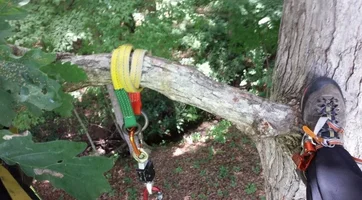
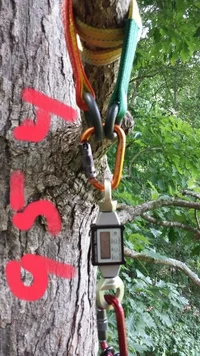
Re-thinking the need for a pulley saver or friction-less tie in point.

How many make the ascent SRT then work down DdRT?


  • Total voters
    41

Richard Mumford-yoyoman

Been here a while
Location
Atlanta GA
As climbing styles changed, specifically moving from pure DdRT to SRT and a mixture of both, it made me re-think the use of a pulley saver or minimized friction at the primary support point. This may especially come into play if a climber is setting a pulley saver just to block down a spar or mostly moving and descending from the primary support point.

I installed a load cell to the friction hitch on a DdRT (doubled rope technique) and I was amazed at what I found.

Suppose a climber has adopted more of an SRT (single rope technique) for the ascent, then switches to a DdRT by setting a pulley saver or such for working the tree on the way down in an effort to minimize friction, as was popular with a pure DdRT system. This may actually increase wear on the friction hitch and make it less smooth to operate.

The friction at the anchor remarkably decreases the heat, friction and wear at the hitch, much more than I ever imagined. I found that, aside from using no friction saver/cambium saver (removal only), the caterpillar style provided the most friction, above leather, ring to ring and pulley to minimize friction at the hitch.


Correct.
I changed back from a pulley friction saver to a ring ring friction saver about six years ago. At first I changed over to a DMM revolver/ring but later on went all the way back.
Over heating and extra strain on the hitch is one. The other problem I wanted to tackle was the fact that you have to use excessive force in the left elbow when feeding the rope with the right hand on an ascent.
 
I think you were hanging off a risky oak branch. Using your load device, setup a 6:1 pulley and see what it takes to snap it...350lbs is my guess

I did see a difference this week, when ascending 2 pines, one where I used a ring to ring, the other a pulley saver, I was using a lockjack, the ride was smoother on the ring to ring.
 
Last edited:
That is interesting Richard. Nice little load cell you have there. What is interesting to me also is,when I put two rollers on the rope wrench, the wrench still held significant weight, as long as the tail was held from running through it (the wrench) by the hitch below.

You should repeat your experiment with the Hitchhiker set up SRT and see how the load on the hitch compares.
 
I think you were hanging off a risky oak branch. Using your load device, setup a 6:1 pulley and see what it takes to snap it...350lbs is my guess
Thanks tuttle, although that would be interesting to know for any branch, I don't have a real desire to break my favorite back yard tree. You can't imagine how many times I have stood, jumped, walked out on and sat on this perch. I would trust it with my life, or at least great bodily injury, oh ya, I did.
 
I have found that senerio true also Rich. I know from trials that all these systems take a little tweaking to run as the user would prefer. I run my Uni with your barrel SRT 99% and as such have found that Vortex with my body weight makes for a perfect friction combo. I can controll all the friction by just feathering the barrel on decent. As a result when I do use it Ddrt anything other than a good, larger OD pulley will cause me to have to much friction to run smoothly. In which case I will either switch ropes or just use the Zig Zag. As a point of information, the same rope and Uni without the drum was a whole different pattern. Leather all the way for Ddrt and SRT was always to jerky for me to love the combo.
 
The friction has to go somewhere. Where the pulley saver really shines in my opinion is short bursts of ascending where it's not practical to clip into pantin, and also coming back from limb walks.
Sure do burn through a lot of hitches though, and especially once I'm way down low below the saver, the bind up can be frustrating as heck
 
The thing that got me was the collar, although oaks are rock hard, when they shed a limb its a bit odd considering the iron strength of the branch.

I always say to the boys, never trust an oak until its tried and tested. I'm sure now you have :)

and to add.....if you do something 10 times....there always runs a risk that something will go wrong.
 
Very cool video. Neat device. Less friction at the TIP, more on your elbow. E2E cord isn't that expensive. Elbows are. Depends on the tree and the situation what is best. FWIW, I would not tie into that branch in that manner.
 
Interesting. Iv always liked the leather friction saver best. For me a little extra friction is helpful at times. It seems much more easy to make small adjustments or hold your weight with one hand without a pulley in the mix. Thanks for posting
 
I agree Sherwood, in fact I have often thought that a pulley with user adjustable friction might be an interesting item to play around with. SRT up and spike the pulley in for some Ddrt with a friction saver feel. Play low and slow as your gear changes for that pefect balance no matter what devices you are rocking that day/week.
 
Yes I noticed this the very first time I tried to climb off a pulley - no TIP friction moves all the load to the hitch and the body - it sucks mostly but useful for certain situations. I've taken to using a floating false crotch on removals when possible, using the O-Rig and a pulley up top in conjunction with my "magic shoes" works like a breeze.

Great research video, tnx! But please tie in differently or reinforce that little branch with a high strength back tie. No bueno there hombre.
 
Here is a perfect example of the r-think I am referring to.
A recent Sherrill flyer arrived for July 2014. There is a guy on spurs doing a spar removal using the A.R.T. Rope Guide.
The text below says, "as for descent, friction at the tie in point is completely erased and diverted friction entirely to the climbers friction controlled device,...

Great salesmanship, they don't mention that all of the wear and heat will also go there and that if you really want to be able to feather the control of a hitch it needs to have less weight on it.
Also requires climbing to install. Only around 350 bucks. I am a gear junkie but I think I just talked myself out of this one for sure.
 
Last edited:

New threads New posts

Back
Top Bottom